Forecasters see signs of strong NM monsoons later this month after punishing snow drought and heat
Jul 08, 2026 | 5:45 pm ET
Description
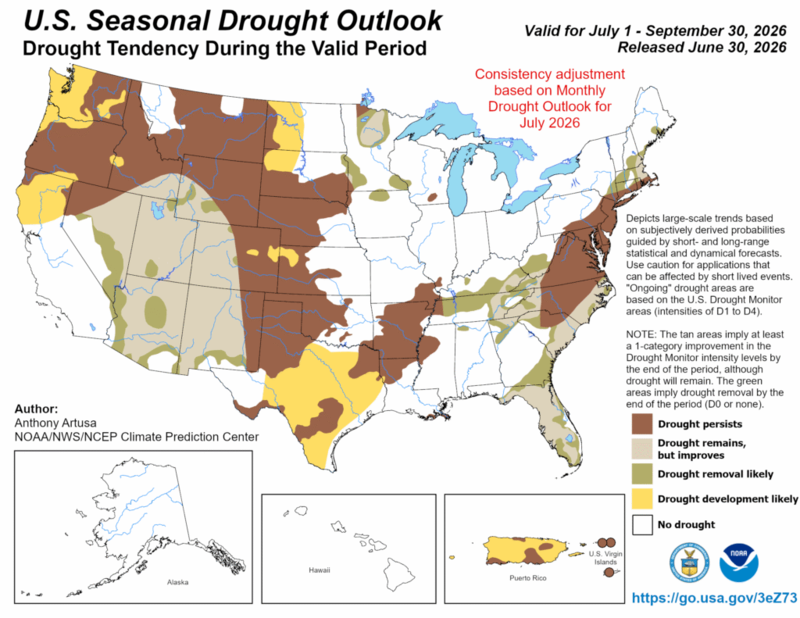
National forecasters on July 8, 2026, released a new drought outlook, forecasting monsoon precipitation they predict could help alleviate — but not eliminate — drought conditions in much of New Mexico. (Courtesy NOAA)
Forecasters with the National Oceanic and Atmospheric Administration said Wednesday that they see indications New Mexico and the rest of the Southwest could experience strong monsoon rains in the coming weeks, which they described as a reprieve from record-low snowpacks and above-average temperatures across the region.
Conditions for an “enhanced monsoon” in New Mexico have been developing for weeks, according to the NOAA Drought Outlook released Wednesday, including rising temperatures in the East Pacific Ocean and a heat wave gripping much of the Southwest.
“Obviously it’s bad for intensifying drought, but typically these kind of heat spells do precede the onset of the monsoon, and we’re pretty confident that’s going to occur during the next two weeks,” Brad Pugh, a forecaster with NOAA’s Climate Prediction Center, in a presentation Thursday, said about the outlook.
Pugh said the administration’s models show that monsoon rains over the next several months have the potential to improve region-wide drought conditions. In New Mexico, the western two-thirds of the state are forecast to see drought remain but improve by October, and a stretch along the southernmost part of the state is listed as “drought removal likely.”
“It’s important to note the improving drought conditions, but not an elimination of drought, as we could still have long-term drought impacts continue beyond the end of September,” Pugh said.
As of Wednesday, 94% of the state is experiencing some level of drought, according to NOAA, with much of northern New Mexico under “extreme drought.”
The monsoon rains would arrive in a state and region grappling with the lowest snowpack on record and ensuing meager runoffs that have left riverbeds dry and reservoirs near empty. The Elephant Butte Reservoir, according to the presentation Wednesday, is 3% full, holding only roughly 68,000 acre-feet of water of its capacity of more than 2 million.
“Lake Mead, Lake Powell and Elephant Butte are all critically low, and this is not just due to the drought this year,” said Dan McEvoy, a NOAA researcher. “This is a water supply crisis in the Colorado River Basin that has been ongoing for a couple of decades now, and so it’s still critically low there.”
The monsoons could improve drought conditions and reservoir levels and also help the West manage an intense wildfire season, particularly in Colorado and Utah, where eight large, complex wildfires have drawn large amounts of national firefighting resources.
In New Mexico, the lightning-caused Sacaton Fire in the Gila National Forest has grown to nearly 10,000 acres. That fire remained 17% contained as of Wednesday and had drawn more than 160 personnel to help battle it.
A National Interagency Fire Center outlook earlier this month anticipated the monsoons arriving in the state later this month, though it warned that northwest New Mexico would experience above-average wildfire risk.
The New Mexico Forestry Division, in a social media post Tuesday, celebrated the expected arrival of much-needed precipitation, but warned that monsoons can be a source of dry lightning in forests heavily stressed due to drought.
“Long story short: Rain is coming (hopefully!) but it’s still very dry out there,” division officials wrote.
Santa Fe, NM