Ford may have ditched the Lightning, but its first buyer hasn’t
Apr 27, 2026 | 7:30 am ET
Description
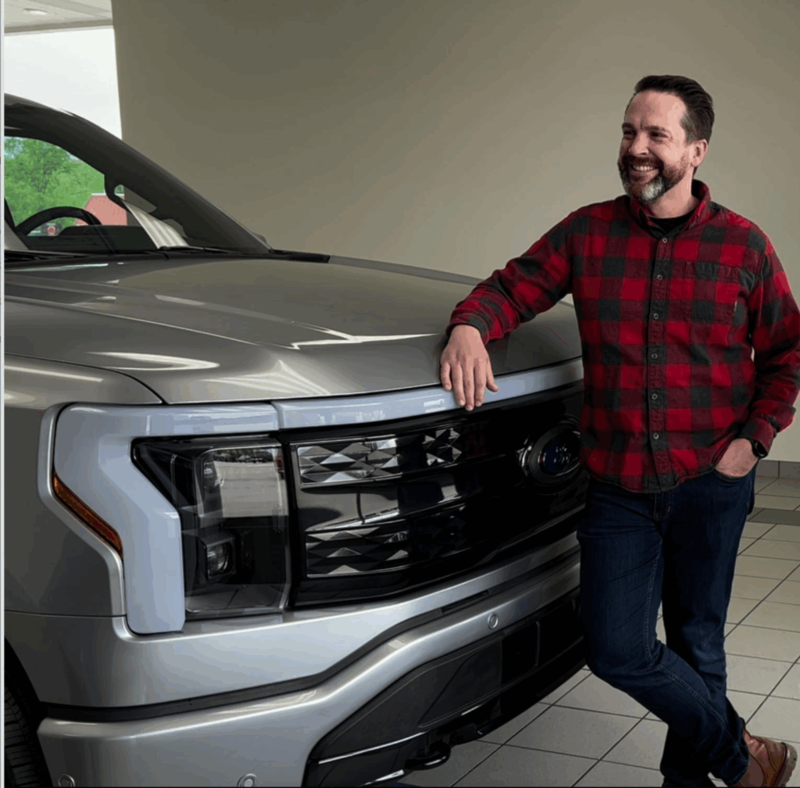
Nick Schmidt with his Ford F-150 Lightning pickup truck. | Photo provided by Nick Schmidt
Nick Schmidt was the first person in the world to take delivery of a Ford F-150 Lightning pickup when the Dearborn automaker introduced the innovative electric truck to much fanfare in 2022.
Nearly four years later, he still owns and enjoys the pickup that Ford has since discontinued in a rapid shift by the Detroit Three back to producing more gas-powered vehicles. But Schmidt’s Lightning purchase is suddenly looking smart with $4-a-gallon gas triggered by the U.S. war against Iran.
“It’s been a great truck,” he told me in a telephone interview.
Being the first person to take delivery of the EV garnered Schmidt national publicity in part because the Lightning seemed to represent an early, but significant shift away from gas-powered cars and trucks.
The story stuck with me because Schmidt lives in Standish, a small, Northeast Michigan town about 35 miles south of the one where I grew up.
While the Lightning is not his daily driver—his primary vehicle is a Tesla Model 3—Schmidt has put about 40,000 miles on the truck, many of them pulling a large Airstream trailer on camping trips throughout the state.
He said the Lightning has an advantage over his previous, gas-powered F-150 because that truck’s transmission often struggled to find the right gear while driving through hills. EVs don’t have transmissions.
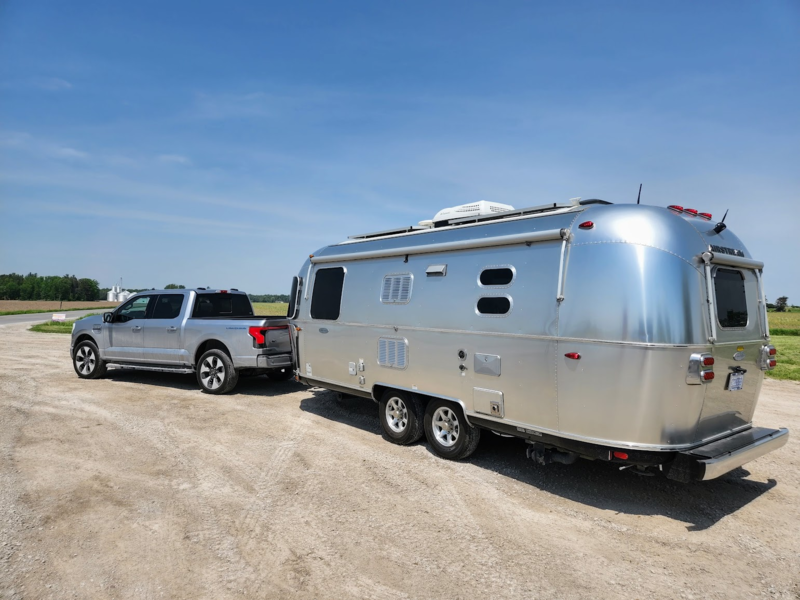
“The power is always on,” Schmidt said. “Towing is a dream other than range constraints. It was touch and go for the first year or two when going camping. But the charging infrastructure has gotten a lot better in the past 12 to 18 months.”
Ford has been dogged with quality problems, with one study finding that it had more recalls during the past 12 months than the rest of the U.S. industry combined. But Schmidt’s truck has been nearly trouble-free.
Other than a balky driver’s side power window, Schmidt said his EV has had “no issues.”
While EVs aren’t perfect—they’re subject to maddening software glitches and charging failures—they have far fewer parts than gas-powered vehicles and require less regular maintenance.
That hasn’t stopped Ford, General Motors and Stellantis from running away from EVs faster than the Lightning can go from zero to 60—about four seconds. (“This sucker’s quick!” former President Joe Biden said after test driving a prototype Lightning in 2021.)
But Biden’s successor wants cars and trucks to run on gasoline, not electrons and has taken steps to ensure it. President Donald Trump quickly wiped out Biden’s agenda to promote EVs and help domestic automakers compete with China’s booming EV industry.
EV sales plunged after Trump eliminated the $7,500 EV tax credit. And Trump’s rollback of Biden vehicle exhaust emission standards cemented the advantage of gas-powered vehicles over EVs.
The response by Detroit was swift. Ford pulled the plug on the next-generation Lightning. General Motors scrapped plans to build full-size EV pickups at its Orion Township assembly plant and will instead will produce gas-powered versions there.
Stellantis killed its planned Ram EV full-size pickup and reintroduced its beastly, gas-guzzling hemi engine, which powered its muscle cars for decades.
Detroit hasn’t completely abandoned EVs. GM, for instance, offers 10 EV models in the U.S. and says it still plans to eventually phase out gas-powered vehicles.
In the meantime, domestic automakers are moving more toward gas-electric hybrids of various types. Ford is replacing the Lightning with an extended range electric vehicle, or EREV that runs on an electric motor charged by a gas-fueled generator.
The Lightning initially sold well, but Ford CEO Jim Farley recently said the company misjudged the market for an expensive full-size pickup with limited range. But Schmidt said he thinks Ford could have done a better job of marketing the ground-breaking EV.
Truck owners like to think of themselves as largely self-sufficient, he said, and Ford should have appealed to that by selling the Lightning as an energy-independent vehicle that can be charged cheaply at home. No need to worry about being at the mercy of energy disruptions caused by geopolitical conflicts.
Schmidt also said he’s disturbed by rapidly seesawing U.S. energy policies that many experts say are hurting U.S. economic competitiveness.
“I think it’s a shame,” he said, noting that the Chinese EV business is thriving due to that country’s laser-focus on future technologies. “I’d like our industrial policy to be more consistent.”
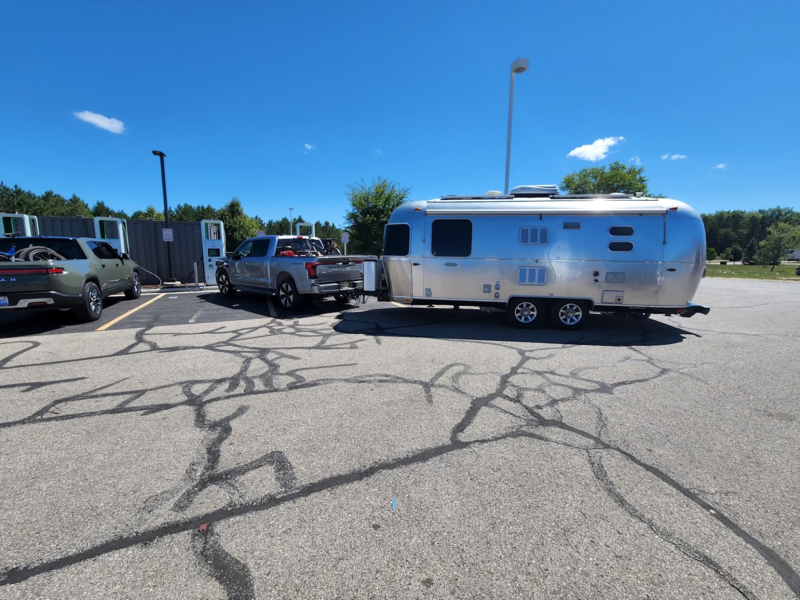
Schmidt told me in retrospect his overall driving needs might have been better met with a hybrid EV truck. Michigan’s charging infrastructure still isn’t built out enough for him to pull his Airstream trailer with the Lightning to the Upper Peninsula without a lot of planning.
But he and other family members are enjoying the Lightning’s low operating costs in the current high-gas-price environment. Schmidt said his parents recently borrowed his truck to pick up some groceries and haul “a ton of rock. They don’t want to drive their own vehicle with the high gas prices.”
And Schmidt still gets comments about the Lightning’s front trunk, or frunk.
“People always comment on it when I go to Meijer,” he said. “Where’s your engine?”

Lansing, MI