Fontes vows to fight DOJ lawsuit over voter data, says he’d rather be jailed than comply
Jan 06, 2026 | 8:23 pm ET
Description
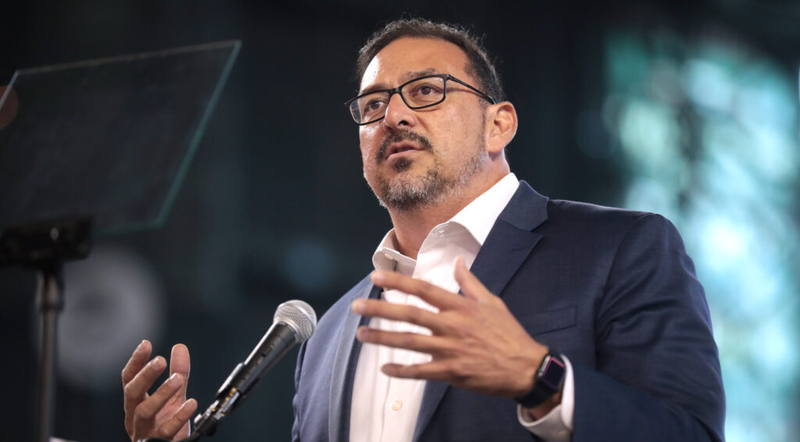
Secretary of State Adrian Fontes on Jan. 6, 2023, at an Arizona Chamber of Commerce and Industry event. Photo by Gage Skidmore (modified) | Flickr/CC BY-SA 2.0
The U.S. Department of Justice sued Arizona Secretary of State Adrian Fontes on Tuesday because he has refused to grant the Trump administration access to the state’s voter rolls, saying that he is violating federal law by failing to produce the records.
Fontes, meanwhile, said he’s prepared to be locked up if that’s what it takes to protect the privacy of Arizona voters.
“They’re going to have to put me in jail if they want this information and have somebody else give it to them because I’m not going to do it,” he told Democracy Docket founder Marc Elias in a podcast interview recorded Tuesday, hours before the lawsuit was filed.
Fontes, who did not respond to a request for comment from the Arizona Mirror, told Elias that the Trump administration is requesting he break the law, something he won’t do.
“It’s going to take a lot more than just a court order to get me to turn this stuff over. It’s going to be a knockdown drag out fight,” he added. “I will not turn this data over as long as I am the Secretary of State here in Arizona.”
In a video posted on social media, Fontes responded to Jesus Oete, a top attorney at DOJ’s Civil Rights Division who announced the lawsuit in a post on X, by telling him to “pound sand.”
Arizona Attorney General Kris Mayes said she will defend the state against the Trump administration’s overreach.
“Arizonans’ private voter registration information is not up for grabs. Both state and federal law prohibit the unrestricted release of Arizona’s complete voter registration database to the DOJ,” she said in an emailed statement. “My office will continue to work with the Secretary of State to defend the private data of Arizona voters and safeguard our independent election systems.”
DOJ first asked Fontes to provide an unredacted electronic copy of Arizona’s voter registration rolls in July 2025. The next month, he told the Trump administration that state and federal privacy laws bar him from doing so.
The lawsuit alleges that the Civil Rights Act of 1960, which the DOJ describes as imposing a “sweeping obligation on election officials” to retain and preserve election records, grants Attorney General Pam Bondi “sweeping power to obtain these records.”
While DOJ frames the request for voter roll information — it is seeking access to voter information in all 50 states — as part of an effort to ensure compliance with federal voting laws, voting rights advocates and other critics say its true aim is creating a national voter database in order to ferret out undocumented immigrants.
President Donald Trump has repeatedly, and falsely, claimed that there are tens of millions of undocumented voters — something he attempted to prove during his first term in an effort that failed to produce any evidence.
Multiple studies have found that noncitizen voting is vanishingly rare and poses no meaningful threat to election integrity. And voters in 2004 required that everyone in Arizona provide proof of citizenship when they register to vote. (Arizona is the only state with such a law.)
In an amicus brief filed in a similar lawsuit over California’s refusal to provide voter information, 17 former DOJ attorneys said the Trump administration is merely seeking to create a pretext to access voter data for its own nefarious purposes.
“While DOJ has provided a purpose for its requests — enforcing the NVRA — that purpose appears to be a stalking horse for its true purpose: to create a national voter roll and enable the federal government to conduct its own list maintenance to discover whether noncitizens or undocumented immigrants are registered to vote,” they wrote.
And a draft memorandum obtained last year by Stateline, a sister publication of the Mirror, shows DOJ plans to share voter data with the U.S. Department of Homeland Security, which would flag voters it believes are ineligible. States would then be expected to remove those voters from their rolls based on federal recommendations — a significant departure from traditional state control over election administration.
Election experts and state officials have raised alarm about federal overreach into an area traditionally managed by states. Dax Goldstein of the States United Democracy Center called it a “power grab and a fishing expedition… meant to undermine state authority over elections.”
Fontes also expressed concern about who would have access to the data, saying at an April 2025 press conference that Trump’s directive “is asking us elections officials to turn your personal identifying information in these voter records over to the federal government, over to DOGE.
“And I can tell you right now, I don’t want Elon Musk and his crew of incompetents taking those voter rolls away from our office,” he added.
Some critics fear that the Trump administration will disenfranchise voters in this year’s midterm elections. Republicans hold a narrow — and shrinking — majority in Congress, and federal intrusion into state management of voter rolls could lead to large-scale purges of eligible voters based on faulty database matches. And that could particularly affect communities of color and students — groups that overwhelmingly back Democrats at the ballot box.
“This voter data could be misused to justify large-scale voter purges based on faulty database matching techniques cooked up by election deniers,” ACLU senior attorney Ari Savitzky said last month. “Federal overreach of this kind threatens voters’ privacy and their fundamental right to participate in our democracy.”
Phoenix, AZ