Florida Dem again files bill to create database to help in voter-rights restoration
Oct 01, 2025 | 12:31 pm ET
Description
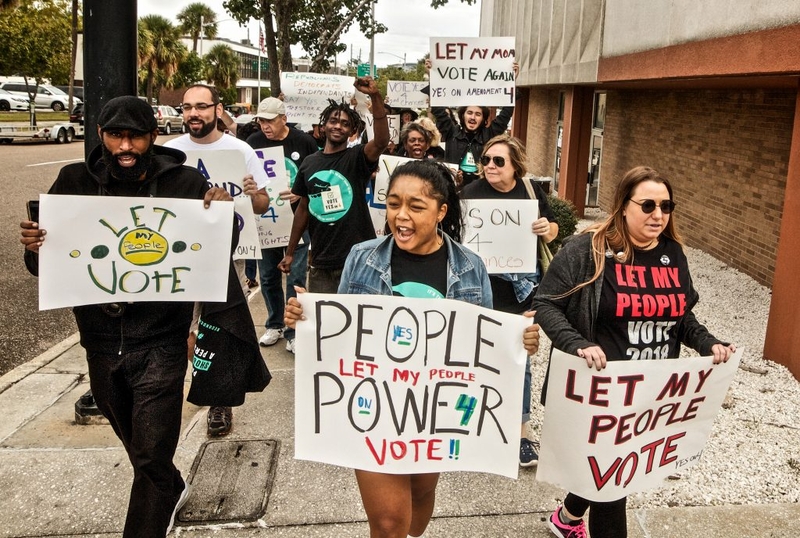
People march in Jacksonville to support Amendment 4 in 2018. (Florida Rights Restoration Coalition photo.)
A bill (HB 73) that would establish a centralized database to track the voting-rights status of individuals with felony convictions has once again been filed in the Florida House of Representatives.
Rep. Felicia Robinson, D-Miami Gardens, has sponsored similar legislation over the past several sessions. None have received a committee hearing (Broward County Democrat Tina Polsky has filed similar legislation in the Senate in previous years).
The origin of the legislation date to what happened after Floridians passed Amendment 4 in 2018. That measure was designed to restore the voting rights of Floridians who had served their criminal sentences (except for those found guilty of murder or sexual offenses).
The pool of potential eligible voters was reduced substantially, however, after the Legislature in 2019 required people with felony convictions to have to pay any “legal financial obligations” — fines, fees, and restitution — before regaining their right to vote.
That has led to uncertainty among individuals who have received confusing or contradictory information from the state since then about whether they are eligible to vote. Most notably, that resulted in the arrests of 20 individuals right before the 2022 primary election. Those arrests took place after state lawmakers approved the Office of Election Crimes and Security at the urging of Gov. Ron DeSantis during the legislative session earlier that year.
That lack of a centralized voter database led the Florida Rights Restoration Coalition, the leading advocate for the passage of Amendment 4 in 2018, to file a lawsuit in 2023 against DeSantis and election officials, alleging they had created a “bureaucratic morass that prevents people with felony convictions from voting, or even determining whether they’re eligible to vote.” (The group dropped the lawsuit in 2024 as they agreed to enter into mediation with the Florida Department of State, according to the News Service of Florida).
What would happen
Robinson’s legislation calls for the Florida Commission on Offender Review to develop and maintain a database of information for those with felony convictions including:
- The remaining length of any term of supervision.
- The remaining amount of any restitution owed to a victim as ordered by a court as part of his or her sentence.
- The remaining amount due of any fines and fees initially ordered by a court as part of his or her sentence or as a condition of any form of supervision.
If the measure were to become law, the Department of State, the Department of Corrections, the clerks of the circuit courts, the county comptrollers, and the Board of Executive Clemency would provide the information listed above to commission.
That body would be required to provide the governor, president of the Senate, and speaker of the House a comprehensive plan by July 1, 2027, that would:
- List government entities and methods by which the commission would collect, centralize, analyze, and secure the information required to be included in the database.
- Describe any infrastructure and services, including but not limited to, software, hardware, and information technology services, that may be necessary to create and maintain the database.
- List the anticipated number of additional employees to develop and maintain the database.
- Estimate the cost of the database.
- Cite any legal authority necessary for the commission to develop and maintain the database.
Tallahassee, FL