Flock camera opponents say they were left out of state-led policy review
Oct 15, 2026 | 5:16 pm ET
Description
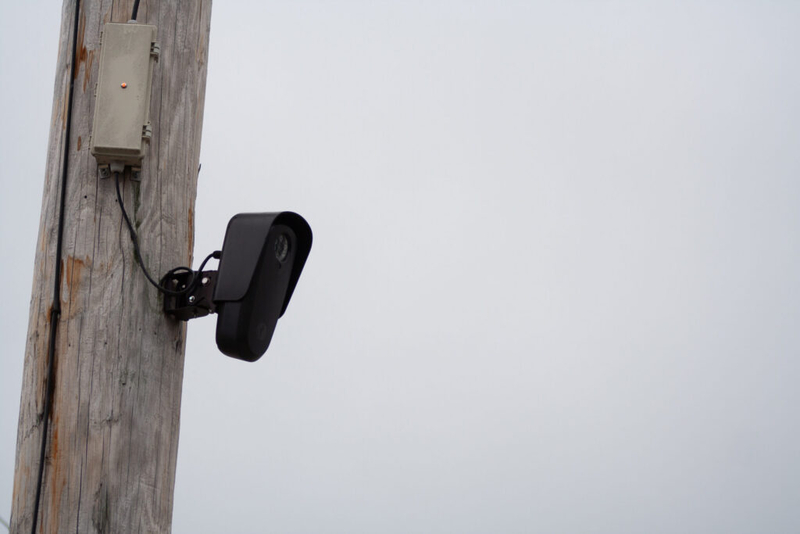
A Flock automated license plate reader records data on Main Road in Tiverton on Monday, Aug. 17, 2026. (Photo by Nolan Page/Rhode Island Current)
Rhode Island’s two-month pause on new automated license plate reader installations is set to expire Monday, the same day State Police may be ready to announce new policies governing the surveillance technology.
Lt. Col. Erik Yanyar, a State Police spokesperson, said officials were making final edits to the policy as of Thursday. But advocacy groups and the Office of the Public Defender say they have been left out of the review process entirely.
Gov. Dan McKee on Aug. 18 directed Rhode Island’s Department of Public Safety to conduct a 60-day “comprehensive review” of automated license plate reader systems amid growing resistance to Flock Safety cameras over concerns about privacy and how police are using the surveillance technology.
Before McKee ordered the pause, four Rhode Island communities — South Kingstown, Narragansett, Glocester, North Kingstown — voted to cancel their Flock contracts. The Tiverton Town Council, by contrast, voted in July to approve four cameras that have not yet been installed.
The Woonsocket City Council on Sept. 17 gave first passage to an amended ordinance regulating its 15 Flock cameras, with a second vote required.
As municipalities across Rhode Island resist Flock cameras, McKee orders review
In Providence, three City Council members were scheduled to introduce an ordinance Thursday to ban the technology and require its deactivation. The city’s police chief, Col. Oscar Perez, said in a statement Thursday he respects elected officials’ authority to set policy but would have welcomed the opportunity to weigh in before the legislation was drafted, citing the potential consequences for police operations and criminal investigations.
McKee’s order called for the Department of Public Safety, overseen by State Police Col. Darnell Weaver, to work with stakeholders including the Rhode Island Police Chiefs Association and the Rhode Island League of Cities and Towns.
“We’re probably close on the main issues,” Rhode Island Police Chiefs Association Executive Director Sidney Wordell said in an interview Thursday.
In an Oct. 9 letter to Weaver, the American Civil Liberties Union (ACLU) of Rhode Island and three other organizations — the Alliance to Mobilize Our Resistance, the state’s Office of the Public Defender and Planned Parenthood of Southern New England — wrote that the public safety working group made no effort to solicit public feedback.
In the letter, the four organizations offered their own recommendations, calling for stricter limits on how police use the cameras, retain and share data, and ensure public oversight.
“With less than two weeks left of this study period, we are concerned that there does not appear to have been any attempt to seek out any meaningful incorporation of public input in the process,” they wrote.“We hope that you consider these critical safeguards when studying the policy recommendations for these cameras in Rhode Island.”
Steven Brown, executive director of the ACLU of Rhode Island, said the group had not heard back from State Police about the letter as of Thursday afternoon. The letter was also shared with the police chiefs association and the League of Cities and Towns.
Wordell said he had reviewed the letter and found the four organizations repeated concerns of which the working group is already aware.
“There’s nothing new there,” he said.
The groups called for limits on how long police can retain license plate data and share it with other law enforcement agencies, including prohibitions on using the technology to monitor constitutionally protected activities or assist federal immigration enforcement.
Concerns about privacy and potential misuse are largely a matter of trust, Wordell said, arguing that officers who misuse the technology should be held accountable. He pointed to Flock’s own policies on data retention and sharing as safeguards against misuse.
Police departments must also closely monitor which officers have access to the cameras’ data and how they use it, he said. “We would suggest, expect and support that there’s tight reins on making sure that that’s happening,” he said.
But Wordell took issue with the recommendation to limit the cameras’ use to specific serious offenses. The groups urged police to use the technology to identify stolen vehicles, locate missing or wanted people, and assist investigations into violent felonies and domestic violence.
He argued that restricting the cameras to certain offenses could rule out their use in other cases, including property crimes.
“The average citizen is more likely to be affected by someone stealing property from them, which causes a hell of a lot more financial issues,” Wordell said.
A spokesperson for the Rhode Island League of Cities and Towns did not immediately respond to request for comment.

Providence, RI