Five Rhode Island schools receive national recognition for civic engagement efforts
Dec 05, 2024 | 5:20 pm ET
Description
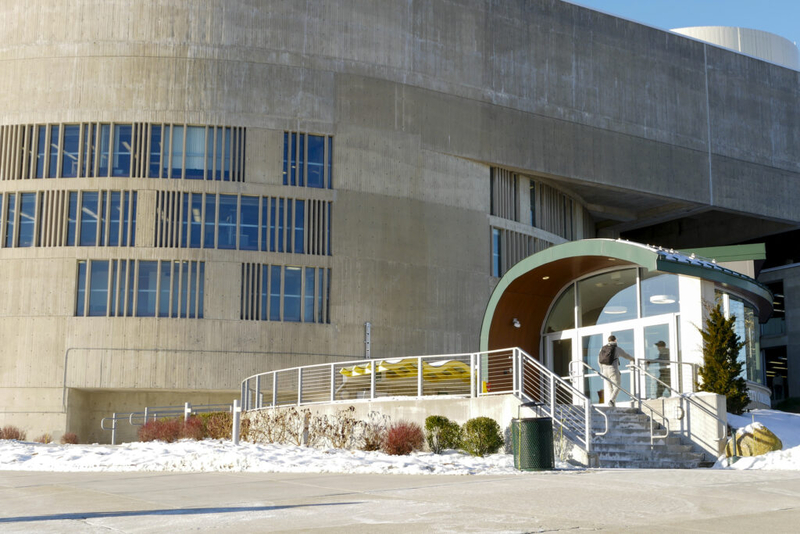
A student is seen on the Community College of Rhode Island’s Knight Campus in Warwick on the first day of spring semester classes in January 2024. (Alexander Castro/Rhode Island Current)
For the second consecutive election season, Brown University and the Community College of Rhode Island (CCRI) won national recognition for their efforts supporting civic engagement among students.
The ALL IN Campus Democracy Challenge, part of the nonprofit ecosystem Civic Nation, named 471 institutions of higher education this year as “Most Engaged Campuses for College Student Voting.” Brown was awarded a “silver” distinction for its voter turnout in 2022. CCRI was the only public higher ed institution in Rhode Island to earn the award, and scored a “bronze” distinction for 2022 turnout among its students.
Johnson & Wales University (JWU), Rhode Island School of Design (RISD) and Salve Regina University also won recognition for being “Highly Engaged” campuses.
“CCRI is deeply committed to fostering a strong democratic society by empowering our students and community members with the knowledge and tools they need to engage in civic life so they are well-informed and empowered to make their voices heard at the ballot box,” said Rosemary A. Costigan, the school’s interim president, in a statement released Tuesday.
To qualify for recognition, institutions must actively participate in the ALL IN program. That includes sharing National Study of Learning, Voting, and Engagement (NSLVE) reports with ALL IN as well as developing voting engagement action plans and pledging to foster voting efforts.
CCRI’s initiatives to boost student voter participation in the 2024 election included events like a campus-wide celebration of National Voter Registration Day. The school also made voting resources readily available during orientation week. The school’s collaboration with ALL IN dates to 2020, when members of the Phi Theta Kappa Pi Omicron fraternity launched efforts to get students to the polls.
Performance in previous elections also informs ALL IN’s awards. Jennifer M. Domagal-Goldman, the executive director of ALL IN, said in an email that the highly-engaged schools “are on-average outperforming their peer institutions in terms of voter participation rates by nearly 4 percentage points,” a trend that has held true across the 2018, 2020 and 2022 elections.
Domagal-Goldman said data for the 2024 election, which is taken from NSLVE reports, will likely arrive next fall.
CCRI has three awards from ALL IN, the second highest amount statewide after Brown, which first took the challenge in 2016. Other institutions — including RISD and JWU took the challenge for the first time this year.
The NLSVE reports suggest CCRI’s efforts may be working. In the 2022 midterm election, the school had a 22.5% voting rate — lower than Brown’s above-average voting rate of 32.1% that year, but also higher than the 16.1% observed at RISD, Brown’s neighbor in Providence’s College Hill neighborhood.
They are deeply aware, in intimate ways, of the issues that local and state government grapple with each day.
Matthew Ulricksen, who teaches courses on American government and state politics, wasn’t surprised CCRI students tend to be politically engaged in midterm elections, which historically see lower turnout. They largely live and work in Rhode Island, Ulricksen said, and, “They have skin in the game.”
“They are deeply aware, in intimate ways, of the issues that local and state government grapple with each day,” Ulricksen said. “They might not be directly cognizant of it, but they live with the challenges of food insecurity, housing insecurity, public transportation, discrimination, what have you.”
The school’s diversity spans racial and ethnic categories — a little under half of the student body is white — and also age and previous educational attainment. Most students attend part-time and may work jobs or raise families alongside their education, and about a third of students are over the age of 25.
“Community colleges are probably the singular democratizing force in American society today,” Ulricksen argued. “They are vehicles for any person from any segment of society to empower themselves.”
Providence, RI