Fertilizer from coal a key part of North Dakota critical minerals processing plans
Aug 10, 2026 | 6:00 am ET
Description
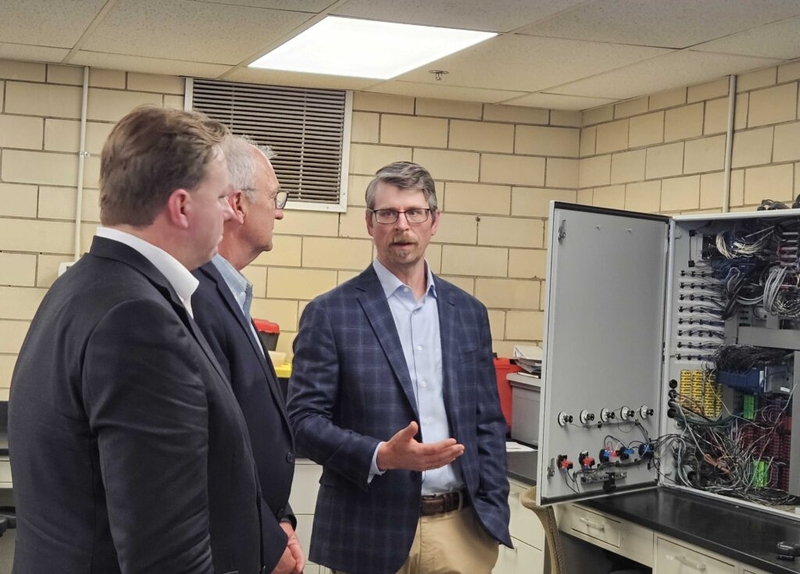
Dan Laudal, executive director and research professor with the University of North Dakota College of Engineering and Mines, provides a tour of the critical minerals research facility in Grand Forks on May 26, 2026, to Sen. Kevin Cramer, center, and Department of Defense official Michael Duffey. (Photo by Jeff Beach/North Dakota Monitor)
North Dakota’s abundant supply of lignite coal has been touted as a domestic source for critical minerals needed in magnets and electronics. But research at the University of North Dakota shows the potential for another lignite byproduct — fertilizer.
UND has secured a contract with the U.S. Department of Energy to expand its critical mineral refining to the first commercial-scale test site at the Falkirk coal mine near Underwood.
Dan Laudal, executive director and research professor with the UND College of Engineering and Mines, in a presentation last month to legislators, said a key to making the pilot project work is its ability to make enough money so that it can survive beyond the five-year Department of Energy contract.
Laudal said the $100 million project is estimated to have about $13 million a year in operating costs and potential for $14 million in revenue. About 87% of the revenue would come from fertilizer, according to his presentation.
The fertilizer made while refining for critical minerals would be different from the nitrogen fertilizer made at Basin Electric Power Cooperative’s coal gasification plant near Beulah.
University of North Dakota seeks to scale up critical mineral refining
The fertilizer made at Underwood would be made from the organic material in coal, extracting what is known as humic acid. It would be similar to extracting humic acid from leonardite, which is already being done in North Dakota and a handful of other sites around the United States.
“There’s nothing new that we need to invent,” Laudal said.
Leonardite Products in Williston is one of the places that makes humic acid.
Cherie Harms, president of Leonardite Products, describes leonardite as lignite that was exposed to water from glaciers thousands of years ago, creating a substance that has little value as a fuel but is rich in organic matter.
She said the humic acid that comes from leonardite doesn’t really act as a fertilizer, but when mixed with other fertilizer products, those products are more effective.
Her company digs up leonardite near Williston, refines it and sells the humic acid to fertilizer companies. She said it is especially valuable in areas where there is little existing organic fertilizer in the soil.
“Farmers may not even know they are using a fertilizer with humates,” Harms said.
Rep. Mike Brandenburg, R-Edgeley, took notice when Laudal mentioned fertilizer. Farmers like Brandenburg have seen fertilizer prices shoot up in recent years because of conflicts in other areas of the globe that supply fertilizer to the U.S. The U.S. war with Iran and the closing of the Strait of Hormuz has driven up costs this year.
Brandenburg said North Dakota farmers pay a premium price for fertilizer compared to other states and needs in-state fertilizer production.
“We’ve got to get it done,” Brandenburg said.
Harms, who also is one of the founders of the Humic Products Trade Association, said the rising prices have driven up demand for humates from fertilizer suppliers in the U.S.
It will be a few years before the Underwood site is able to help meet that demand.
Laudal said the design phase would take about 15 months followed by two years of construction.
Rare earth minerals seen as a rare opportunity in North Dakota
The Underwood pilot site would be about 10% the size of a full-scale facility. It would be owned by a company called Ore Spring Materials, created through a partnership with UND, North American Coal and others.
Laudal said it would allow UND to test processes developed in Grand Forks at a scale large enough to prove it can work at a full-size facility.
UND has been working to finalize the contraction with the Department of Energy, but Laudal said he expects the contract to take effect in January.
Laudal in May provided a tour of UND’s critical minerals research facility in Grand Forks for U.S. Sen. Kevin Cramer, R-N.D., a Department of Defense official and others.
That tour focused on the process UND has developed for removing critical minerals and rare earth elements from lignite coal before the coal is burned. The process yields high-value minerals in small quantities and a cleaner burning coal.
Laudal said the many minerals found embedded with lignite coal are critical because of their importance to the economy and because they are at high risk to supply chair disruptions, with most of the refining done in other countries, primarily China.
With the fertilizer product providing much of the revenue in the short term, it would help research and developments of the critical minerals aspect of the operation.
He said developing an industry that can take advantage of North Dakota’s critical minerals is where the real value lies.
“North Dakota has an opportunity to become a national leader in critical and strategic materials production and value-added manufacturing,” Laudal said.
Reach North Dakota Monitor deputy editor Jeff Beach at [email protected]
Bismarck, ND