Federal research funding canceled in Iowa includes medical, student-driven studies
Sep 16, 2025 | 9:05 pm ET
Description
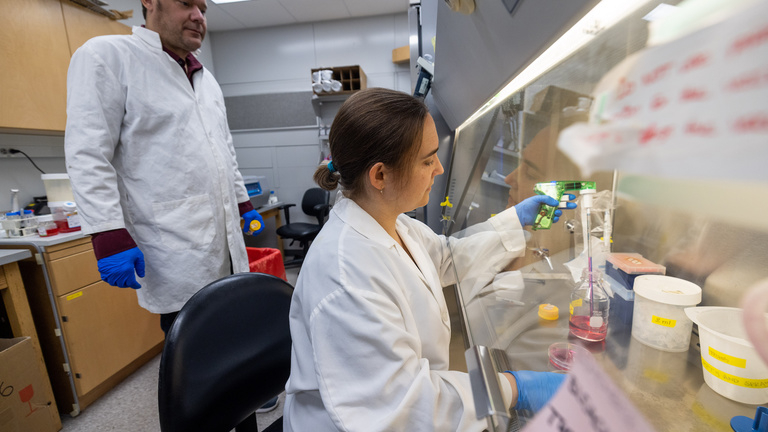
Researchers at the University of Iowa saw federal funding for their research cut this year, in medical and other areas. (Photo courtesy of University of Iowa)
National Institutes of Health grant terminations hit the University of Iowa hardest out of the dozens of universities housed in the state this summer, according to a national project working to compile grant dollars that have been frozen or canceled entirely as President Donald Trump and his administration seek to end federal funding for certain research.
There are seven National Institutes of Health grants identified by Grant Witness to have seen some funds terminated in Iowa, with only one seeing possible reinstatement. They run the gamut of research — from cancer to cochlear implants, Alzheimer’s to vaccine messaging, genomes to access to research careers.
Many of the projects to see some or all of their funding canceled have already received hundreds of thousands of dollars worth of grant funds over years of work.
The longest-running project to see portions of its grants terminated has received federal funding since 2013, according to USAspending, an open data source tracking federal spending. The study is set to run through a portion of 2028.
UI public relations manager Chris Brewer said in an email a diversity supplement grant to the project has been canceled, leading to a loss of $89,000 in future funding. Funding of the project as a whole will continue.
According to the project summary reported by NIH, the study is looking into using different materials on the surfaces of cochlear implants — a surgically implanted device to aid people with severe hearing impairment — in order to reduce bacteria and lower the risk of infection and other issues.
“Additionally, this work will provide a deserving researcher from an underrepresented group an exceptional career training and mentorship experience,” the summary stated.
A UI program aimed at increasing research accessibility also saw its federal grant terminated this year, with the Maximizing Access to Research Careers (UI-MARC) program having received $1.3 million in funding so far and expecting $1.5 million in total. According to USAspending, the goal of the initiative is to “develop a diverse pool of undergraduates who complete their baccalaureate degree and transition into and complete biomedical research-focused higher degree programs.”
The Iowa Sciences Academy, in which the UI-MARC program is housed, stated in a May story about the program that it expected its federal funding would not be renewed for fiscal year 2026, “due to changing funding priorities at the NIH.”
Other canceled medical research included one study diving into potential therapies for people with early Alzheimer’s disease and another studying responses to a certain therapy for head and neck squamous cell carcinoma.
The diversity supplement for a study looking at new therapies for those dealing with triple-negative breast cancer, totaling $59,000, was also canceled, Brewer said in his email, though funding for the research project itself remains in place. The project summary stated triple-negative breast cancer is the only type of breast cancer with no targeted therapy.
One of the terminated grants provided funding to studies diving into topics the Trump administration has spoken about previously, namely vaccines.
One grant, started in August 2020, was supposed to provide a total of nearly $520,000 to University of Iowa researcher Aaron Scherer to find the motives that spur unvaccinated, older adults to get their vaccines and work with older adults who are hesitant to vaccines to develop motivational influenza vaccine messaging and complete a pilot study to judge its efficacy.
The only grant to have been possibly reinstated deals with differences in polygenic scores based on sex. “A novel approach for understanding how sex influences polygenic score associations,” started in September of 2022, explores what is described in its description online as “summaries of the genomic contribution to risk and resilience for biomedical traits.”
Research into polygenic scores has traditionally left out groups like gender minorities, according to the description, and the study seeks to close the gap by developing a new method for study of sex-related differences for both genomic and general research. Its end date is slated in the award summary for July 31, 2026, with $1.4 million of the $1.6 million obligated amount processed.
The grant was ruled to be reinstated this summer according to Grant Witness’s data, but the organization states on its website grants under this category are being listed as “possibly reinstated” because its members do not know what the reinstatement process will look like or how long it will take.
Editor’s note: This story has been updated to include information on diversity supplement grant funding that was canceled for two University of Iowa research projects. The story previously stated, based on reporting from Grant Witness, that the projects had their federal funding canceled entirely.
Des Moines, IA