Teachers satisfied with cellphone bans, but policy is not ‘silver bullet’
Aug 04, 2026 | 5:00 am ET
Description
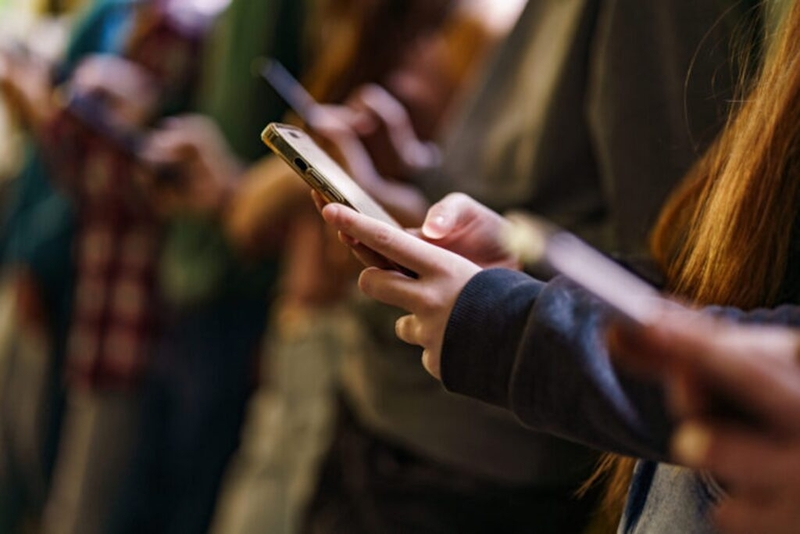
Three-quarters of teachers said in spring they have seen cellphone use in classrooms either “rarely” or “never” since the ban. (Getty Images)
For years, Manchester High School’s policy required students to put phones away in class, but allowed them to be taken out in the cafeteria. Students could use headphones or earbuds while eating lunch, but only over or in one ear.
Then, in 2025, lawmakers passed a law championed by Gov. Kelly Ayotte that required schools to ban the devices for the whole day: “bell-to-bell.” With some reservations, Manchester’s Board of School Committee changed the policy last August, and the cafeteria exception disappeared.
It’s a social experiment that has played out in schools across the state; the state law required the policies in place for the 2025-26 school year. And last week, state officials received early validation. A Department of Education survey of 1,399 New Hampshire teachers and administrators serving grades six to 12 has found that the law is working, and that educators are broadly satisfied. Three-quarters of teachers said in spring they have seen cellphone use in classrooms either “rarely” or “never” since the ban.
“Our effort to get cellphones out of the classroom is paying off, and I’m highly encouraged by the progress schools are reporting,” Ayotte said in a statement July 28 reacting to the results.
Manchester officials agree. Superintendent Jennifer Chmiel says the district is “pleased” with the results. “Teachers and administrators have reported students engaging more in the classroom and with each other during the school day,” she said in a statement to the Bulletin. “We are excited to see our students continue to thrive during the upcoming school year.”
But others say the ban is not a silver bullet.
On its broadest aim, the policy appears successful. Among New Hampshire teachers, 79% called the bans effective in reducing classroom distractions; 87% of administrators said the same, according to the survey.
Educators are more mixed on whether the policy has led to improvements in test scores and disciplinary incidents.
Meanwhile, as New Hampshire schools prepare for their second year of the policy, some researchers are pushing for even more rigidity in the policies. And a new potential target in the battle against distraction has emerged: laptops.
“The major things we’re seeing are: The stricter the policy, the happier the educator,” said Kelly Flynn, a research coordinator at the Duckworth Lab at the University of Pennsylvania, which has conducted a national survey of teachers.
A range of perceptions
While the survey indicates the policy is broadly popular as a means to reduce distractions, other, secondary goals of the policy had slightly less robust results.
Under the new policy, 75% of teachers said students appeared more focused and 65% said students interacted more during lunch and other breaks, the survey found.
Lower proportions — 56% of teachers and 58% of administrators — noticed increased peer bonding. And 54% of teachers reported seeing students’ social skills improve. Meanwhile, just 38% of teachers noticed improved academic outcomes and just 30% reported a drop in school disciplinary actions as a result of the ban.
The state survey was distributed to educators by school superintendents and was voluntary.
New Hampshire’s results correspond with some national data. In March, a working paper by the National Bureau of Economic Research, a nonprofit organization, found that schools that adopted strict phone bans showed an 80% decline in phone usage.
Researchers measured phone activity by tallying GPS pings in schools, and focused on schools that have bought and utilized lockable phone pouches from the company Yondr.
But the same study also found that “average effects on test scores are consistently close to zero.”
“High schools see modest positive effects, particularly in math, while middle schools see small negative effects,” the researchers concluded. “We find little evidence of effects on school attendance, self-reported classroom attention, or perceived online bullying.”
The findings were nuanced. For instance, the study found that nationally, instances of student suspensions increased by about 16% among schools using the pouches in the first year, but dropped in the second year. And students’ self-reported well-being dropped in that first year but rebounded in the second year.
International research is also mixed. A 2016 study on English schools that adopted a ban found that overall test scores increased about 6%, but that lower-achieving students saw a 14% increase in scores. A 2022 Spanish study found significant improvements in math and all science scores and a reduction in bullying incidents; a 2026 Norwegian study found similar results. But research in Sweden and South Australia found no improvements.
In the United States, some say the research needs more time. Most states did not adopt laws banning cellphones until last year, and it will take time to measure long-term effects, noted Flynn.
“One to three years after the ban might not be enough time to have a real culture shift and a real change in the school itself,” Flynn said. “So maybe five, seven years down the line, we might see something. We might not.”
The Duckworth Lab, led by professor Angela Duckworth, sent surveys to teachers from April 2025 to last June and reached 118,000 educators, representing about 30% of all U.S. public schools, Flynn said. The lab is currently collating school standardized testing data and will eventually issue a report with more empirical findings. It also plans to issue state-level reports in August to participating state education departments, including New Hampshire’s.
Deb Howes, the president of the American Federation of Teachers New Hampshire, a teachers union, said she was pleasantly surprised at how well the ban rolled out. Teachers unions have supported the policies, but stressed that they should be structured so teachers do not bear the brunt of enforcement.
“The thought was you were going to take a lot of time trying to get students to follow the ban, and it didn’t happen that way,” she said. “It really worked much better than everyone anticipated.”
A first step
To Duckworth and Flynn, the national data supports another lesson that could apply to New Hampshire: Cellphone bans are best when they are strict.
Successful policies regulate two components, Flynn says: the “when” and the “where.” New Hampshire law uses a strict framework for the “when.” After fierce debate and two closely competing proposals, lawmakers passed Ayotte’s preferred “bell-to-bell” ban, prohibiting schools from allowing students to have their phones back at lunch or between classes.
But where students are allowed to store those phones has a bigger effect than policymakers may realize, Flynn said. Psychological research by Duckworth suggests that even if a student turns off their phone before stashing it in their pocket, the physical proximity of the device acts as its own distraction. It is far more effective to collect devices at the beginning of the day and remove them from the student’s possession until the end, Flynn said.
“If you were on a diet, you wouldn’t want to carry a cupcake around in your hand,” she said.
That conclusion is supported by the national teacher survey data: Educators reported higher satisfaction with policies that required lockers, pouches, or collection systems for phones, according to Flynn.
New Hampshire’s law leaves that aspect of implementation up to school districts.
The state’s survey found that 63% of New Hampshire teachers said their schools allow students to keep their phones as long as they are out of sight. Just 24% said the policy is to require students to put the phones in a bag or container at the beginning of the school day.
‘The next frontier’
As schools and parents adapt to the movement to restrict phones in schools, some are already looking to the next battleground: laptops.
One in 3 teachers report that students are using laptops for personal purposes during class time, the Duckworth Lab survey found.
That trend may not be as pervasive as cellphones once were: A 2025 New Hampshire survey found that before the statewide ban, 68% of teachers observed phones being used at least sometimes for non-instructional purposes. But as the new policies take effect, the distraction mechanism of choice may shift to school-issued Chromebooks and other laptops.
It also could be much trickier to regulate, especially after schools have broadly invested in the technology. “Laptops, tablets — they’re a tool for doing so many good things and so many bad things,” Flynn said. “It’s this co‑location of the virtue and the vice.”
It is unclear whether lawmakers or educators are interested in exploring restrictions on laptops. But if they are, Flynn and Duckworth have emphasized that policymakers should proceed transparently to win over parents, and be prepared to hear concerns and present calm arguments backed by data. That, the researchers hope, is where their work could help. Next year’s survey will pivot its attention from phones to “screens in schools” more generally, Flynn said.
“We definitely feel like this is the next sort of frontier in the tech‑in‑schools research,” she said.
Howes agrees that the laptop concern is real. She has heard from teachers reporting students holding conversations by editing shared Google Docs on school-issued devices. “You can also read what they’re doing in the Google Docs, so it’s not private,” she joked.
But to Howes, the potential next focus on restricting laptop use belies a bigger problem in education. Students are growing up in a world that has increasingly de-emphasized long-term, focused learning, like reading entire books, in favor of more fragmented instruction. That development, accelerated by the age of AI, will take more than a ban on devices to reverse, she said.
“If they’re using phones or computers to look up answers instead of reading and thinking about it to find an answer, we can only do so much to help them learn,” she said. “The learning is the journey, not just having the answer handed to you.”
Concord, NH