Federal lawmakers to introduce bill reauthorizing, expanding RECA
Jul 14, 2026 | 6:25 pm ET
Description
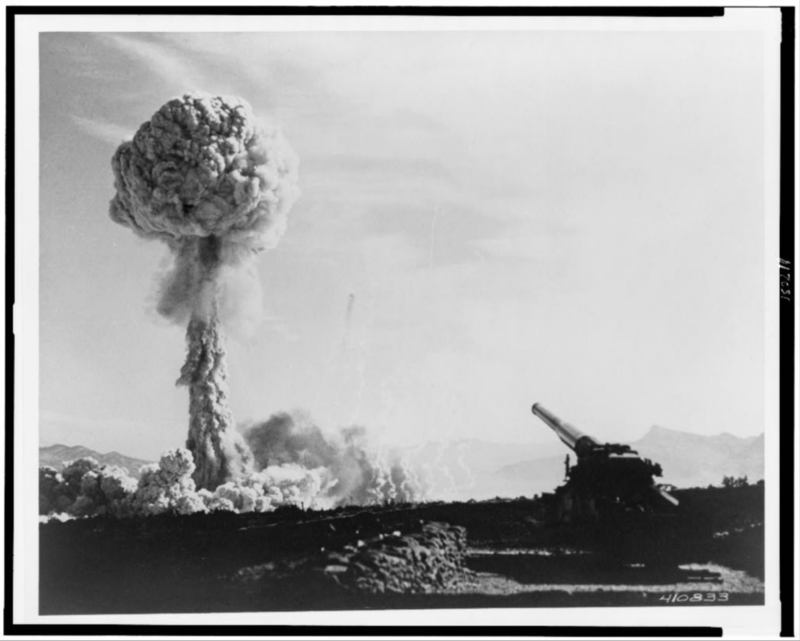
A fireball ascends from the first atomic artillery shell in history, tested at the Nevada Test Site in 1953. Radiation from the test site fell across the West, including in Montana. (Photo: Library of Congress)
A bipartisan group in Congress plans to introduce legislation that will expand the federal government’s program compensating people exposed to nuclear weapons testing or uranium mining and milling.
The bill will expand the Radiation Exposure Reauthorization Act, or RECA, to include individuals in Montana, which recorded some of the highest concentrations of radiation in the country from nuclear weapons experimentation in the 1950s and ‘60s.
In a virtual press conference on Tuesday, U.S. Delegate. James Moylan, R-Guam and Reps. Dina Titus, D-Nevada; Wesley Bell, D-Missouri.; and Gabe Vasquez, D-New Mexico; announced they would introduce the bill to expand RECA in the next few days, in line with the 81st anniversary of the Trinity Test and National Atomic Veterans Day on July 16.
The legislation will broaden geographic eligibility to fully cover four new states plus Guam, add specific new communities including the Hanford Site in Washington and waste sites near St. Louis, and expand the eligibility for qualifying illnesses, include atomic cleanup veterans, allow the parents of radiation victims to apply, and support Radiation Exposure Screening and Education Program clinics.
Delegate Moylan (territorial delegates can introduce bills, but cannot vote on final passage) has led efforts to expand RECA for years, with varied success, and this bill to reauthorize and expand the program is intended to fill the gaps previous versions contained.
“We fought for major reforms to RECA, adding Guam to the Downwinder program, and we have fought for radiation survivors across the country as well,” Moylan said on a press call. “Unfortunately, many groups were left out of the final version (of RECA adopted last year), and I am pursuing a fair bill for all to be involved.”
What the new bill does, Moylan said, is “expands the eligibility to reflect the realities of U.S. atomic weapons testing.”
RECA was first implemented in 1990 and was set to expire in 2022. President Joe Biden extended the program for two years, and a bipartisan group of senators, led by Missouri Republican Josh Hawley as well as delegates from western states including Idaho, sought to reauthorize and expand the program in subsequent years without success.
One version of the bill which included Montanans passed the Senate, but never saw a vote in the House.
The latest version of RECA, which expanded it to states including Idaho, but not Montana, was included in House Resolution 1 last year, known as the One Big Beautiful Bil Actl, with an expiration date of 2028.
Moylan’s proposed reauthorization bill will expand coverage for individuals exposed to radiation fallout from nuclear tests, called “Downwinders,” to all of Arizona, Colorado, Guam, Montana and Nevada.
A landmark study in 1997 by the National Cancer Institute looked at the top 25 counties in the country which received the highest concentration of radioactive byproducts — iodine-131— from nuclear testing in Nevada.
Of those top 25 affected counties, 15 of them were in Montana, with Meagher County receiving more radiation than any other. The other top-25 counties include Broadwater, Beaverhead, Chouteau, Jefferson, Powell, Judith Basin, Madison, Fergus, Gallatin, Petroleum, Lewis and Clark, Blaine, Silver Bow and Deer Lodge; while much of the rest of the state also received high exposure to radioactive material.
In 2024, the Daily Montanan and other States Newsroom outlets partnered with investigative journalism outlet MuckRock to publish a national series of stories in January called “The Radius” investigating the effects of the radiation fallout on Americans in the states that were affected.
The Daily Montanan’s reporting featured a woman who grew up on the Blackfeet Indian Reservation who believes it’s possible radiation could have caused her to develop thyroid cancer and an ovary malady, as well as a woman who now lives in Billings but who grew up in New Mexico and lost several family members to illnesses believed to have been caused by radiation from the Trinity test. Both said they believe any victims of the government’s nuclear testing deserve fair compensation.
Advocates in other affected states and jurisdictions told similar stories on the press call..
“After doing this work for 21 years, I know of no one that died the day of Trinity,” said Tina Cordova, co-founder of the Tularosa Basin Downwinders Consortium, which has advocated for RECA expansion for decades. But, “It was the beginning of the end for tens of thousands of people, including thousands of babies that died that summer that have never been recognized, acknowledged, and their families have never been compensated.”
Cordova, grew up in Tularosa, an hour away from the Trinity test site, said she is the fourth generation of her family to have cancer since 1945.
“My dad died after having three different cancers he didn’t have risk factors for, except that he was a 4-year-old child living a very organic lifestyle, 45 miles away from Ground Zero,” she said. “We were never warned before or afterwards. No one understood what it meant to be overexposed to radiation.”
Cordova also had two siblings and a niece get cancer, but her siblings are not eligible for compensation due to the types of cancer they developed.
“I think that it’s high time our government realizes that we are not going to stand for justice for some. We are in favor of justice for not just a few, but justice for the many, and we will continue to fight until we receive justice for all,” she said.
While Montanans are not eligible for compensation under RECA, the federal government has paid out nearly $12 million to current Montana residents who were exposed to radioactive material in locations that are covered.
Despite Montanans being excluded from RECA compensation, the state has played an active role in the program’s expansion, with former U.S. Sen Conrad Burns, a Republican, introducing the first expansion bill in 2005.
Montana’s subsequent senators — Democrats Jon Tester and Max Baucus — teamed up with Idaho Republicans Mike Crapo and Jim Risch to push for expansion into both states. Republican Sen. Steve Daines voted in favor of a standalone RECA bill in 2024.
During Montana’s 2023 Legislative session, a bipartisan group of state lawmakers passed Senate Resolution 69, urging the federal government to include Montana in the RECA program.
The Daily Montanan reached out to all members of Montana’s federal delegation asking about their support for RECA expansion and reauthorization, but did not receive responses from any of them by publication.
“We’re reaching out to all representatives as well for each of the sections that we are including — Colorado, Montana, all of Nevada, and all of Arizona. So this is a bigger partnership that we have going,” Moylan said on the press call. “It’s important that we get all of these folks who need to be added, that want to be added … so they can help fight for us to get this passed.”
The reauthorization bill will also cover individuals exposed to radioactive material at specific sites across the country, including Manhattan Project waste sites in or near St. Louis , the Hanford Site in Washington, the Portsmouth Gaseous Diffusion Plant (in Ohio), the Rocky Flats Plant and the Cañon City Mill (both in Colorado).
It will also fund a study through the National Cancer Institute to examine the long-term health impacts of radiation on both individuals who are exposed and their descendants.
Helena, MT