Federal judge weighs whether to bar commissioner from in-person work at the PSC
Jun 18, 2026 | 10:03 pm ET
Description
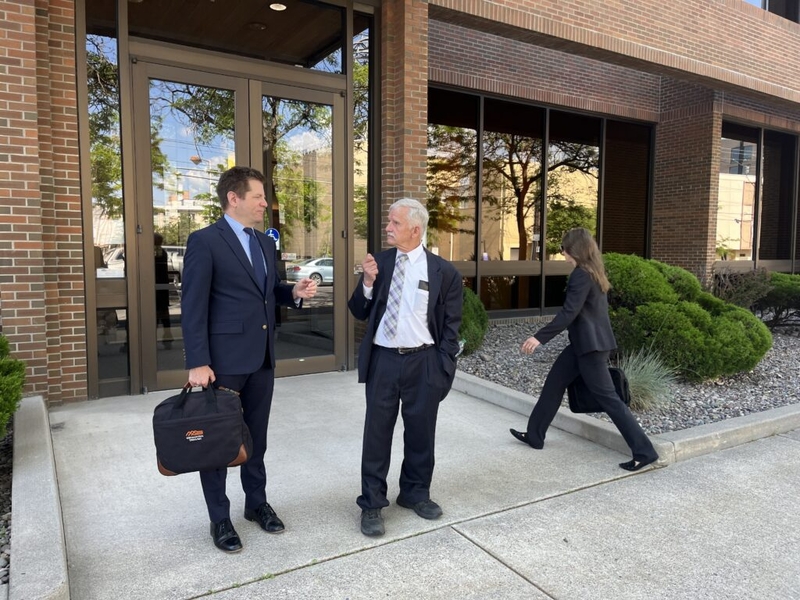
Lawyer Matthew Monforton, left, confers with Public Service Commissioner Brad Molnar outside the federal courthouse in Missoula in June 2026. (Keila Szpaller/The Daily Montanan)
MISSOULA — A U.S. District Court Judge on Thursday said he will weigh whether to uphold a decision to ban Public Service Commissioner Brad Molnar from working in person in his own office — or whether the expulsion is retaliation for speech protected by the First Amendment.
Judge Donald Molloy held out little hope that commissioners could resolve their disputes because of juvenile behavior.
The case stems from an investigation into allegations of professional misconduct by Molnar and a report in May that concluded he violated policies, including by retaliating against those who filed complaints against him.
The report recommended Molnar apologize, reform his behavior and receive remedial training. It recommended the PSC have Molnar work out of the office to “mitigate the risk of further retaliation,” and that the commission ask Gov. Greg Gianforte to temporarily suspend him.
In the hearing Thursday, Matthew Monforton — Molnar’s attorney — asked the judge to find the defendants’ decision to limit him to remote work was unconstitutional retaliation for protected speech.
The Public Service Commission regulates monopoly utilities, and Molnar has been publicly critical of other commissioners and the PSC’s relationship with NorthWestern Energy, the state’s largest utility.
He has argued his criticisms were followed by retribution.
But Natasha Jones, representing three other commissioners, said the issue isn’t Molnar’s First Amendment rights or free speech but his violations of agency policy, including retaliation against PSC staff and threatening behavior.
Molnar facing retaliation, lawyer argues
In arguing the ban be lifted, Monforton said Molnar could show he was retaliated against — he engaged in constitutionally protected activity; the other commissioners’ actions will chill his free speech; and his speech was a substantial factor in the decision to punish him.
Monforton also said the First Amendment exists because free speech can improve or resolve a situation, and Molnar’s criticisms should prompt the PSC to scrutinize NorthWestern Energy instead of rubber stamping the utility’s requests.
Monforton said Molnar objected to the communications policy of the PSC, along with a finding Molnar violated it when he “made unauthorized external communications.”
“That sounds an awful lot like prior restraint,” Monforton said, or censure ahead of speech.
He said Molnar was being punished by fellow commissioners for something else — “making them look bad.”
Monforton asked the judge to grant a preliminary injunction, or temporary block, on the in-office work ban, and for the parties to work out the problem.
Molloy said he was not hopeful the parties would be able to negotiate given the acrimony among or between them, and he called for civility. He said the case never would have landed in court otherwise.
“It would be nice if instead of juvenile behavior, there was professional behavior,” Molloy said.
PSC staff need protection, Jones says
Jones, of the Boone Karlberg law firm in Missoula, said the 40 employees who work for the Public Service Commission deserve protection.
Representing PSC President Jeff Welborn, Vice President Jennifer Fielder and Commissioner Annie Bukacek, Jones said the PSC is obligated to act when complaints are filed alleging retaliation or a hostile work environment.
The ban on Molnar’s access to the building needs to stay in place because he has demonstrated he is incapable of following the basic rules of decorum, Jones said.
But Molloy said the report identified only about four specific allegations of inappropriate conduct during a long period of time.
“I think you’re overstating what the record is,” Molloy said.
He also questioned whether the other commissioners would have banned Molnar if not for his criticisms of them or NorthWestern Energy. But Jones said Molnar’s inappropriate conduct was the driving force behind the decision to keep him out of the office.
Molnar intimidated employees, including moving into an office next to one staff member and “leering” at her, and he was responsible for some staff leaving the PSC, Jones said.
She said the role of the federal judge was to make a decision about Molnar regarding his access to the physical space, and the role of the governor was to decide if there is cause for his suspension.
Jones also argued Molnar needs to show “irreparable harm,” but he can’t do so because he can still perform his job duties remotely.
She said the hearing was the first time she heard that Molnar was willing to apologize.
After the hearing, Molnar said any apology would be a “future event.”
“But I’m not going to apologize for standing up for the First Amendment and due process,” Molnar said.
Helena, MT