Georgia lawmakers advance bill to delay voting machine changes until 2028 presidential election
Jun 18, 2026 | 6:21 pm ET
Description
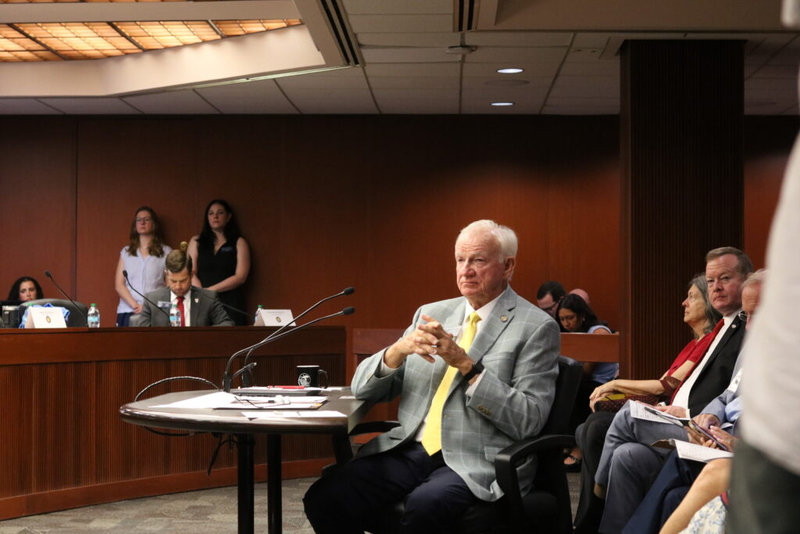
Sen. Max Burns, a Sylvania Republican, introduced a bill aimed at addressing ballot QR codes in the Senate Ethics Committee on June 18, 2026. Maya Homan/Georgia Recorder
Georgia lawmakers have advanced a bill extending the deadline to remove QR codes from Georgia’s ballots to 2028, taking their first official step during the special session to rectify a problem that threatened to destabilize the state’s midterm elections.
The bill passed out of the Senate Ethics Committee in an 8-4 vote along party lines Thursday morning. Sen. Max Burns, a Sylvania Republican who sponsored the bill, said the measure was the result of a compromise between the House, Senate and governor’s office, and resisted attempts from Democrats on the committee to amend the language.
Under current law, the QR codes currently used to count Georgia’s ballots must be removed by July 1. Georgia’s current ballot-marking devices were purchased for $107 million from Dominion Voting Systems and used statewide for the first time during the 2020 election. Secretary of State Brad Raffensperger told lawmakers in 2025 that updating all the necessary equipment to remove QR codes will require roughly $66 million in state funds.
“This is a proposal that resolves some concerns among our election community and allows a road map moving forward beyond 2026,” Burns said. Under the new proposal, Georgia would switch to a new voting system ahead of the 2028 presidential election.
Election measures capsize on the final day of Georgia’s 2026 legislative session
Republican lawmakers on the committee appeared hopeful that the bill could address the state’s current QR code crisis. Georgia residents largely vote using ballot-marking devices, which rely on QR codes to tally election results. However, the technology has faced pushback from a contingent of conservative activists, who argue that ballots should be counted based on text that can be deciphered by humans.
In 2024, the General Assembly passed a law preventing QR codes from being used to tally election results starting in July, but lawmakers failed to appropriate the funds necessary to make the switch. A bill aimed at solving the issue passed out of the House on the final day of the 2026 legislative session but didn’t make it across the finish line in the Senate.
Gov. Brian Kemp announced the special session in May, calling lawmakers back to the Capitol to address the QR code issue. He also urged them to consider redrawing congressional and state legislative districts for 2028 in the wake of a U.S. Supreme Court ruling that diluted a key provision of the Voting Rights Act.
Georgia Republican lawmakers drop plans to redistrict, citing pending legal cases
However, Republican leaders in both the House and Senate chambers ultimately backtracked on plans to redistrict, stating that they were waiting to see how pending legal cases over Georgia’s current maps played out before making any changes.
In addition to extending the deadline for phasing out ballot QR codes, Burns’ bill also lays the groundwork for selecting the state’s next voting system. A special committee, which will be composed of appointees from the governor and both chambers, will be tasked with setting standards and requirements for a new election system.
Notably, the bill removes the secretary of state from exercising authority over future voting equipment, placing that responsibility in the hands of state legislators instead.
“The secretary of state in 2027 will be a partner in that, but they will not be the sole deciding factor,” Burns said, arguing that current Secretary of State Brad Raffensperger had failed to act on the QR code issue. “They can certainly participate in that decision and discussion once the standards and specifications are provided, but at the end of the day, the Legislature will control the resources that would be appropriated to acquire any system.”
Raffensperger’s office did not immediately respond to a request for comment.
Democrats also voiced objections that, unlike the measure that passed the House on the final day of the 2026 session, there is no provision in this bill ensuring that the minority party will have a seat on the special committee.
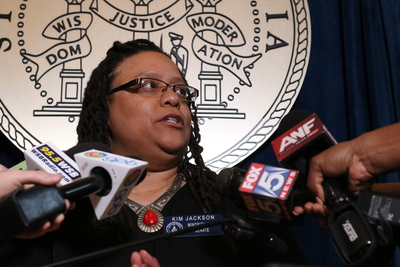
“My main issue with this bill is that we are creating a pathway forward for a new election system in Georgia, and we are not ensuring that Democrats have a voice in that process,” Minority Whip Kim Jackson, a Stone Mountain Democrat, told reporters after the meeting.
Among local election officials, who faced conflicting guidance from state election leaders on how to administer elections after the July 1 deadline, the measure came as a relief.
Joseph Kirk, the Bartow County elections director and president of the Georgia Association of Voter Registration and Election Officials, called the bill a “responsible choice” on the part of state lawmakers.
“I really do think that a legislative solution is absolutely necessary here to avoid the court system deciding how we conduct elections in the future,” he said.
Senators are scheduled to vote on the legislation on Saturday.
Atlanta, GA