Federal judge in Colorado holds ICE officials in contempt over ‘re-detention’ policy
Nov 19, 2026 | 2:27 pm ET
Description
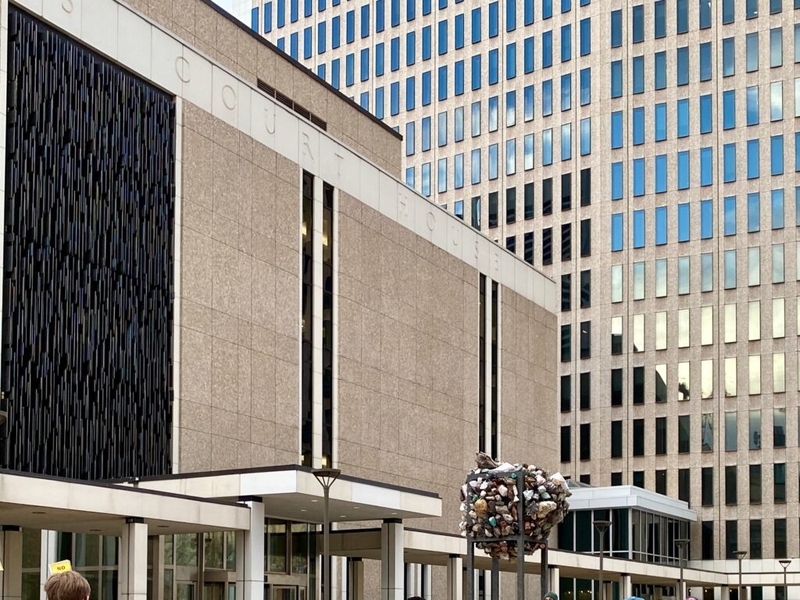
The Byron G. Rogers U.S. Courthouse, home of U.S. District of Colorado, in downtown Denver is pictured in 2021. (Photo by Chase Woodruff/Colorado Newsline)
A federal judge in Denver on Wednesday held senior U.S. Immigration and Customs Enforcement officials in contempt of court over a policy of immediately re-arresting individuals who had been ordered by the court to be released.
In a scathing 15-page order, Judge Charlotte Sweeney of the U.S. District Court of Colorado wrote that the conduct of Nichole Black, the assistant field office director for ICE’s Denver Enforcement and Removal Operations, and other agency higher-ups “should — and, in the Court’s opinion, must — shock any reader.” But she declined to impose sanctions on the respondents following sworn testimony that the policy is no longer in effect.
The order concerned proceedings in a habeas corpus case filed by Ramon Quintero Alvarez, a longtime U.S. resident born in Mexico who was detained by ICE in February, and instructions that Black received to “immediately re-detain” Quintero Alvarez and other individuals “following their release pursuant to court orders.” In Quintero Alvarez’s case and at least 18 similar cases Black was aware of, detainees were processed for release, given their personal property and then re-arrested moments later in a “public area” outside the detention facility.
“Sometimes, behavior stuns and renders a listener speechless,” Sweeney wrote. “To the extent any reader may be lost for words as to what ICE and Respondents did in this case and others in this judicial district like it — and the ridiculous nature of the justification for their behavior — turn to what the Supreme Court has said repeatedly over the course of our Nation’s history. ‘The government of the United States has been emphatically termed a government of laws and not of men.'”
“Any reader — and chief among them, Respondents — would do well to keep these binding statements in mind,” she concluded.
At least two other federal judges in Colorado have clashed with ICE officials in recent weeks over the policy, which Black characterized as a “direct order” from agency leaders to re-arrest individuals “that had some type of criminality.” Quintero Alvarez, who has lived in the U.S. for more than 30 years since entering the country with his mother and is the father of two children who are U.S. citizens, was arrested on criminal charges prior to his detention by ICE, but those charges were later dropped.
Sweeney said she wasn’t convinced by testimony from Nathan Rasper, ICE’s acting field office director in Denver, suggesting that there had been a “misunderstanding” about the new policy, characterizing the agency as exhibiting “unconstitutional behavior that runs top to bottom.”
She ruled that Black and other agency officials “were in clear contempt” of her earlier order, but that the cessation of the re-detention policy has “essentially cured” that contempt finding.
“The single thing that saves Ms. Black and Respondents (from sanctions) is Mr. Rasper’s unequivocal representation that ICE has “ceased” its immediately re-detain them ‘approach’ as a result” of a Nov. 4 hearing, Sweeney wrote.
Denver, CO