Federal job cuts in Alaska among the deepest in the nation, analysis shows
Aug 05, 2026 | 5:53 pm ET
Description
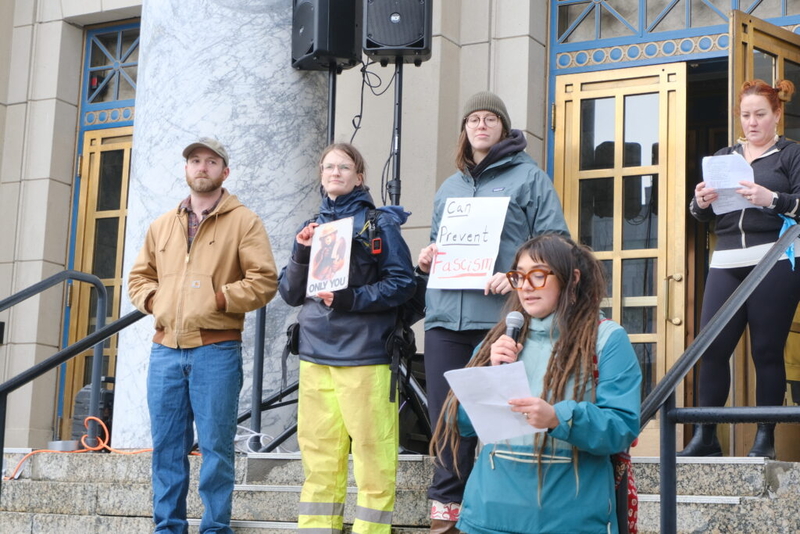
Fired federal workers formerly with the U.S. Forest Service based at the Mendenhall Glacier in Juneau speak at the Alaska State Capito; on March 21, 2025, about their experiences. The Forest Service was among the federal agencies in Alaska most heavily affected by job cuts. (Photo by Corinne Smith/Alaska Beacon)
Alaska lost a higher percentage of its federal workforce last year than almost all U.S. states to sweeping Trump administration cuts, according to a newly published analysis by the Alaska Department of Labor and Workforce Development.
By the end of 2025, Alaska’s federal workforce was 10.5% smaller than it had been at the end of the prior year, according to the analysis, published in Alaska Economic Trends, the monthly magazine of the department’s research section. In the fourth quarter of 2025, after many workers accepted buyouts or early retirement, the state’s federal workforce had dropped by 1,607 from the total in the fourth quarter of 2024, to 13,767 from 15,374 the year prior, according to the analysis.
The job losses came through mass firings and cuts made by the so-called Department of Government Efficiency, or DOGE, the government-reducing campaign led by trillionaire Elon Musk that started shortly after Donald Trump took office for his second term. To a large extent, job losses were concentrated at the end of the year.
Calculated by the annual average, Alaska lost about 4.5% of its federal jobs in 2025. Only Maryland, which lost 6.5% of its federal jobs, and New Mexico, which lost 5.8% of its federal jobs, lost more.
Federal job losses reduced Alaska’s total earnings by $36.5 million on average in 2025, according to the Department of Labor and Workforce Development analysis, and they brought federal employment in Alaska to the lowest level since at least 1990.
Much of the cutting in Alaska came in the U.S. Department of Defense’s civilian workforce. Calculated by annual average, 340 defense related jobs were lost to the DOGE cuts, but the fourth-quarter loss was calculated at 755 jobs.
The large amount of job losses in the Department of Defense category was a bit surprising, said Karinne Wiebold, the state labor economist who wrote the Trends article. “I assumed early on that the DoD might be one of the less affected departments and that our strong military presence might insulate us,” she said by email.
Federal agencies that sustained high numbers of job losses included the U.S. Forest Service, which had 180 fewer employees at the end of 2025 than in late 2024, the Bureau of Land Management, which had lost 133 jobs at the end of the year, and the National Oceanic and Atmospheric Administration, which had lost 101 of its workers by the end of 2025.
Job losses in the Forest Service and NOAA have affected important Alaska industries and services, including fishery science, weather forecasting, scientific research and tourism.
The fallout from the job losses continues, and the public does not yet have a complete picture, Wiebold said. “I do think the public is aware of the federal job losses and that they have been deep and a bit unpredictable,” she said. “I don’t know if the public generally understands what the ramifications of the cuts will be — federal employees perform a wide variety of oftentimes highly specialized work.”
Certain parts of the state were harder hit than others. The Southeast Fairbanks Census Area, which has been reliant on military-related employment, and parts of Southeast Alaska, where employment related to the Tongass National Forest is important, are among those regions with steeper job losses by percentage, according to the analysis.
Alaska’s ranking among states hit by DOGE-related job cuts could change, Wiebold said. Data from this year has yet to be fully analyzed, she said. “Even in the first parts of 2026, there are reports of the rankings shifting somewhat,” she said.
Juneau