Federal cuts hobble efforts to prevent overdoses from contaminated drugs
Nov 09, 2026 | 6:00 am ET
Description
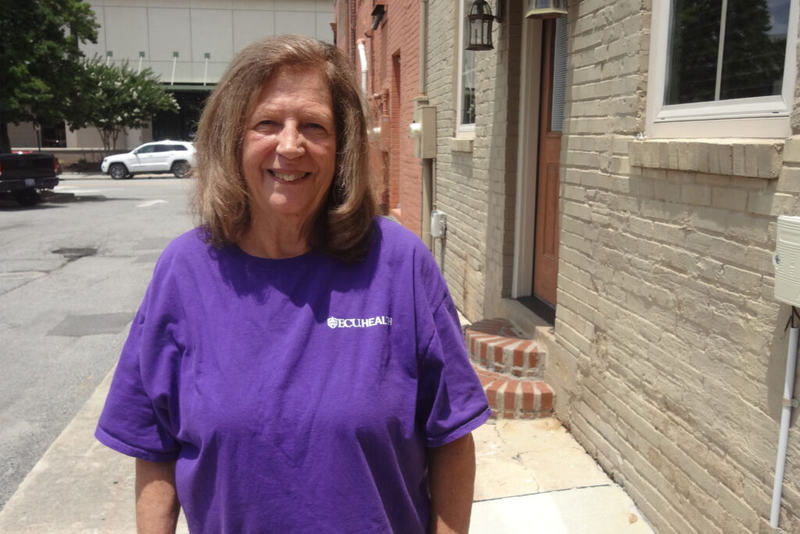
Diannee Carden Glenn is the director of ekiM for Change, a volunteer-run public health organization in eastern North Carolina. With federal Substance Abuse and Mental Health Services Administration funding no longer available for street-drug test strips, she must now come up with the money on her own. (Taylor Sisk for KFF Health News)
GREENVILLE, N.C. — When the federal funding ran dry, Diannee Carden Glenn’s options were few.
Carden Glenn is the director of ekiM for Change, a volunteer-run public health organization that works to prevent overdoses in Greenville and surrounding rural communities. For much of the past decade, she relied on funding from the federal Substance Abuse and Mental Health Services Administration to buy drug test strips, used to check for contaminants in the street-drug supply.
But in April, the federal agency sent out a “Dear Colleague” letter announcing that organizations like hers could no longer use its money to buy test strips for fentanyl, xylazine, medetomidine, or other substances that heighten the risk of overdose, particularly when the user is unaware of what they’re consuming.
Carden Glenn’s options?
“Well, I’m 81 years old, and I get Social Security,” she said, “so I use my Social Security. And I’m lucky to have a husband who can support me.” She also has other retirement income; she allocates that to ekiM’s work as well. Occasionally, she receives a donation. The federal funding was a little more than $15,000 a year.
Carden Glenn’s small organization is part of the “harm reduction” movement, which aims to help people who use drugs stay safe. Opponents argue that distributing test strips and similar supplies abets drug use and detracts from abstinence-based recovery. Proponents counter that checking street drugs for contaminants is a proven way to prevent overdoses, particularly with so many unknown drugs now in the supply. While fentanyl is ubiquitous, front-line workers are also commonly discovering that drugs sold on the streets unexpectedly contain methamphetamine and an increasing number of ultrapotent synthetic drugs, including carfentanil, medetomidine, and nitazenes.
Research has indicated that people who use test strips are more likely to engage with other harm reduction services and strategies, such as carrying naloxone and not using drugs alone.
In North Carolina, the federal agency was the state opioid response program’s exclusive funding source for fentanyl and xylazine test strips, which were then distributed to organizations across the state. These cuts are part of a more than $300 million reduction in federal funding for overdose prevention and treatment initiatives nationally.
North Carolina is among the states that permit such groups to use a variety of drug-checking tools. Carden Glenn’s organization typically hands out test strips for fentanyl, xylazine, and medetomidine. The strips can cost $1 or more apiece, depending on the type. Giving away several hundred a week adds up.
Test strips are one in a spectrum of tools that are being utilized throughout the state.
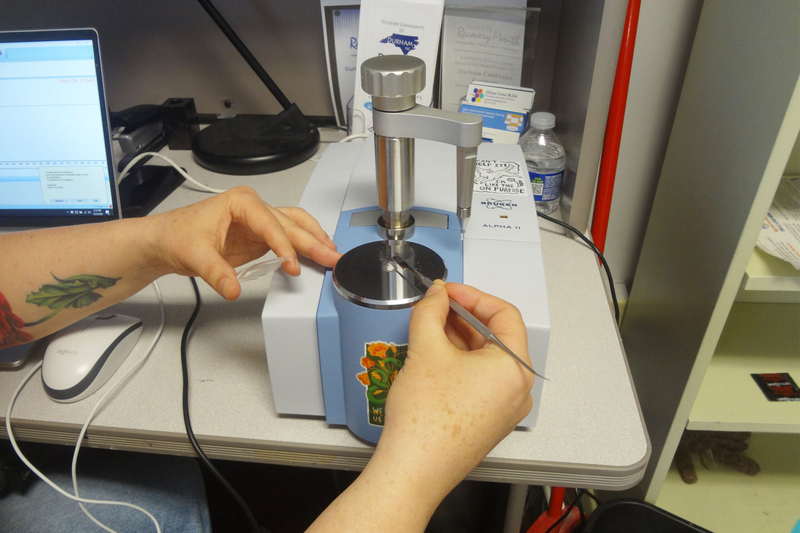
Each Friday afternoon, 100 miles west of Greenville, team members of the North Carolina Harm Reduction Coalition arrive at Elizabeth Street United Methodist Church near downtown Durham with a toaster-oven-sized contraption called a Fourier transform infrared spectroscopy machine. The device allows for more thorough examination than test strips, providing insight into the varied, sometimes startling contents of drugs brought in by the people who use them or by their friends, family, or advocates.
Jennifer Carroll is an associate professor of anthropology at North Carolina State University who partners with the Harm Reduction Coalition to evaluate testing results from such equipment. The university received funding from the North Carolina Collaboratory to enable this work. The utility of the technology excites her; each new drug sample presents a mystery.
Those who visit the testing site range from regular to occasional users. Often, they have no clue what might be found in a sample. “It just feels nice being able to offer this to people, and for them to have the power of having that knowledge,” Carroll said.
“We see quinine, lidocaine, tetracaine,” she said while seated behind the testing machine on a Friday afternoon in January. “We see tranquilizers like xylazine and medetomidine. We occasionally see gabapentin show up, but it’s not common. We occasionally see heroin.”
The machine isn’t perfect, she said. For example, it might miss traces of medetomidine in cocaine that a test strip would detect. So the staffers keep strips on hand.
For more comprehensive testing, the team sends samples to the Street Drug Analysis Lab at the University of North Carolina-Chapel Hill, known more commonly as “Nab’s Lab,” in recognition of Nabarun Dasgupta, the lab’s director and recipient of a 2025 MacArthur Fellowship “genius grant.”
Dasgupta and his team use an instrument that provides more thorough analysis, offering confirmation of the chemical formula of a sample. Since the lab’s launch in 2022, they’ve detected some 500 unique substances in the drug supply. From rural Edgecombe County, for example: levamisole, a medication primarily prescribed to treat worm infestation in animals. From Asheville: the industrial chemical BTMPS, used to protect plastics from ultraviolet exposure.
Pearson Ripley with the harm reduction organization Steady Collective in Asheville said keeping up with the flow of adulterants in the drug supply is probably the foremost challenge today for those doing this work. For a time, the biggest problem was the emergence of fentanyl. But people have learned to adjust to its effects, he said. Now it’s the unknown complexity of the supply.
Look at graphs charting the composition of street-drug samples, Ripley said, “and it’s just, bam, stepping up every single year in the number of substances found in a supply.”
Thus, those on the front lines say, the urgent need for easily accessible drug testing.
Carroll emphasized the critical role street-drug suppliers can play in drug-checking initiatives.
“We’re still a very nascent service in North Carolina,” she said; those relationships have yet to be established. “But in many other places that have been offering this service longer, some of their most impactful relationships around the service are with drug suppliers who are like, ‘I want to be able to communicate what I’m selling to other people so that no one is surprised.’”
Dasgupta has been impressed with street-drug checking strategies conceived and launched in rural communities, which he calls “engines of ingenuity.” He cites Holler Harm Reduction in rural western North Carolina, “where they’re going to people’s houses and doing driveway drug checking. That’s cool.”
The Good Mind Initiative, serving Indigenous communities across North and South Carolina, holds monthly community socials at the United Katehnuaka Longhouse at which as many as 300 people convene for fellowship, food, first aid kits, naloxone, condoms, and more. Throughout the month, Good Mind Initiative staff distribute supplies.
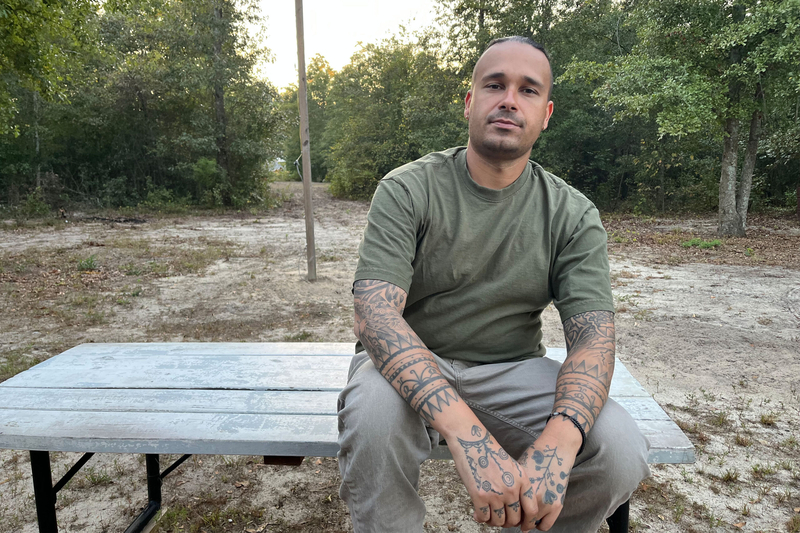
“Our identity, our culture, our language, our songs, our dances are integral to our healing and to our ability to help each other reduce harm,” said Kaya Littleturtle, the initiative’s program manager. So too were test strips, which they no longer have the money to provide.
His organization holds fundraising events, including target-shooting contests in which the prizes are turkey or other types of meat. He acknowledged, though, that it would take a lot of fundraising to replace the lost federal money.
In July 2025, President Donald Trump signed an executive order stipulating that federal grants not be spent on “‘so-called’ harm reduction” efforts, writing that they “only facilitate illegal drug use and its attendant harm.”
That order and subsequent funding cuts have contributed to what North Carolina Harm Reduction Coalition executive director Elyse Powell calls “an incredibly hostile time” for critical services.
And there’s a ripple effect. Carroll said she has had interactions with federally qualified health centers that have said they’re not allowed to participate in an event that has the term “drug checking” associated with it.
In May, U.S. Sen. Ed Markey (D-Mass.) sent a letter — co-signed by four fellow senators and 16 members of the House of Representatives, all Democrats — to the Substance Abuse and Mental Health Services Administration asserting that its recent directive “defies evidence showing that harm reduction for substance use reduces overdose deaths and dangerous infections, threatening to reverse years of progress in combating the overdose epidemic.”
“To abandon harm reduction is to do so at our own peril,” he wrote.
Markey also noted that the federal Centers for Disease Control and Prevention has acknowledged that test strips can be “the difference between life or death.”
Margaret Bordeaux is a longtime advocate for harm reduction efforts. “I know people who have done amazing things, incredible work, to really advance drug testing here in North Carolina, and the impact that’s having on communities,” she said. “I know exactly what happens when those resources aren’t available in communities. We lived through it, and to think that we’d have to go through it again is sad. It’s sad.”
Littleturtle agrees. “It’s just a hard time right now, because of politics, and politics should never get in the way of saving lives,” he said. “But it does.”
KFF Health News is a national newsroom that produces in-depth journalism about health issues and is one of the core operating programs at KFF — the independent source for health policy research, polling, and journalism.
Raleigh, NC