Federal court nixes challenge by Byron Donalds, GOP college groups to ’20 Census
Jul 08, 2026 | 11:31 am ET

Description
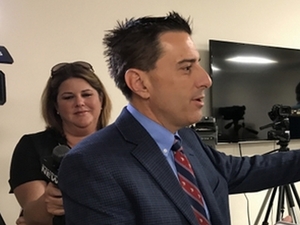
Florida Republican U.S. House member and gubernatorial candidate Byron Donalds addressing the Sunshine State Showdown in Davie on June 27, 2026. (Photo by Mitch Perry/Florida Phoenix)
A three-judge federal court in Tampa Tuesday again dismissed a lawsuit originally filed by Florida College Republican groups and later joined by Florida gubernatorial candidate Byron Donalds challenging the statistical methods the Census Bureau used in the 2020 Census.
The Republicans alleged that a proper count would have given Florida an additional U.S. House seat and an additional vote in the Electoral College but for the “vast use” of a statistical method known as imputation. However, for the second time in six months, the U.S. District Court for the Middle District of Florida dismissed the case, this time with prejudice, finding that any further amendment to the pleadings “would be futile.”
That means the court won’t entertain additional arguments.
Litigation began in September, nearly five years after the 2020 Census was finalized. That’s when America First Legal (AFL), a conservative public interest organization co-founded by White House deputy chief of staff Stephen Miller, filed a lawsuit alleging that the 2020 count was unconstitutional and violated federal law because it relied on unlawful statistical methods, distorted congressional representation, and diluted the votes of lawful citizens.
The suit was originally filed on behalf of University of South Florida College Republicans and its president, Michael Fusella, along with the Pinellas County Young Republicans and its president, Parisa Mousavi. Donalds became a plaintiff in November.
However, a three-judge federal panel dismissed the lawsuit in February, ruling that the plaintiffs waited too long to sue. America First Legal then filed an amended complaint, alleging the Census Bureau’s COVID-19 pandemic-related decisions to suspend or alter its standard procedures to conduct a count of the population “crossed the line and caused inaccurate results.”
The group seized on a U.S. Census Bureau report released in 2022 that found Florida was one of six states undercounted in 2020 — Florida, by 3.48%, or approximately 760,000 people. AFL argued the Census Bureau relied too heavily on “imputation,” a statistical method used to insert missing individuals into official population counts. The Census Bureau says that occurs when an address is confirmed to be occupied, but no direct demographic data are collected. AFL called for the three-judge panel to decide that the data were unlawfully produced and order the bureau to produce new data.
However, the panel again dismissed those arguments in a 68-page decision.
Regarding the complaint that whole-person imputation was excessively used, the judges wrote that “the data cited in the Complaint show that it is entirely speculative whether the imputation employed in the census for Florida increased or decreased the Florida head count relative to other States.
“For example, Plaintiffs cite Estimates for People in the United States by State, which reports that Florida’s whole-person imputation rate was 3.6%, while the nationwide rate was 3.4%. … Of the 11 states with a whole-person imputation rate of 3.6% or higher, two had an undercount (Florida and Illinois), and three had an overcount (New York, Rhode Island, and Utah).”
The lawsuit also alleged that Rep. Donalds suffered an injury because he used Census data to “inform his votes” and “depends on accurate census data to inform his constituent services and relations.” But the judges ruled that the plaintiffs hadn’t identified a single vote that Donalds would have cast differently if he had access to different data.
The judges dismissed an allegation that Donalds advised his constituents about programs like SNAP and Medicare, which set eligibility requirements using Census data.
“But Representative Donalds operated from the same set of Census data that the administrators of programs like SNAP and Medicare use,” the panel wrote. “So Plaintiffs don’t explain how Representative Donalds was stymied in advising his constituents on how to navigate those programs.”
The original defendants in the case were Treasury Secretary Howard Lutnick and George Cook, acting director of the U.S. Census Bureau.
A motion to dismiss was filed by the Elias Law Group in February on behalf of the Alliance for Retired Americans and two students at the University of Central Florida, who intervened in defense of the Census Bureau.
“For the second time in six months, a federal court has thrown out this reckless attack on the Census process,” said Elias Law Group partner David Fox in a written statement Tuesday night.
“From the beginning, it has been clear that the Republicans intended to use this lawsuit to lay the groundwork for a partisan manipulation of the 2030 count. Thankfully, the court saw right through these recycled claims and correctly dismissed this baseless lawsuit once again. Every Floridian deserves a fair and accurate Census count, and today’s ruling helps protect the integrity of this important process.”
The push to redress the 2020 Census has been supported by Florida Gov. Ron DeSantis and Attorney General James Uthmeier.
DeSantis cited the Census Bureau’s post-enumeration survey showing the Florida undercount as one of several reasons why Florida needed to conduct a rare mid-decade congressional redistricting. Florida’s GOP-controlled Legislature did pass a redistricted map in late April, which DeSantis signed into law in May.
Uthmeier wrote to the Census Bureau in August, saying it should use the “knowledge” gained from the post-enumeration survey to conduct a manual recount of the 2020 Census. He filed a petition with the bureau in April, requesting that, going forward, it should take several actions during the 2030 census, including inquiring about citizenship and immigration status; excluding illegal or temporary residents from the apportionment; excluding children of illegal and temporary residents from the apportionment; and stopping use of statistical “interferences that manipulate the numbers.”
Tallahassee, FL