New poll shows El-Sayed, Stevens statistically tied in Michigan’s Democratic U.S. Senate primary
Jul 08, 2026 | 12:36 pm ET
Description
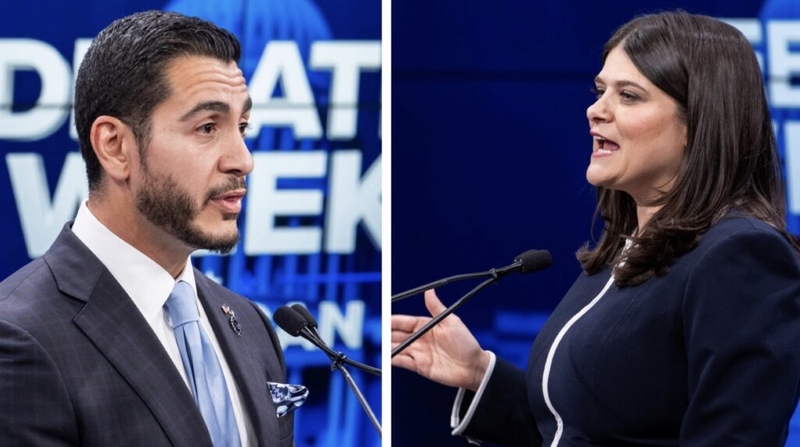
Abdul El-Sayed and U.S. Rep. Haley Stevens (D-Birmingham) during a televised debate on WOOD TV8 in Grand Rapids. July 7, 2026 | Photo by Bryan Esler/WOOD TV8
Detroit’s Abdul El-Sayed and U.S. Rep. Haley Stevens of Birmingham, the two remaining Democratic candidates seeking Michigan’s open U.S. Senate seat, are statistically tied in a poll conducted the day before and day of Tuesday’s first head-to-head debate.
According to an online survey of 2,211 likely Democratic primary voters from Tavern Research, with a 2.5% margin of error, El-Sayed and Stevens are neck-and-neck without state Sen. Mallory McMorrow of Royal Oak in the race. McMorrow suspended her campaign earlier this week, and just before Tuesday’s debate, which gave voters their first real glimpse of the sharp contrast between El-Sayed and Stevens.
Tavern Research asked likely voters to pick between the two as if the Aug. 4 primary were held today. Stevens led with 42% saying they would vote for the congresswoman, but another 41% said they would cast a ballot for El-Sayed. Notably, 18% of those surveyed said they weren’t sure, comprising a sizable chunk of undecided voters.
That number of undecided voters, however, is significantly down from the previous total of 38% from earlier polling when McMorrow was still in the race.
El-Sayed, Stevens sharpen contrasts in first one-on-one Senate debate
After a major shakeup in the race — McMorrow’s exit — and a lively debate that had a good mix of policy substance and clippable attack lines, the polling data is coming into clearer focus.
Although Stevens held a nominal one-point lead, according to Tavern Research, the 2.5% margin of error means that she and El-Sayed are statistically tied in the final stretch of the race.
If McMorrow was still in the race, survey respondents said they would be more likely to vote for El-Sayed at 41%, Stevens at 38% and McMorrow receiving just 5% in the poll. Still another big chunk of undecided voters remained in the hypothetical three-way contest at 16% unsure of who to vote for. Although El-Sayed performed better in a two-way race against Stevens, the data shows that El-Sayed was benefiting with McMorrow still in the hunt — a scenario that is no longer possible.
That said, the survey asked its respondents to rank their second choices in a three-way race if they had changed their minds. In that scenario, McMorrow had the lion’s share with 22% saying they would consider switching to her campaign, 19% said they would choose Stevens as a second choice and just 14% would reconsider El-Sayed. 45% said they were unsure of who to vote for if they had to make a second choice.
The survey is also noteworthy because it polled more women at 62% of all respondents compared to men, who made up 38% of the survey respondents. At least 55% said they identified as Democrats and 32% described themselves as independent voters. The highest share of respondents said they had some college with no degree (30%) and the vast majority were white Michigan residents (72%). Notably, only 20% of the survey’s respondents identified themselves as Black and just 3% of respondents identified as Latino.
The data from Tavern Research noted that while 37% of those surveyed said they believed El-Sayed could very likely beat the presumed Republican candidate, former U.S. Rep. Mike Rogers of White Lake, in a head-to-head matchup in November, 42% thought Stevens was the better option against Rogers in the fall.
Overall, the Democrats and independents who dominated the poll said they ranked El-Sayed with a net favorability of 45%. Stevens in the same poll had a net favorability rating of 40%.
Lansing, MI