Facing removal, SC school board member refutes accusations in first-of-its-kind hearing
Sep 29, 2026 | 7:45 am ET
Description
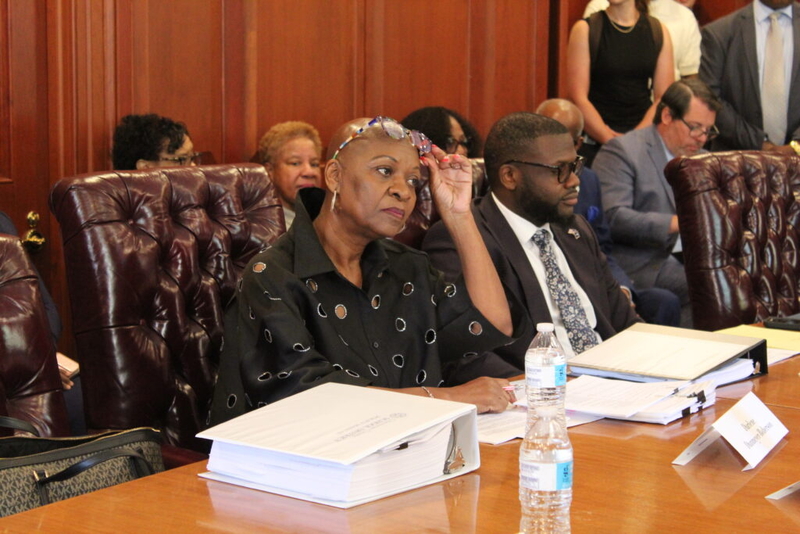
Darlene Dunmeyer-Roberson and her attorney, Rep. Kambrell Garvin, respond to an inspector general's report during a hearing on Statehouse grounds in Columbia, S.C., on Monday, Sept. 28, 2026. (Photo by Skylar Laird/SC Daily Gazette)
COLUMBIA — The Charleston County School Board member at the center of potentially multiple state investigations told a panel Monday she didn’t mean to share confidential information or tip the scales to get a contract for her former campaign manager. Whether her answers allow her to stay on the board remains to be seen.
The hearing, which lasted nearly four hours, was the first of its kind under a 2022 state law that gave the governor the ability to remove any school board member who engages in “malfeasance, misfeasance, chronic unexcused absenteeism, conflicts of interest, misconduct in office, or persistent neglect of duty in office.” By law, the governor must give the school board member a chance to be heard before making that decision.
SC governor moves to oust Charleston school board member after report found possible fraud
And Darlene Dunmeyer-Roberson asked for the opportunity to defend herself against the findings of an investigation by the state inspector general’s office.
The report, released last month, said she may have broken multiple laws and board policies. It was sent to the State Law Enforcement Division and Department of Revenue for further investigation.
Monday’s hearing focused on three claims in the report: that Dunmeyer-Roberson breached confidentiality by sharing information from the board’s closed-door meetings, that she violated attorney-client privilege in emails shared with reporters, and that she helped her former campaign manager get a contract with the school district.
As for other issues raised in the report, Dunmeyer-Roberson declined to answer questions about whether she lived in her district, which includes Edisto Island, Hollywood, Johns Island, and Ravenel. Panelists didn’t ask about potential issues with her taxes, and questions about payment for her work as a contractor came up only briefly.
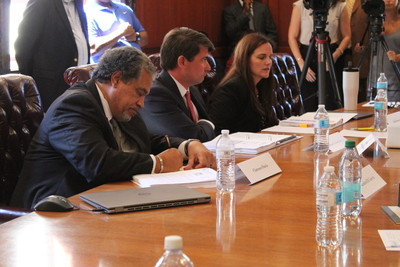
Prior to the 2022 law, no one had the authority — outside of a courtroom — to remove individual school board members. While it gave the governor sole discretion, Gov. Henry McMaster appointed a three-person panel to hear Dunmeyer-Roberson’s case. The three attorneys have until Oct. 5 to give their recommendation on whether McMaster should remove her.
“The governor has a big decision to make, because this has precedent for how we operate and how we handle elected officials moving forward,” said her attorney, Rep. Kambrell Garvin, D-Columbia. “That’s a big responsibility.”
The panel McMaster created consists of Adair Ford Boroughs, South Carolina’s U.S. attorney during the Biden administration; Charleston attorney Thomas Limehouse, McMaster’s in-house attorney for almost nine years; and Columbia attorney Clarence Davis, an assistant U.S. attorney during President H.W. Bush’s tenure.
Sending emails
Dunmeyer-Roberson, in her first extensive public response to the report, didn’t deny sending the emails included in the report. But she said she didn’t mean to anything wrong.
Every time she sent an email with potentially confidential information, she believed that information was already publicly available, she and her attorney said.
The inspector general’s report found 10 instances of Dunmeyer-Roberson sending confidential emails to local reporters and 28 times when she forwarded emails to another of her email addresses.
Several marked with attorney-client privilege came in response to questions she had asked, so she thought she could send them, she said.
The emails Dunmeyer-Roberson sent to reporters had to do with information already published in opinion articles, included on public agendas or posted about on social media, Garvin said.
“Those things were already being discussed publicly,” Garvin said. “They were already being discussed on social media.”
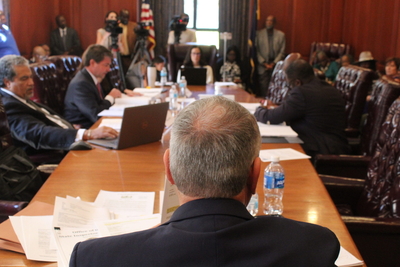
But one board member doesn’t have the right to break that privilege for the entire school board, Boroughs said.
And all of the emails from attorneys included a note at the bottom telling the recipient not to forward them without permission, Limestone said.
Dunmeyer-Roberson said she never paid attention to that.
“I’m going to be honest: I don’t think any board member reads the boilerplate to pay attention to it,” she said.
Presenting the findings of his report, Inspector General Brian Lamkin also raised problems with Dunmeyer-Roberson forwarding emails from her school district-provided email address to her own.
“Once it goes to a vendor email account or a personal email account, you have no oversight,” Lamkin said. “You have no control over it, and you don’t know where it’s going to end up.”
The forwarding was especially concerning, he said, because Dunmeyer-Roberson used the same email address for her education consulting business, which worked with the school district until she decided to run for the board in 2022.
Dunmeyer-Roberson stopped doing work with the board in March of 2022, but she didn’t receive her last payment until June. She never removed herself from the list of vendors, which meant she was technically still sending confidential information to a school vendor, Lamkin said.
Dunmeyer-Roberson objected to the idea that she was sending herself information for business reasons. She happened to use the same email address for both personal matters and business, she said.
She sent herself emails she wanted to save, since the district’s emails automatically delete after a certain amount of time, she said.
Doing so is a common practice among board members, Dunmeyer-Roberson said, adding she didn’t know she was doing anything wrong.
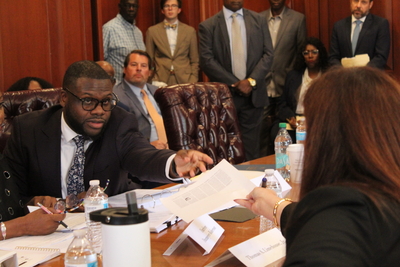
“They’re emails about governance matters, emails about things that I would need to refer to, but it’s nothing that could harm the district,” she said.
Garvin also pointed to a mention in the report that a grand jury indicted former board member Kevin Hollinshead on charges of bribery, wire fraud and bank fraud. The federal indictment accuses Hollinshead, who resigned in March, of sharing confidential information with another, unnamed board member.
But the panel can’t say for certain that person is Dunmeyer-Roberson, Garvin said.
“Before someone can be held responsible for making an improper disclosure, the evidence must first establish that she was the person who made it,” Garvin said. “Here, that foundational connection is missing.”
Conflict of interest
Dunmeyer-Roberson admitted she sent an email introducing her former campaign manager, Aaron White, to a principal in the district. But that’s not why White got a contract with the district to help mentor students, she said.
“An introduction is not a procurement decision,” Garvin said.
White, who addressed the panel virtually, said he didn’t talk to Dunmeyer-Roberson about his business or contract. The two of them spoke about how his cousin, a student at the high school, had been killed in a shooting several days earlier, and Dunmeyer-Roberson offered to introduce White to the school’s principal to talk about ways of helping students, White said.
Dunmeyer-Roberson was not involved in the process of getting the contract for White’s newly established consulting business, she said.
But Lamkin said she had influence over the decision even if she never explicitly told anyone to hire White.
The presence of a board member on an email with a principal might have created pressure for the principal to give White a contract, Lamkin said.
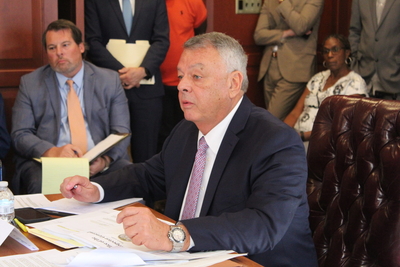
“The effect, the chilling effect, is, ‘If I don’t do this, I’m going to get my boss in trouble,’” he said. “You don’t have to give a directive to do that. It’s just the implied presence of your position as a board trustee.”
Garvin cautioned the panel about making such a determination.
Saying an elected official can’t make any introductions would tie the hands of everyone elected in the state, said Garvin, a legislator since 2018.
“If we’re going to get into the business of penalizing elected officials for doing their jobs, that’s problematic,” he said. “I mean, from the top to the bottom, from the Statehouse to the county council to the school board, you’re going to have a lot of problems.”
The report raised other issues with White’s contract. School officials never did any background checks of his nonprofit, Circle of Life Foundation. And in an email included in the report, a district employee questioned whether Circle of Life offered “anything unique” that existing staff couldn’t do.
Like other issues raised in the report, Garvin said, those are less about Dunmeyer-Roberson and more about a culture at Charleston County School District that needs changing.
The report “does not show that there is a Darlene Dunmeyer-Roberson problem,” Garvin said. “It shows that the problems potentially are greater and that there needs to be a school board issue as a whole.”
Columbia