Facing an ongoing snowplow driver shortage, New Hampshire to increase private contractor pay
Oct 26, 2026 | 5:00 am ET
Description
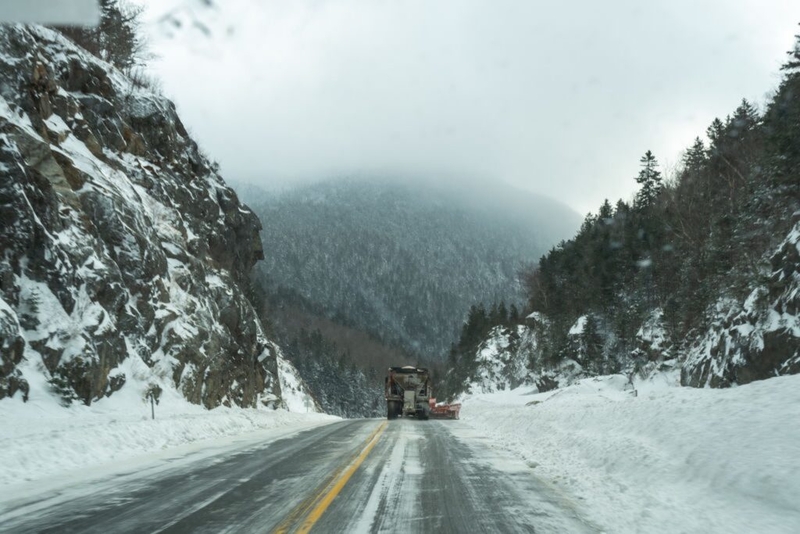
A plow clears a road in Bartlett during a storm on Jan. 17, 2024. (Photo by Spencer Platt/Getty Images)
The leaves have only just begun to fall, but New Hampshire’s Department of Transportation is already raising concerns about snowplowing season.
For years, the agency has struggled to recruit plow drivers and has turned to private contractors to make up the gap.
On Wednesday, the department presented its latest maneuver to the Executive Council: a plan to increase the amount it pays those contractors by 15%. That move would raise the hourly rate for private plow operators with a commercial driving license from $26.45 per hour to $30.42 per hour.
The increase will cost the state an additional $2 million to $3 million for the 2026 to 2027 winter season, the department estimates. That money could come from the New Hampshire Highway Fund, funded by motor vehicle registration fees and gas taxes, or the Turnpike Fund, funded by tolls.
Department of Transportation Commissioner David Rodrigue told councilors the increases are necessary to help combat an intractable workforce shortage. The department is facing an overall 26% vacancy rate, one of the highest in the state, but the vacancy for plow drivers specifically is “significantly higher than that,” Rodrigue said.
“The department has always and — from what I see, for the foreseeable future — will continue to rely on engineering consultants and hired equipment to help us achieve our mission,” Rodrigue said.
The Executive Council approved the plan last week. But councilors in both parties raised objections with the department’s use of private contractors and urged Rodrigue to do more to increase the ranks of Department of Transportation employees.
“I am concerned that we are getting ourselves into a sort of downward spiral,” said Councilor Karen Liot Hill, a Lebanon Democrat.
“We’re not investing adequately into our own personnel, and then we end up having to hire contractors, and we pay them more to do the same job that if we had personnel on staff that they would be able to do.”
Councilor John Stephen, a Manchester Republican, echoed that concern, noting that the private contractor rate is higher than the hourly rate for state plow drivers.
“What does this say to the DOT employees that are out there, that are going to be driving alongside these contracted-out plow drivers and equipment, and they receive a 15% increase, and the DOT employees are not receiving that increase?” Stephen said.
Rodrigue said he heard those concerns. “We represent the citizens of New Hampshire at the end of the day who own our infrastructure, and we need a solid, competent workforce in order to do that,” he said.
New Hampshire’s plow driver recruitment problem is not new. The number of potential employees with commercial driver’s licenses has dwindled, and the state has faced increased competition from towns and cities for the same drivers. Meanwhile, the neighboring state of Massachusetts pays, in some cases, more than twice as much for its private contract snowplowing work, further complicating New Hampshire’s recruitment pitch.
In 2023, those same problems forced the department to make a similar move: It increased private contractor pay by 15%.
The workforce problems have affected the private sector as well as the public sector.
“The Department has had similar difficulty contracting drivers with rental equipment to supplement the Department’s internal staff shortage,” Rodrigue wrote in a document explaining the 15% increase to the council. “Our limited pool of available CDL drivers with plowing experience only serves to heighten the need for recruiting and retaining sufficient contractors and equipment.”
The New Hampshire department is responsible for maintaining more than 4,000 miles of state highways. During a snowstorm, the agency divides those roads into priority tiers: “Type 1-A” roads, such as Interstates 89, 93, 293, and 393, must be plowed every 90 minutes during the day and every four hours at night, while low-volume roads that see fewer than 1,000 cars a day require plowing every 3.5 hours during the day and 7 hours at night.
To accomplish those goals, more than half of New Hampshire’s plow trucks every year are rented and staffed with private contractors, according to the department.
Last winter, the department was hoping to deploy 667 trucks — 300 of which the state owns, and 367 of which would be rented — Rodrigue explained to the council. But the department was able to find drivers for only 323 of those 367 rental trucks.
That shortfall had consequences. “The existing shortage increases the time it takes for us to respond during ice storms and increases the snow on the road during snowstorms due to other state and rental trucks having to cover multiple routes,” Rodrigue wrote.
The differences between New Hampshire and Massachusetts rates are stark. For a one-ton truck, the smallest in the fleet, New Hampshire paid $77.79 per truck per hour last winter. Massachusetts paid $126.34. New Hampshire paid $105.29 per hour for each 3- to 5-ton truck — the medium-sized option — compared to Massachusetts’ $222.83 rate.
Under its plan for the coming winter, New Hampshire would increase the 1-ton hourly rate to $89.46 and the 3- to 5-ton rate to $127.28. Those two states’ numbers include both the rental cost of the truck and the contracted driver’s salary.
Massachusetts has had higher contract rates for plow drivers for years, according to graphs provided by the department, but in recent years, the Bay State has also increased its pay at a faster rate than New Hampshire has, the graphs reveal.
While the department estimated a $2 million to $3 million annual increase, that number is not a guarantee. Having now announced its plan to increase the private contractor rates, the department will return to the council this winter to request transfers from the Highway Fund or Turnpike Fund, depending on how much it needs.
On Wednesday, Liot Hill and Stephen both suggested that Rodrigue make a greater effort to increase pay for state plow drivers and to make it a priority in the next proposed Ten-Year Transportation Improvement Plan.
Rodrigue said he would focus on recruitment “as vigorously as I can,” without issuing specifics.
“You have my 100% commitment, and our DOT teams’ 100% commitment to continue to do our best to tell our story about what we need to do to reduce the vacancy rate at the DOT,” he said.
Concord, NH