Every Cochise County police agency will soon use the same iris scanners ICE deploys
Jun 04, 2026 | 4:37 am ET

Description
(Photo via Getty Images)
Every law enforcement agency in Cochise County will soon be using the same iris-scanning technology as U.S. Immigration and Customs Enforcement.
This week, the Cochise County Sheriff’s Office announced that, with the support of the Western States Sheriff’s Association, it and every municipal police department in the county would be adopting the biometric tech.
“This is about accuracy, safety and accountability,” Cochise County Sheriff Mark Dannells said in a statement. “By ensuring every law enforcement agency in Cochise County is connected to the same secure biometric identification system we are protecting our deputies, our partner agencies and the public by making sure the right person is identified every time.”
The Cochise County Sheriff’s Office did not respond to questions about how the technology will be deployed and if ICE or other federal agencies will also have access to its data.
Earlier this year, the company that makes the software Cochise County law enforcement will be using landed a lucrative sole-source contract with ICE for the exact same technology.
Massachusetts based BI² Technologies’ $10 million ICE contract is for the Inmate Recognition and Identification System, or I.R.I.S., software. The company claims to already have a database of upwards of a million scans of irises, and even has a mobile platform that purports to allow police officers to use their cellphones to scan the irises of people they encounter in order to verify their identities.
ICE has been purchasing the mobile units for their deportation efforts, according to reporting by 404 Media. The contract also states that ICE intends to allow “agents and 287(g) partners to quickly authenticate the identity of subjects during field operations.”
A 287(g) agreement is one in which local sheriffs or police departments can partner with ICE to train officers to identify and flag people who may be eligible for deportation during routine traffic stops or jail bookings, even if charges against them haven’t been proven. Cochise County entered into a 287(g) contract in August 2025.
Shortly after President Donald Trump was elected to a second term in 2024, the company hired lobbyists from a firm with connections to Trump’s second administration. Ballard Partners was opened in part by Susie Wiles, who is now Trump’s chief of staff, and former Attorney General Pam Bondi used to work there, according to reporting by the Project on Government Oversight Investigates.
POGO Investigates also found that BI² Technologies offered border sheriffs free use of the IRIS technology for three years during the first Trump administration, and an investor in the company attempted to get a meeting between the CEO and an advisor to Trump’s first attorney general, Jeff Sessions, according to The Intercept.
While Dannels has touted the technology as a way to ensure “accuracy” and “safety,” historical uses of biometric technology have shown that it is not as foolproof as proponents say.
In 2012, researchers showed that iris scanners could be tricked with synthetic irises. A 2012 National Institute of Standards and Technology report also found that the miss rate for the technology can be between 2.5% to 20%.
While the technology has often been touted as the most secure way to identify an individual, it has been proven to be able to be bypassed or have errors.
Prior to its use by American police agencies, the technology was used by the military in Iraq and Afghanistan. The biometric data in Afghanistan was abandoned during the United States’ withdrawal, leading to not just biometric data but data connecting individuals to family members, work history and more in the hands of the Taliban.
In 2022, a military biometric device was sold on eBay with the information still on it.
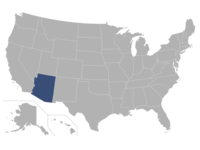
Phoenix, AZ