Even after bidding controversy in Legislature, Intralot wins Montana’s latest lotto contract
Sep 25, 2025 | 7:14 pm ET
Description
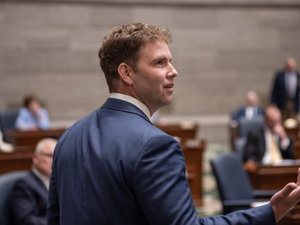
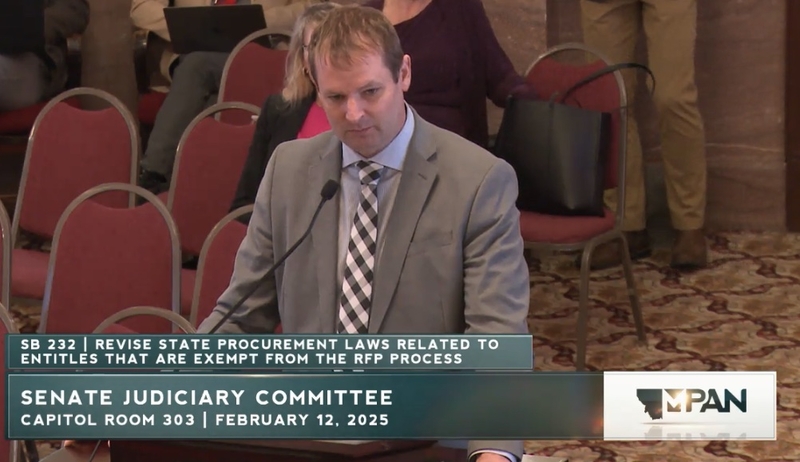
Montana Senate President Matt Regier testifies at the 2025 Legislature, warning members about the dangers of not putting the state's lottery contract out for bid in a public process (Photo courtesy of MPAN).
The only vendor to ever provide legalized sports gambling in Montana recently won the state’s contract after a successful bidding process in which it underbid it’s current contract as it inked a new deal for a seven-year term that could be extended to as long as 10.
Intralot, a Greek-based sports betting and technology company, won the bid, but that process wasn’t always so certain. During the 2025 Legislature, lawmakers, including Montana Senate President Matt Regier, R-Kalispell, raced to close a loophole that would have allowed the state’s lottery commission to circumvent the bidding process, and simply name a vendor.
The Legislature stymied the plans, and forced the commission to go out to bid, and now that the process has been finalized, some of those same lawmakers say they’re feeling good.
Regier said the bidding process this time around looked a lot like the others, and he’s happy with the outcome because he said it provides transparency.
“We just wanted the bidding process to be transparent — and if they (Intralot) win, they win,” Regier said.
The Senate’s leader also praised fellow members of the state’s upper chamber, saying the issue wasn’t partisan — both Democrats and Republicans demanded transparency. He also said that the “free conference committee” which made the last-minute change to the lottery’s bidding process in 2023 was a big reason the Legislature, which met earlier in 2025, didn’t rely as heavily on free conference committees.
A free conference committee is an ad-hoc group of lawmakers who convene to wrap up legislation and put the finish touches on the final few bills of the session. However, at those free conference committees, lawmaker participation is often variable, and the changes happen quickly, often without public notice or much debate. That was the case in 2023 when the small loophole was created for the lottery commission which was getting ready to bid the next contract, and no one could track exactly who made the change and how it came to be because of the chaotic, last-minute nature of the session’s end.
Still, the experience left unanswered questions for Regier and some of his colleagues.
“It does make you question the vendor, their connections and why they don’t want the competition,” he said.
Intralot’s bid came in at 5 cents on the dollar, less than its current rate of 8 cents. It was also 8 cents on the dollar lower than the next closest bid.
In addition to transparency, the deal provides stability, including a seven-year contract, a potential for new revenue and new gaming machines and software proponents say will give Montana sports betting a better user experience.
Montana Lottery Director Bob Brown was contacted several times by the Daily Montanan, but did not return calls about the new deal.
But, the state of the state’s sports lottery isn’t quite as rosy. Intralot, a multinational company, has struggled with a series of fines and missteps throughout the United States. For example, in Washington, D.C., this year, it was at the center of a scandal that cost the company $6.5 million in fines. While some states, like Idaho, have re-upped contracts with the company, Ohio pulled its contract after a series of problems with its betting kiosks. Meanwhile, at about the same time Montana agreed to a new contract with Intralot, it also brokered a deal with Maryland that has recently collapsed.
Also, a new revenue report suggests that Montana’s cut of sports revenue may be falling. And new research by experts says the state’s restrictive approach may be costing it millions in revenue from offshore sports betting companies, which have become much easier to use through virtual private networks and cryptocurrency.
Kahlil Philander is a professor at Washington State University who studies gambling, gaming and sports betting. He said that Montana may not be as robust of a betting market for several reasons, some which have to do with the structure of sports betting, others because of geographic features.
The most robust state-approved sports betting operations usually have technology that is easy to access and is licensed out to multiple vendors for a fee. For example, Philander said, currently the most popular and used sports betting is through betting apps. Vendors may have their own sports betting programs, but often license other vendors to compete, making a robust, easy-to-use environment.
“When an operator is a monopoly, we find that their product is not as robust,” Philander said.
However, Montana law requires sports betting in the state to be made a kiosk. Currently, Intralot reports that there are 1,300 retailers statewide. Philander said having to go to a brick-and-mortar operation can limit the amount of money a state can take in, and having just one sports betting company, instead a multitude, usually means less competition.
Because gambling enthusiasts have figured out how to work around those obstacles, whether through off-shore betting sites, cryptocurrency, or using VPN connections, he said usually the more restrictive a state is about sports betting, the more money those states lose because sports bettors find ways around state-sanctioned gaming.
The other challenge for Montana, Philander said, is that the market isn’t huge, but the state itself is. That means more technology is spread out, adding to a vendor’s cost. Also, Montana’s population of approximately 1.2 million is small compared with other markets, meaning that some companies may not be interested in all the rules and capital investment for so few betting enthusiasts.
Philander said that the top three sports betting apps command 80% of the market share nationally, leaving smaller operators, like Intralot, bidding for the remainder of the market.
Yet because of Montana’s single vendor with a bricks-and-mortar model, Philander said that the state may believe it’s gotten a good deal, as Intralot lowered its bid, but lose out.
“In markets where you have a monopoly, you’re going to get an OK product, and capture (less than) 50% of the betting market,” Philander said. “That’s because off-shore products can be quite good.”
He said that’s because many of those companies don’t pay taxes, have little overhead and because of the multi-national nature of the business can increase “global liquidity.”
He said off-shore betting used to come with myriad problems of currency and getting money routed internationally. Those hurdles have been somewhat overcome by cryptocurrency.
“I suspect when the state had its first contract with Intralot, it had more market power. There may have been many vendors and many companies wanting to serve the state. There was probably more competition,” Philander said.
Helena, MT