Environmental group says EPA has failed to act while Great Bay Estuary nears collapse
Nov 19, 2026 | 5:25 pm ET
Description
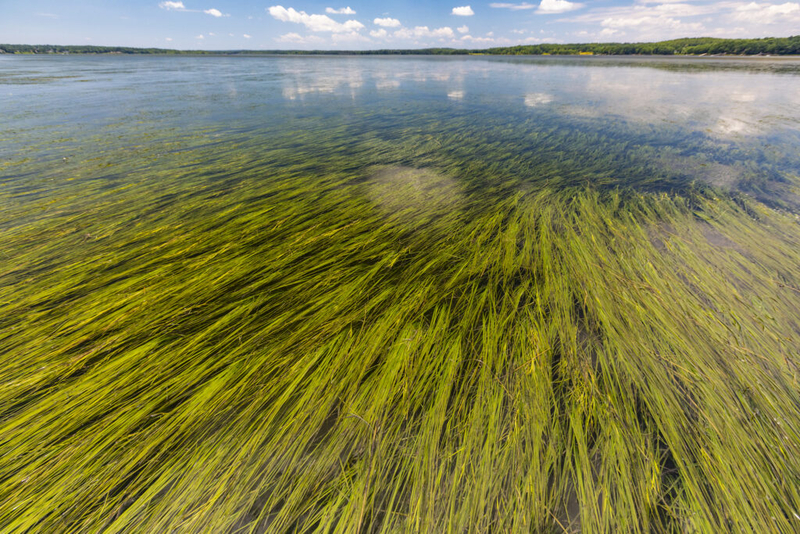
An eelgrass bed in New Hampshire's Great Bay. (Jerry Monkman photo)
The Conservation Law Foundation announced on Thursday it plans to sue the federal Environmental Protection Agency and two top officials over what the CLF describes as the agency’s failure to prevent pollution of New Hampshire’s Great Bay Estuary.
“There is a very large body of evidence documenting the decline in health in the estuary over decades. …The state and federal agencies are well aware of this problem, and it’s way past time for EPA to step up,” CLF Senior Attorney Heidi Trimarco said in an interview Thursday.
The EPA did not respond to a request for comment from the Bulletin on Thursday.
New Hampshire’s Great Bay Estuary is a tidal water body east of Newmarket, about 8 miles inland from the coast at the confluence of several rivers and the Gulf of Maine. Its brackish water and surrounding marshes are essential habitat for many species of wildlife, including commercially important fisheries, such as clams and oysters. The estuary is one of 28 in the U.S. designated as nationally significant by the EPA.
The bay’s ecosystem has been showing signs of decline for years. The plight of the bay’s eelgrass, a species of aquatic plant that is a foundational player in the ecological health of the coast and environments beyond, has been a visible indicator of that decline. A report published earlier this year by researchers from the University of New Hampshire, cited in CLF’s Thursday letter, found that eelgrass coverage in Great Bay had dropped about 80% since 2024, a decline the researchers said was linked to the estuary’s overall health.
One factor that can stress eelgrass plants is the influx of excessive nutrients, such as nitrogen, into a waterway. Nitrogen enters waterways from several main sources, including fertilizers, wastewater and stormwater runoff. The latter is the major source of nitrogen pollution entering the Great Bay Estuary, as well as the focus of CLF’s planned lawsuit.
“There is concern that this pollution will help usher Great Bay toward an ecological tipping point that, once crossed, will make recovery extremely challenging and costly,” the website of the National Estuarine Research Reserve System Science Collaborative states.
Stormwater pollution has worsened with increasing development, which often converts absorptive surfaces, like green spaces, into impervious surfaces, such as roofs and concrete parking lots. Those surfaces prevent rainwater from being filtered through the soil; instead, the water carries pollutants into waterways. Intensifying storms linked to climate change have also heightened stormwater concerns.
Under the Clean Water Act, the EPA is responsible for taking action to prevent the pollution of American waterways, including the Great Bay Estuary, Trimarco said.
CLF has previously argued that the agency was not doing enough to protect the estuary. In 2023, the organization petitioned the EPA to do more to regulate stormwater pollution filtering into Great Bay from commercial, industrial and institutional properties around it. On Thursday, Trimarco said the agency had done nothing in response, despite a requirement in the Clean Water Act that she said required the agency to issue a decision within 90 days of such a petition.
In a letter sent to the EPA, Administrator Lee Zeldin and Regional Administrator Mark Sanborn on Thursday, Trimarco wrote that CLF intended to sue the three parties under the Clean Water Act and Administrative Procedure Act for knowingly allowing excess nitrogen to flow into Great Bay in the form of stormwater pollution.
CLF hopes the outcome of the planned suit would require the agency to adopt a permitting protocol to regulate stormwater discharge in the watershed around Great Bay, Trimarco said. Such permits could be applied retroactively to developments that are already complete in that area, requiring them to take additional measures to prevent excess stormwater pollution from their property. But the request does not apply to residential properties, Trimarco said.
Thursday’s letter started the clock on a 60-day notice period, after which CLF plans to file its lawsuit in the U.S. District Court for the District of New Hampshire, Trimarco said.
Concord, NH