Enrollment-calculation trapdoor will squeeze Iowa’s public schools
Oct 19, 2026 | 5:25 pm ET
Description
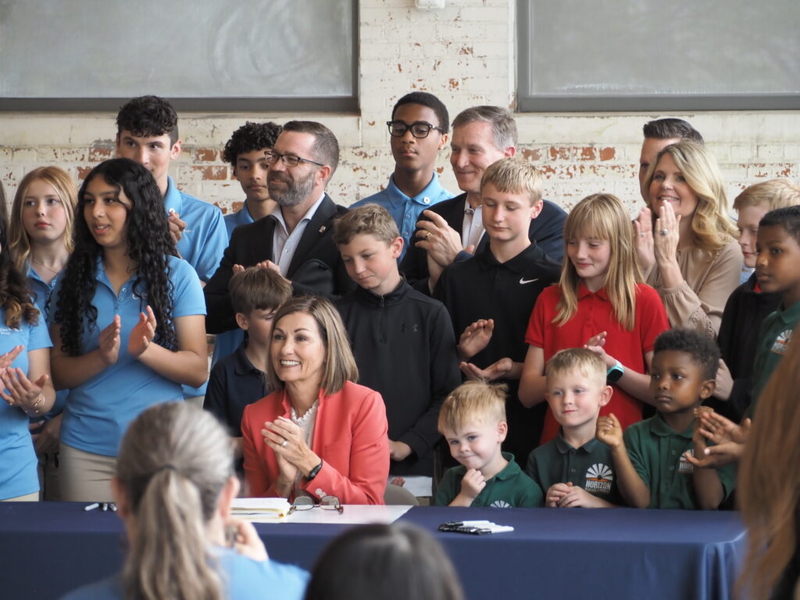
Iowa Gov. Kim Reynolds was joined by Des Moines Prep students, state legislators and other charter school advocates as she signed into law a measure making changes to charter school and homeschooling regulations May 12, 2026. (Photo by Robin Opsahl/Iowa Capital Dispatch)
Iowa Gov. Kim Reynolds signed Senate File 2201, the school funding bill, into law on Feb. 26. The 2% increase in per-pupil funding for the 2026-27 school year works out to $160 more per student. When the decline in public enrollment is taken into account, it’s a statewide increase of $17 million from last year’s allotment.
The law includes a massive change in calculation of enrollment formulas. Instead of a single count of certified enrollment taken Oct. 15, a second count has been added to take place on Jan. 15/the third Monday in January called “adjusted enrollment.” (Because of Martin Luther King Jr. Day, the de facto date can be as late as Jan. 18.) The average of these two numbers will become the “basic enrollment” number used for determining the following school year’s funding.
That means the tally used for calculating state supplemental aid will be an approximation in mid-November and not exact until early February. This will end up in conflict with the law requiring state aid to be set within 30 days of the governor’s budget proposal — a deadline that has repeatedly been blown. But that’s OK, since the Legislature can exempt itself from following the law.
“The requirement of section 257.8, subsection 1, regarding the enactment of bills establishing the regular program state percent of growth within thirty days of the submission in the year preceding the base year of the governor’s budget does not apply to this division of this Act.”
This change also runs closer to the deadlines schools are under to submit property tax rates (March 5) and finalize budgets (April 30). A bill that passed the House but stalled in the Senate would have limited schools to using the previous year’s allowable growth rate if state aid is not set by March 5 and enabled updates after the fact.
During debate on SF 2201, Sen. Lynn Evans, R-Aurelia, said the second enrollment count would help in situations where a student moves into a district after Oct. 15. Under the current formulas, that student’s enrollment wouldn’t get counted toward funding until two school years later.
That may sound reasonable, but the overwhelming majority of Iowa districts are losing enrollment, and this only applies to changes in the student body over a three-month period.
The trapdoor with this second count was sprung in a different bill, House File 2754, which mainly concerns charter schools. Rep. Skyler Wheeler, R-Hull, said in opening remarks on the House floor April 16: “This is our One Big Beautiful School Choice Bill, or the one-double-B-S-C-B as we like to call it. This bill is big, and it is beautiful.”
HF 2754 includes a section allowing applications for a student to leave a public school at semester break and take half the value of that year’s state cost per pupil with them as education savings account money. An e-mail from IDOE’s Heather Doe said data updated with the second count “will include certified enrollment counts for public districts and the second ESA student enrollment period.” The exact dollar amount in ESAs overall will depend on it.
On April 27, the same evening that the Senate sent HF 2754 to the governor, the Cedar Rapids Community School District voted to close six schools and reconfigure its entire grade lineup starting in 2027. (Reynolds signed the bill May 12, during National Charter Schools Week, while surrounded by charter school students and advocates.) Another division of HF 2754 puts teacher salary supplement funding in the bundle of money that goes with each student from a public school to a charter school. Based on information from the Legislative Services Agency, that would have cost the Cedar Rapids district an additional $270,000 this past year.
“The continual attacks, generally speaking, against the ESA program I find to be fascinating,” Wheeler said on April 16. “I find it to be fascinating entirely because it has been effective. Parents have been empowered. And so we’re going to get upset, generally speaking, because parents were given the ability to go a different route. There hasn’t been a mass exodus.”
Public school enrollment in Iowa for 2025-26 had the most substantial yearly decreases, in both number and percent, in four decades, while private school enrollment increased 26% in three years to a level not seen in a quarter-century. If that’s not a “mass exodus,” what is?
Who’s not complaining?
Last winter, the Senate wanted a 1.75% increase in state aid, the House wanted 2.25%, and the compromise was 2%. The difference in the one-half percent was $18.9 million statewide, or only $2.1 million more than was spent on ESAs for students in the Davenport school district alone in the 2025-26 school year.
“You know who’s not complaining about a 1.75% increase?” Sen. Jesse Green, R-Harcourt, asked Feb. 10 during floor debate on the original version of SF 2201. “Those private schools. They’re working with a heck of a lot less, and they are happy.”
In 2022, the year before ESAs, Dowling Catholic High School’s tuition was $9,132 for parish families and $12,776 for non-parish families. In 2025, it was $11,076 plus $364 in fees for parish families and $15,498 plus fees for nonparish families. Dowling is also engaged in a $76 million capital campaign that did not require 60% supermajority approval from any public electorate.
Holy Family Catholic Schools in Dubuque raised its tuition from $2,200 in 2022 to $11,500 in 2025.
Siouxland Christian’s tuition went up 18% from 2024 to 2025.
Hull Christian School, which last year received more than $1.25 million in ESA money from students living in the Boyden-Hull school district, broke ground March 27 on a $4.7 million expansion.
Iowa does not require private schools to publish budgets or curriculum information. Iowa does not require them to have public meetings before major construction.
Private schools wouldn’t even have been bound by a bill of Wheeler’s that was approved by the House Education Committee on Feb. 11, but died later in the session, mandating that all students at public schools conform to a statewide dress code.
Des Moines, IA