Elliott gets public grant; Lamont gets $3.5M from a guy named Ned
Jul 13, 2026 | 2:49 pm ET

Description
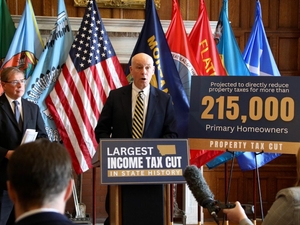
Photo courtesy of CT Mirror
By the metric of money, there is no doubt Gov. Ned Lamont is taking the challenge this summer from state Rep. Josh Elliott more seriously than the one eight years ago from the mayor of Connecticut’s largest city, Joe Ganim.
As of July 1, total spending by the largely self-funded governor’s campaign for the Democratic nomination surpassed $3 million — about three times what he spent at the same point competing for the open seat against Ganim in 2018.
The quarterly finance report filed July 10 shows a Lamont campaign ramping up as it became evident Elliott would qualify for a primary and a public financing grant, which was more than doubled to $3.75 million this year.
The public financing will allow Elliott to air his first television ads Tuesday, four weeks before the Aug. 11 primary and less than three weeks before early voting begins Aug. 3, his campaign said Monday.
Eight years ago, Ganim was hobbled by the corruption conviction that ended his first stint as mayor of Bridgeport. It did not keep him from a comeback as mayor in 2015 but left him ineligible for public financing. His campaign spending was limited to about $600,000.
Eventually spending more than $2.6 million, Lamont won the Democratic primary over Ganim with 81% of the vote. Including the general election in which he narrowly defeated Republican Bob Stefanowski, Lamont spent $15.9 million on the 2018 campaign, then $25.7 million on the rematch he easily won in 2022.
This year, the governor has raised $367,743 from donors not named Ned Lamont, roughly the same as Elliott. One difference, of course, is that the independently wealthy governor kicked in another $3.5 million and is poised to give more, as he has done in all five runs for statewide office: U.S. Senate in 2006 and governor in 2010, 2018, 2022 and 2026.
The 41-year-old Elliott is trying to become the first challenger to deny an incumbent governor their party’s nomination in a primary. He is running to the left of the 72-year-old Lamont in a year when generational and ideological challenges have succeeded in other states.
Elliott, a five-term lawmaker from Hamden, is making Lamont’s wealth and the struggles of the middle class elements of his campaign. He was unknown to 41% of likely primary voters in one poll released a month ago, but his campaign manager, Melissa Murray, said his message makes voters “drawn to know more.”
“The affordability crisis happened under Ned’s watch, so he should be taking Josh seriously,” Murray said.

Lamont spent not quite $600,000 in the four-plus months immediately after declaring his candidacy in mid-November, when Elliott showed little sign of gaining traction. In the three-month period ending June 30, the Lamont campaign spent another $2.4 million.
The biggest single expense was $875,825 paid June 17 to his campaign consultant, SKD Knickerbocker, to purchase time on television, getting Lamont’s commercials on the air well ahead of Elliott’s.
Last week, the State Elections Enforcement Commission approved Elliott’s application for public financing under the voluntary Citizens’ Election Program, and Murray said Monday the money allows the start of the television ad campaign on Tuesday.
To qualify for public financing, Elliott had to demonstrate support by not only earning a place on the Aug. 11 primary ballot but by raising at least $335,500 in small dollar donations ranging from $5 to $340.
Lamont’s spending reflects Elliott’s resources, given the more robust nature of the Citizens’ Election Program in 2026.
With the governor’s consent, the General Assembly overhauled the public financing program after two election cycles in which the nominees of both parties, Lamont and Stefanowski, opted against participation. Both largely self-funded their campaigns.
At issue was the sufficiency of the public grant for a gubernatorial race, which was $7.7 million for a general-election campaign and $1.6 million for a primary. Participants had to agree to strict spending limits.
The general-election grant for a major-party gubernatorial candidate is now $18 million.
State Sen. Ryan Fazio of Greenwich, the Republican nominee for governor, also is relying on public financing.
Aside from polling that shows the governor with consistently strong approval ratings and a lead in matchups with Elliott, the governor’s campaign points to the contributions that are coming in, on par with Elliott’s, as evidence of an incumbent with broad support — even if he is not in need of the outside funds.
“There are a lot of people who support the governor, who want to be involved and show their support,” said Lauren Gray, a Lamont campaign spokeswoman. “It makes them feel they are really a part of this strong campaign.”
The contributions range from $5 to $3,500, the maximum allowed by state law for a candidate not participating in the Citizens’ Election Program. About 1,900 of the contributions were for less than $105.
They included 297 donations of $5; 140 of $5.36; 394 of $10; 206 of $10.53; 290 of $25; 120 of $26.01; 197 of $50; and 136 of $100; and 93 of $103.45.
Forty-nine people gave the maximum of $3,500, producing $171,500 of the $367,743 that came from donors other than the governor.
Hartford, CT