Educators launch ‘I love WV public schools’ campaign while more school closures loom
Jul 10, 2026 | 6:00 am ET
Description
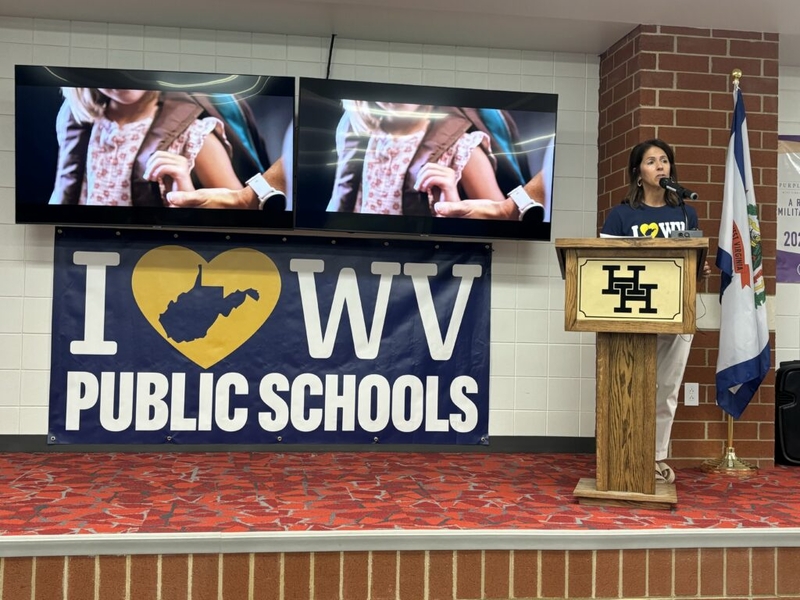
Kanawha County School Superintendent Paula Potter speaks at the launch of the “I love WV public schools” campaign on July 7, 2026, at Herbert Hoover High School in Elkview, West Virginia. (Photo by Amelia Ferrell Knisely/West Virginia Watch)
Educators kicked off a statewide “I love WV public schools” campaign in hopes of increasing community and lawmaker support amid funding struggles.
Campaign supporters said they want to highlight the impact public schools have while serving the majority of West Virginia students. The goal is to ensure students continue to have access to public education in their communities.
“We don’t close our doors to a child because they have special needs, because they are experiencing poverty, or because they are dealing with trauma,” said Will Hosaflook, president of the West Virginia Association of School Administrators and Jackson County Schools superintendent. “We welcome, because the truth is public schools in West Virginia are never just a building where kids learn reading and math. Our public schools are the foundational rock of our communities.”
Members of the West Virginia Association of School Administrators, which includes county superintendents, announced the official launch of the “I Love WV Public Schools” campaign during an event July 7 at Herbert Hoover High School in Kanawha County.
“Those six words are more than a slogan, they’re a celebration of our students, they are a thank you to our educators. They are a recognition of our service personnel,” said Ohio County Schools Superintendent Kim Miller. “They are an invitation for every West Virginian to tell the story of why public education matters.”
“I invite every West Virginian to join us,” she added. “If you’re a parent, tell us about a teacher who changed your child’s life.”
State-level public school funding in West Virginia is tied to student headcount, and West Virginia’s declining student population has impacted schools’ funding levels. Multiple school districts are millions of dollars in debt due to providing mandated special education services; some districts haven’t made job cuts to keep budgets within funding formula parameters.
Student enrollment has also been impacted by the state’s school choice expansion. More than 26,000 students have applied for the Hope Scholarship, the state’s education voucher program, for the upcoming school year after the program opened up to all students for the first time since lawmakers created it in 2019.
West Virginia Board of Education President Paul Hardesty and other state school officials recently sounded alarm bells about public school funding after the state lost an additional 5,000 public school students since October.
“We have been silent, but that time has passed. If we don’t stand up for our public schools, students, employees, and communities, we will continue to see our communities lose their foundation and backbone — our public schools,” Hosaflook said. “We see consistent state exposure and celebration for alternative programs like the Hope Scholarship from some elected officials, regardless of our public schools ranking top 10 in the nation last year in growth for English language arts and math, but there’s a glaring silence when it comes to celebrating the bedrock of our communities, our public schools.”
Lawmakers earlier this year floated ideas to update the decades-old funding formula, including bolstering funding for special education students, but none of those measures made it to the governor’s desk for consideration.
Democratic lawmakers in the House of Delegates last week called on Gov. Patrick Morrisey to call the Legislature into a special session to overhaul the school funding formula before more schools have to close
Kanawha County School Superintendent Paula Potter said that it is important for lawmakers to hear the success stories of public schools that are often absent during debate at the state Capitol.
“We are educating 90% of our students, and it’s super important that our voice starts to be heard. We’re a good choice,” Potter said. “Much more goes on in educating a child than a test score.”
“Our doors open early, before they have to open, so there’s a place safe for students to come before … their parents have to go to work,” she continued. “We provide meals, breakfast, lunch, and many schools send food home at the end of the day.”
Since 2011, 139 public schools have closed in West Virginia, and 62% of counties have closed at least one school.
Charleston, WV