Editor’s Notebook: Lincoln-Douglas, they’re not. The sorry scene of today’s political debates.
Oct 22, 2026 | 5:30 am ET
Description
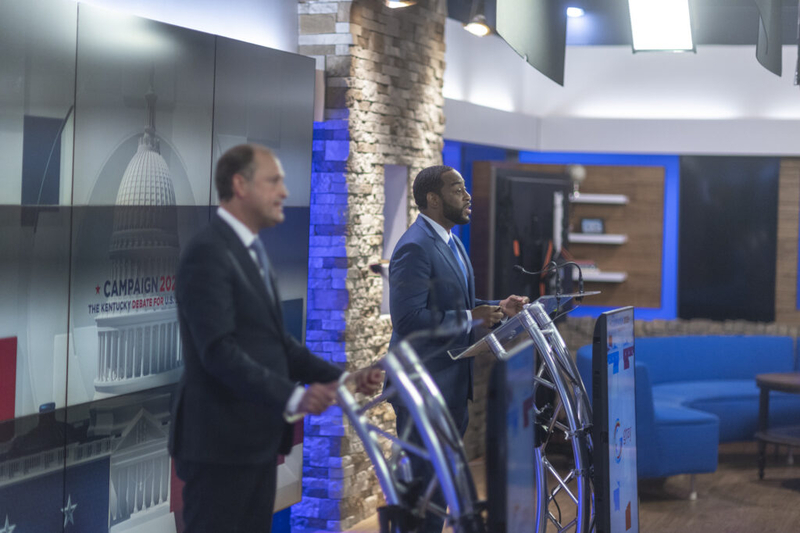
Charles Booker, right, speaks during a debate with U.S. Rep. Andy Barr at the WKYT studios in Lexington, Ky., on Monday, Oct. 19, 2026. (Courtesy pool photographer Ryan Hermens)
Debates sure aren’t what they used to be.
Do you remember gathering around the TV (how quaint!) to watch two candidates try to politely (how delightfully old-fashioned!) out-argue each other on substantive points of public policy?
It’s not that debates aren’t consequential. Ask former President Joe Biden what a big deal they can be.
But here in Kentucky, it feels like we have more debates where one person holds forth than actual debates where two candidates argue about issues.
Just this cycle, KET will host three solo debates: Ed Gallrein, GOP nominee for the 4th Congressional District, and two next week with Democrats Drew Williams, running for the 1st District, and Ned Pillersdorf in the 5th District.
The only real debates so far have been Rep. Andy Barr and Charles Booker battling for Sen. Mitch McConnell’s seat, and the very anticipated matchup between the 6th District candidates Ralph Alvarado and Zach Dembo on Thursday.
Now, the Gallrein conversation happened because of a peculiar set of circumstances. KET, the statewide public television station, has a set of criteria for who gets to be on stage.
Those criteria require each candidate to have raised at least $100,000 by the July filing deadline for the general election. Melissa Strange, the Democratic candidate in the 4th District, had not reached that threshold.
KET spokesman Todd Piccirilli said the same criteria apply for primary and general elections, calling it a “what would be a reasonable minimal threshold of campaign support and viewer interest.” (Piccirilli denied the rules were inspired by Geoff Young, a perennial candidate so unpopular with Democrats that Gov. Andy Beshear disavowed him as a congressional candidate.)
Two points on this: Yes, it’s reasonable to use this as winnowing out of a crowded primary field. And yes, it’s reasonable to expect a viable Congressional candidate of one party in our two-party system to have raised $100,000 by the general election.
In addition, this race has a Libertarian candidate and an independent write-in candidate.
But I wonder why KET wouldn’t just cancel the debate, since the word implies two people debating ideas. In addition, it sends a bad message about our campaign finance system, and the power of the wealthy on both sides of the aisle to control our political systems.
As Melissa Strange noted in a social media post, Gallrein declined to debate Massie during the Republican primary: “Now he accepts when there will be no one there to challenge him on his unpopular policies, and unconditional support of the president,” she wrote.
It’s not democracy, Strange said.
Nor is it a debate.
Larger problems
But debates have bigger problems than KET.
The fact is they’re a lot of work and one slight misstep can send viral videos shooting out across the hemisphere.
Tres Watson is a former Republican operative who is now co-host of the Kentucky Politics podcast. He’ll be providing commentary on the 6th District debate on Thursday evening on Fox 56.
He says campaign experts have realized that in today’s hyperpartisan atmosphere, most voters are unpersuadable, and won’t change their minds based on one debate.
“The partisanship has gotten to a point where they are more likely not to show up to vote than to join your side,” Watson said. “What works best for low propensity votes is fear. It’s cheaper and easier to scare low propensity voters than to persuade undecided voters to vote for you.”
As depressing as that is, it’s also impossible to fact check debates at the speed at which candidates embroider and sometimes erase the truth. They’re too busy coming up with well-rehearsed zingers than providing thoughtful answers to thorny problems.
“If I thought the debates would be substantive, Lincoln-Douglas style debates, then yes, I’d be more enthusiastic, but they’re not,” Watson said. “They say the talking points, they talk over each other, they ignore the questions. There’s this idealized thought we have of debates, but 90% of them, that’s not what they are.”
This is all predictably depressing, another terrible light on our political system. Still, I think debates are one worthy information point in a huge data field. It’s a shame more politicians don’t think so, too.
Frankfort