To avoid becoming roadkill, Florida panthers need critter crossings
Oct 22, 2026 | 12:05 am ET
Description
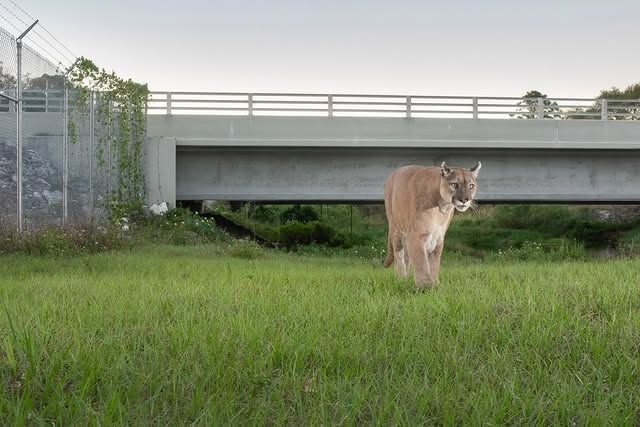
An endangered Florida panther emerges from a wildlife underpass built beneath a busy South Florida highway. (Photo by Carlton Ward Jr., used by permission)
One of my favorite cartoons, drawn by a Pensacola artist named Jem Sullivan, shows a flock of sad-looking chickens gathered around a casket. The chicken minister delivering the eulogy says, “And though we’ll never know why Dave wanted to cross the road, we can rest assured that he is now, at last, on the Other Side.”
I think about this cartoon every time I see another story about a Florida panther that’s been run down by a car or truck. We lost two of the endangered cats last week, one in Hendry County and one in Collier, both of them apparently mowed down by vehicles.
That makes 14 flattened so far this year.
The panthers are far from alone. I took a long drive this weekend and encountered a wide variety of Florida roadkill — raccoons, possums, even a deer lying just off the shoulder.
Why are Florida panthers and other wildlife constantly trying to cross the road? Maybe because there’s no other way to get to the other side.
I’ve just finished reading a terrific book about roadkill by Ben Goldfarb. It’s called “Crossings: How Road Ecology Is Shaping the Future of Our Planet.” (No, RFK Jr., it is NOT a cookbook!)
The book talks about how we humans view roads as a path to freedom — as Bruce Springsteen sang in “Thunder Road,” two lanes that can take us anywhere. But for animals, roads are a prison wall, penning them in, separating them from mates, blocking them from their migration routes.
Any attempt to escape carries the strong likelihood of injury or death.
“Sometime during the twentieth century … roadkill surpassed hunting as the leading cause of vertebrate mortality on land,” Goldfarb wrote. “And it’s only getting worse as traffic swells.”
Yet it turns out — in between scurrying around to paint out every rainbow crosswalk and promoting flying cars instead of installing EV chargers — the Florida Department of Transportation has accomplished something worthwhile.
It has built a string of wildlife underpasses statewide, enabling us motorists to avoid crashing our cars into so many animals.
How, I wondered, is that effort going?

I started calling people involved with Florida’s wildlife underpasses. One of the people I contacted was my friend and fellow author, Cathy Salustri, who actually walked through one of the panther underpasses that cross beneath Alligator Alley.
She remembered parking near the highway and walking down an embankment to a space that had been opened up under the busy road. The passage contained a small creek and lots of vegetation — and a subtle message for us humans.
“It was definitely a moment where I realized, once again, how close humans and wildlife exist in this state,” she told me. “I don’t remember it as visually remarkable, but the import of what it means for the future of Florida’s wildlife was massive.”
Spotting the Skunk Ape
Wildlife underpasses began in the 1970s in England. At first, they focused on aiding amphibians in winning a real-life version of the arcade game “Frogger.” They were known as Toad Tunnels.
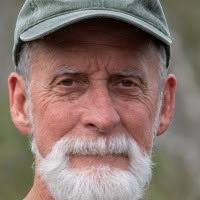
Scientists quickly saw how these tunnels could be adapted for larger animals. One such far-seeing advocate was Reed Noss, a University of Central Florida professor.
When the Florida DOT proposed expanding two-lane Alligator Alley into multi-lane I-75, “I suggested the entire Alligator Alley be elevated so the panthers could cross underneath,” Noss recalled this week. “Unfortunately, elevating the whole thing turned out to be cost prohibitive.”
The expense weighed heavily on the minds of DOT planners, who initially resisted the push to help panthers. At that point in the early 1990s, the big cats’ population had dwindled to fewer than 50 and they were suffering from genetic defects caused by inbreeding.
When the DOT at last agreed to try some passages, some critics openly questioned whether the panthers would use them. State biologists put up motion-sensor cameras that caught plenty of panthers crossing under Alligator Alley, according to the South Florida Sun-Sentinel.
“The radio trackings located the panther using the underpasses even before they were completed,” Audubon’s Charles Lee told the Sun-Sentinel.
The panthers weren’t alone, either.
The cameras snapped pictures of bobcats, white-tailed deer, bears, turkeys, raccoons, wading birds, and even alligators. Also appearing on camera: a guy in a gorilla suit, apparently cosplaying as the stinky Skunk Ape.

The DOT was convinced. “Twenty-four wildlife crossings and 12 other bridges modified for panther use were completed in the early 1990s within a 40-mile stretch of I-75,” the Florida Fish and Wildlife Conservation Commission reported on its website.
The DOT boasted on X last year that it has now built more than 200 wildlife crossings statewide, with more than 50 specifically built for use by panthers. A dozen more are in the planning stages.
“Florida is now recognized as a pioneer in wildlife crossings across the country,” Elizabeth Fleming of Defenders of Wildlife’s Florida office told me. “And their Alligator Alley crossing is one of the largest in the country.”
Turtle tunnels
While I was reading “Crossings,” I ran across a familiar name: Matt Aresco.
Aresco is director of the Nokuse Plantation, a 55,000-acre Panhandle preserve. It was launched by a dirt-road philanthropist named M.C. Davis, whose skills at poker playing and pool hustling made his fortune.
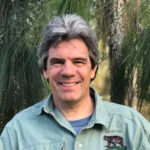
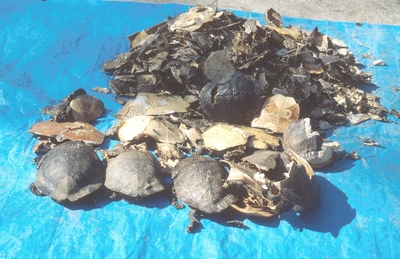
In 2000, while Aresco was just a grad student in Tallahassee, his girlfriend told him she’d seen a turtle massacre on U.S. 27. He hurried to the scene and found 90 dead turtles. It was easy to figure out why.
The highway bisected a wetland, leaving Lake Jackson on one side and Little Lake Jackson on the other. A drought was drying up the big lake, but the little lake still held water. The turtles in the big lake were trying to get to it. They didn’t make it far.
Softshells and snappers, cooters, and box turtles — they all attempted the exodus and they all failed. Sometimes, Goldfarb wrote, “car-struck turtles shot through the air like hockey pucks.”
Aresco, conscience-stricken, spent eight hours a day intercepting them, dropping them in a Rubbermaid bucket and toting them across between traffic.
Over the next four years, he saved more than 8,000 turtles. But he couldn’t save them all, nor the occasional alligator that wandered across the road.
He begged the DOT for help but got only a tepid response. A maintenance worker brought him some fencing so he could direct the turtles to a small culvert under the road. Aresco soon found he was spending as much time fixing the tattered fence as he used to spend saving turtles.
He proposed building something called an ecopassage, modeled on a box-culvert-and-wall contraption that the DOT had built in Paynes Prairie. But there was no money for what he had in mind.
At last, in 2009, the Obama administration produced an economic stimulus package that sent billions to the auto industry and banks. Aresco’s little turtle ecopassage project got $3.4 million.
Some critics (looking at you, Sean Hannity!) mocked the expenditure of millions on mere turtles. But once the DOT built it, Goldfarb wrote, “The torrent of roadkill on Highway 27 shut off, neat as a turned spigot.”
I called Aresco and he verified the story. The ecopassage was completed in 2010, he said, giving turtles a safe way to get from one lake to the other.
“It’s working great,” he said. “There have been no road-killed turtles and alligators on that section of US 27 since the ecopassage was built 16 years ago.”
But he added, “There are lots of other places throughout Florida that have the same problem.”
Both sides of the road
Noss told me that Florida wildlife underpasses have grown more sophisticated over the years.
There are ledges for smaller animals to cross above the larger ones, and ramps to make the crossing accessible to animals with shorter legs, he said.
The wildlife crossings are on more than just roads, too. Now there are pilings that let terrestrial animals find a dry-footed path across Florida’s many canals.
If you’d like to see where the crossings are, the Florida DOT even has an interactive map showing the locations.
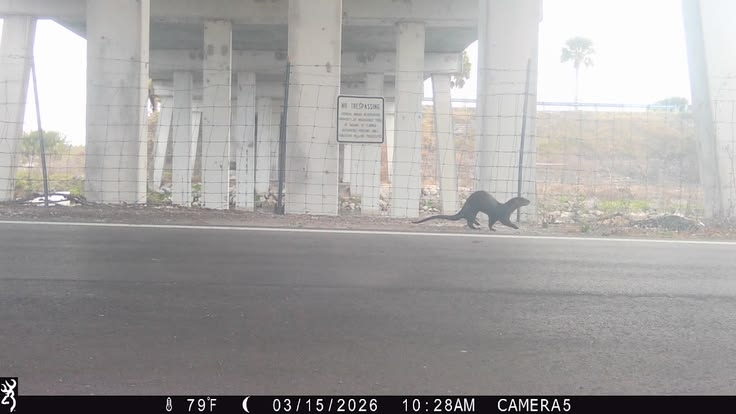
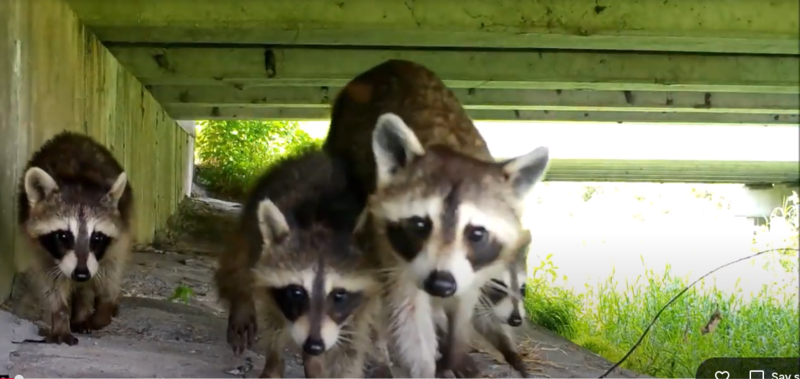
Some points on the map link to photos and video of the animals using them. You can see an otter scampering along under I-75, a bear lumbering beneath State Road 20, a whole family of raccoons crowding the camera under U.S. 27 near Frostproof.
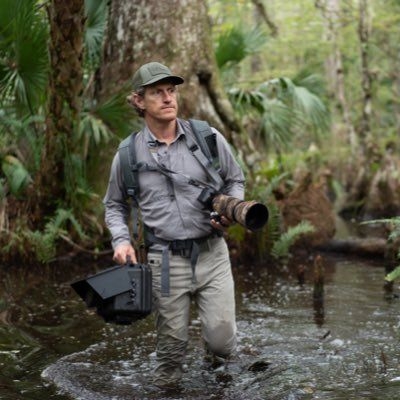
Speaking of cameras, one person I made sure to contact was Carlton Ward Jr., an eighth-generation Floridian and acclaimed wildlife photographer. He’s the person who accompanied Salustri on her visit. He’s seen the inside of more underpasses than anyone else who’s not a DOT employee.
Ward used lots of motion-activated cameras to snap pictures of passing panthers (try saying that three times real fast). His images wound up as both a handsome coffee table book and a National Geographic film, “The Path of the Panther.”
As befits one of the founders of the Florida Wildlife Corridor, Ward praised the Florida DOT’s dedication to installing underpasses at places that could be potential choke points.
When I asked if there shouldn’t be a lot more of them, he made a point that I hadn’t thought of.
“You can’t protect them on just one side of the road,” Ward said. “You have to be able to protect them on both sides.”
There’s no sense in building an underpass in a spot that leads wild animals into a new subdivision, he said. The state has to control both sides, either through outright purchase or a conservation easement. But lots of land is being gobbled up by new development before the state can save it.
“It’s a real race right now,” he said.
Soaring through the sky
Over the past 30 years, Florida panthers have seen a dramatic revival.
Their recovery resulted from an unprecedented experiment that involved bringing in female Texas cougars to breed with male panthers. They produced healthy kittens, sparking a population boom. There were 20 in 1995, and now there are about 200.
Meanwhile, though, development continues wiping out panther habitat. Two new projects in Southwest Florida, new cities called Kingston and Bellmar, are projected to generate so much traffic that they will kill 25 panthers a year.
So much for that revival! Turn out the lights — church is over.
When I interviewed him in 2018, one of the developers of these projects insisted that holding them responsible for the deaths of so many panthers was wrong.
“I don’t control your driving, or your texting and driving, that might have caused you to run over a panther,” he contended, neatly sidestepping the fact that those drivers wouldn’t be there if not for the development.
If the agencies that regulate where and when development occurs won’t say no to these projects, then the only alternative is for the state to buy the land for preservation.
But Noss pointed out that our fine Florida Legislature this year cut all the funding for our popular Florida Forever land-buying program.
It’s a decision that stinks worse than any Skunk Ape. Instead of the $100 million they promised to spend every year, they gave it a big, fat zero.
“It’s one of the stupidest things I’ve ever seen in Florida politics,” Noss told me. Fleming said she hopes that, post-election, the Legislature will rediscover what’s important to the voters.
Meanwhile, the Florida DOT is now building the biggest wildlife crossing in Florida history on Interstate 4.
Unlike the others, it’s not an underpass. It’s an $18 million OVERPASS — 44 feet wide with 8-foot walls, soaring above the traffic. The goal: Link the Tenoroc Wildlife Management Area to the Green Swamp.
“This is the last thread in Polk County to be able to cross wildlife from south to north,” a DOT engineer said last year. “This is really our last chance.”
I sure hope that by the time that overpass opens next year, we still have panthers left to cross over to the other side.
Tallahassee, FL