Eastern Oregon state Rep. Greg Smith will pay $12k to settle latest ethics violations
Aug 07, 2026 | 5:32 pm ET
Description
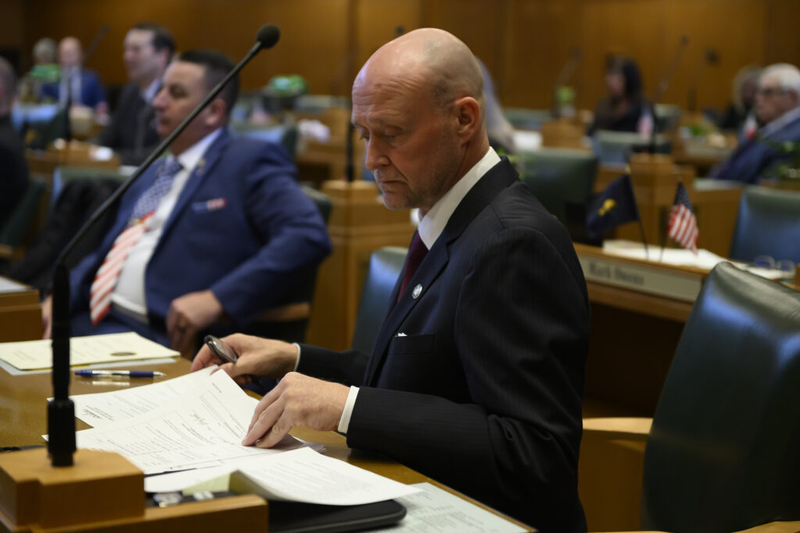
Rep. Greg Smith, R-Heppner, looks at papers on his desk in the state House in January 2025. (Photo by Laura Tesler/Oregon Capital Chronicle)
This is a developing story and may be updated
Oregon’s longest-serving state representative will pay the Oregon Government Ethics Commission $12,000 in fines for breaking state ethics laws and leveraging his position as director of an eastern Oregon public development authority for power and pay.
It’s the second time this year the commission has penalized state Rep. Greg Smith, R-Heppner, and the result of two of four investigations into Smith initiated in just the last year and a half. Smith did not respond Friday to a call, text or email seeking comment.
The $12,000 civil penalty is the result of violations the commission identified last year, finding Smith had improperly used a federal grant application to give himself a $66,000 raise on his annual $129,000 salary as director of the Columbia Development Authority of Boardman.
The development authority is a publicly funded, intergovernmental organization meant to redevelop the site of a former military chemical depot, and it includes the Port of Umatilla, Umatilla County, Port of Morrow, Morrow County and the Confederated Tribes of the Umatilla Indian Reservation. It receives federal grant funding from the Office of Local Defense and Community Cooperation.
“But for his position as the Executive Director of the CDA, Greg Smith would not have been able to pursue and obtain a pay increase through the (Office of Local Defense and Community Cooperation) grant application, would not have had the ability to direct the Fiscal Agent to implement the salaries from the OLDCC grant application, would not have been able to direct that the pay increases be applied retroactively, would not have been able to keep the retroactive pay despite the CDA requiring it be returned, and would not have been able to keep the proceeds of the increased salary,” reads the commission’s report released Friday.
The commission found that Smith improperly kept the excess pay after the authority’s board discovered he maneuvered a pay increase and ordered he return the roughly $33,000 additional he netted for himself before the board reversed that raise. He still has not returned the money, but the commission report said he “continues to stand ready to repay the wages upon further direction” of the Port of Morrow, which serves as the authority’s fiscal agent.
Unauthorized vacation time
The report also details ways Smith violated state laws by signing his own time cards and approving his own paid time off while at the development authority — including more than 54 days of vacation taken between December 2024 and August 2025, for which he received $26,248. In total, the vacation time he approved cost the authority more than $51,000 over the course of three years.
“Because there were no written CDA contracts, policies or procedures dictating the accumulation of vacation time, each time Greg Smith used vacation time, it resulted in a prohibited use of office because, but for Greg Smith holding the position of CDA Executive Director, Greg Smith would not have otherwise been able to take the paid vacation time represented on his timecards,” the report reads.
The commission will discuss and decide whether to accept the final order against Smith at its monthly meeting on Friday, Aug. 14. Smith signed the order on July 16, the report shows, agreeing to pay the $12,000 fine and waive his right to a contested hearing without admitting any intentional violations of state law.
Earlier this year, the commission also found Smith violated state ethics laws when he did not fully disclose clients of his private consulting company on the economic interest statements he must file annually as a public official. The commission dinged him for the same violation in early 2025. Smith has long added onto his legislative salary with high-paying consulting contracts and side gigs supporting economic development efforts in eastern Oregon.
Smith is a member of House Republican leadership and serves on the powerful budget-writing Joint Ways and Means Committee. Neither House Republican Leader Lucetta Elmer of McMinnville nor Speaker Julie Fahey, a Eugene Democrat who controls committee assignments, responded to inquiries Friday about the ethics commission’s draft order or Smith’s continued service in the Legislature.
The Oregon Department of Justice in an investigation into Morrow County officials conspiring to enrich themselves in a deal with Amazon as data center growth exploded in the area also allege that Smith helped the officials develop a strategy for concealing their work. Smith denies the claim, and a civil lawsuit the Justice Department filed against Smith and other officials is pending in Morrow County Circuit Court.
Spokespersons for Attorney General Dan Rayfield did not respond to questions from the Capital Chronicle about any legal action against Smith over the ethics commission’s latest findings. Morrow County District Attorney Justin Nelson also did not immediately respond to the Capital Chronicle’s questions about any potential lawsuit.
The fine Smith agreed to pay is among the largest in commission history but less than the maximum $5,000 per violation the commission could have pursued. The commission in 2018 agreed to settle an ethics case against former Gov. John Kitzhaber for $20,000 and former first lady Cylvia Hayes for $50,000, and more recently ordered former Secretary of State Shemia Fagan to pay $3,600 over her decision to accept a side gig consulting for a marijuana company involved in an audit her office conducted. Most investigations the commission begins result in dismissed cases or letters of education warning officials not to break state law again.
Salem, OR