The dragon comes to the mountains
Jul 08, 2026 | 5:55 am ET
Description
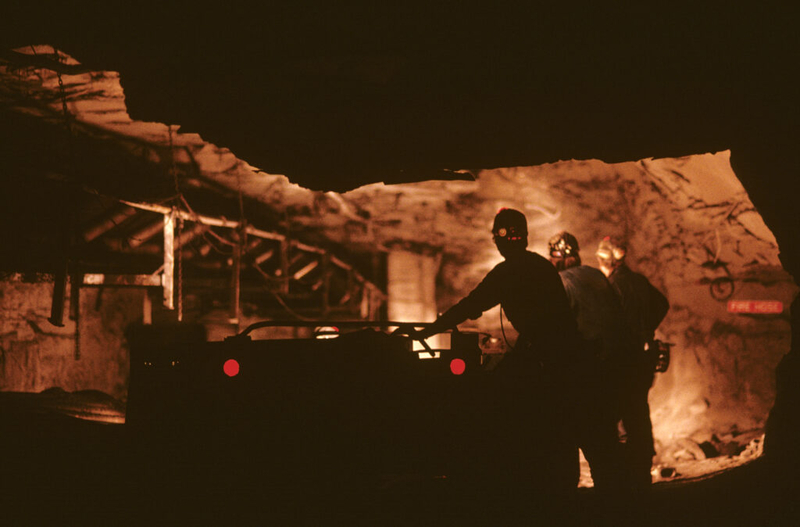
The Congressional Research Service reports that nearly all American met coal comes from Appalachia — West Virginia alone accounting for almost half of U.S. output — and that China is the world's largest consumer of it. (Photo by Karen Kasmauski/Getty Images)
I grew up on a Blue Ridge farm in Carroll County, Virginia, close enough to Galax to know what a furniture town sounds like and smells like — the cut oak and poplar, the lacquer, the lumber trucks grinding up the grades. For most of the 20th century, the mountains ran on factories that turned the region’s timber, its fiber, its coal and steel, and above all its labor into a paycheck. Then, in a single decade, a great many of those factories disappeared. How that happened is, in no small part, the story of one decision made in Washington: to bring China into the world trading system on permanent terms.
In May 2000 the U.S. House voted to grant China Permanent Normal Trade Relations — PNTR — ending the annual review of China’s trade status. President Bill Clinton signed the bill that October, and in December 2001 China joined the WTO. The case was bipartisan and confident: Clinton said the economic consequences were “100-0 in our favor,” and the administration promised farmers $2 billion a year in new exports — a windfall that flowed to Midwest soybean country, not to the hillside farms of Appalachia.
What too few in Washington registered was how exposed Appalachia was to the other side of the bargain. A 2005 Appalachian Regional Commission study by the economists Andrew Bernard, J. Bradford Jensen, and Peter Schott was blunt: Appalachian manufacturing was concentrated precisely in the industries most vulnerable to low-wage import competition — textiles, apparel, furniture, rubber and plastics, electronics, and wood products — and its plants were less productive than comparable plants elsewhere, leaving them more exposed still.
The industries that went first
The clearest case is furniture. The Federal Reserve Bank of Richmond traced what happened: between 1999 and 2009, North Carolina lost more than half its furniture-manufacturing jobs, chiefly to imports from China, whose wood-furniture exports to the United States grew seventeen-fold in a decade. And the offshoring was not imposed from Beijing: the region’s own furniture executives went hunting for cheaper Chinese production and turned their suppliers into their replacements.
The closures came as a roll call: DuPont’s giant nylon plant and the Tultex sweatshirt empire in Martinsville, Stanley and Bassett and Hooker, Vaughan and Webb in Galax, and Pulaski Furniture — where my father once worked — closing its last domestic plants in the mid-2000s. Behind every announcement were people for whom the plant had been the whole architecture of a life. My mother worked the hosiery plants in Hillsville until the industry closed them down. Between them, my parents had worked the two industries that anchored these counties — the very ones that went first and went hardest.
Weirton, the glass factories, and the coalfields
Appalachia is not only the southern mountains. West Virginia’s northern panhandle and Ohio Valley told the heavy-industry version of the same story. Weirton was a steel town in the fullest sense: the Weirton Steel works employed more than 13,000 people at its height and stood for years as the state’s largest private employer. In 1984 its own workers bought the company, making it for a time the largest employee-owned firm in the country. But a 1998 flood of cheap imported steel pushed the industry to the wall, and Weirton slid into bankruptcy in 2003 and passed through a succession of distant owners. In 2024 the last of its tin mill went dark — and with it more than a century of steelmaking in the town — after a federal trade case against imported tin plate, with China among the named targets, fell short.
The Ohio Valley’s glass factories ran the same course. Fostoria at Moundsville, Viking at New Martinsville, Fenton at Williamstown — names that had set American tables for a century — closed one after another as cheaper imported glassware took the shelves. Fenton, which had blown glass at Williamstown since 1907, made its last in 2011.
The coalfields’ ledger is more complicated. In one direction, China was not a villain but a customer. As domestic demand for steam coal fell, Appalachian operators leaned harder on metallurgical coal, the high-grade coal used to make steel. The Congressional Research Service reports that nearly all American met coal comes from Appalachia — West Virginia alone accounting for almost half of U.S. output — and that China is the world’s largest consumer of it.
For a stretch, Chinese demand propped up Appalachian prices. But a customer that large is also a hazard: when China’s appetite faltered, prices could fall by half, and in 2025 the renewed tariff war pushed the duty on U.S. met coal entering China to better than 50%. The final results are visible all across the southern coalfields of this state. The Pocahontas seam mines there, producing the highest grade met coal on earth, closed one by one, leaving economic devastation where prosperity once reigned.
The subtler damage was indirect: coal counties were stitched into the same regional economy as the furniture and textile towns. The China shock did not create the coalfields’ troubles, but it helped pull apart the wider industrial fabric that had once surrounded King Coal.
Labor without leverage
There is one more reason the southern mountains proved so defenseless, and it is the one least often named: the workers there had almost no organized power to begin with. The furniture and textile plants had come South as runaway shops — Northern manufacturers fleeing unionized mills for cheap, non-union labor. When organized labor tried to follow them down, in the CIO’s “Operation Dixie” and the long textile drives, it mostly failed. So when an even cheaper and even less organized labor force opened up in China, the southern furniture or textile worker had no contract to invoke, no strike that could hold.
West Virginia was the opposite kind of place. It had been the bloodiest battleground of the early-twentieth-century coal wars — Paint Creek and Cabin Creek, the Matewan killings, the miners’ armed march on Blair Mountain in 1921 — and out of that long violence came the United Mine Workers and one of the most heavily unionized workforces in the country.
At its postwar peak, West Virginia enjoyed higher wages, lower inequality and higher union membership than most of the nation, as the West Virginia Center on Budget and Policy has documented. That floor gave way. The state’s private-sector union rate fell from about 22% in 1985 to roughly 5.5% by 2025 — the steepest decline of any state, by the Center for Economic and Policy Research’s reckoning.
In 2016, the same year the state handed Donald Trump his landslide, West Virginia’s Republican legislature made it a right-to-work state and repealed the prevailing-wage law that had set pay on public construction for 80 years, overriding the veto of a Democratic governor. Whatever leverage Appalachian workers might have brought to the fight over offshoring — in the South they had never had it; in the North they had lost it — was gone by the time it was needed most.
Wages, work and despair
Job counts understate the harm. The economists David Autor, David Dorn, and Gordon Hanson found that in the local labor markets most exposed to Chinese imports, unemployment rose, labor-force participation fell, and wages dropped — durably. Justin Pierce and Peter Schott showed that PNTR itself, by ending the annual uncertainty over China’s trade status, made it newly safe for firms to move production there. American manufacturing employment fell off a cliff after 2000, with no comparable drop in Europe, where trade policy did not change.
The timing Appalachians felt in their bones was no trick of memory. Pierce and Schott went further, finding that the counties more exposed to PNTR saw relative increases in drug-overdose deaths — what Princeton University economists Anne Case and Angus Deaton named “deaths of despair.” It is no longer possible to treat the loss of the region’s factories and the rise of its funerals as unrelated events.
A factory job in a mountain town was never just a wage. It was a tax base that kept the school open, a sponsorship that kept the ball field mowed, a tithe that kept the church door open. When the plant closed, all of that went out the gate with the last shift.
And the treatment was thin. Trade Adjustment Assistance was in principle the very bargain that made free trade politically possible. In practice, the Office of Management and Budget rated the program “ineffective” in 2003, and as the Brookings Institution summarized the research, most trade-displaced workers ended up leaning on Social Security and disability rather than retraining. A nation that found hundreds of billions to rescue its banks in 2008 met the slow-motion collapse of its factory towns with a retraining voucher and a wish of good luck.
In fairness, the bargain bought something: cheap imports held down inflation and stretched every family’s paycheck. But the gains were spread thin across 300 million consumers, while the losses were piled high on particular places — this county, this mill, this family. The country as a whole was richer; wide stretches of Appalachia were poorer. It was the second truth, not the first, that decided how the mountains would vote.
Who got the blame
Let me be fair. PNTR was not a Democratic project; it was a bipartisan consensus of the governing class, pushed hardest by the corporate executives who stood to profit. Nor was China the sole culprit: automation, NAFTA, and weak labor law played their parts. But politics does not run on shares. It runs on faces, and on memory. Bill Clinton had signed NAFTA, driven PNTR, and called the China bargain “100-0 in our favor.” When the factories closed anyway, it was his face — and his party’s — that many mountain people remembered.
To grasp how far the ground has moved, remember what these mountains used to be. West Virginia sent men like Ken Hechler, who stood before thousands of miners in Charleston in 1969 to demand that black lung be recognized and paid for, and Robert C. Byrd, who became the longest-serving senator in the nation’s history in no small part by delivering, year after year, for coal and the men who dug it. These were Democrats, and the coalfields were theirs by inheritance.
That world is gone. West Virginia gave Bill Clinton 51.5% of its vote in 1996 — the last time a Democrat would carry the state. By 2024, Donald Trump took just under 70% — the highest share any presidential candidate had ever won in West Virginia — carrying every county for the fourth straight election. By 2025 both of the state’s U.S. senators, its governor, and supermajorities in both legislative chambers were Republican. Joe Manchin, the last Democrat to hold statewide office, was gone. Trade did not, by itself, turn Appalachia red — coal, guns, religion and cultural condescension did their work besides. But the old bond between working-class Appalachia and the Democratic Party, forged in the New Deal and the union halls, was among the things the China shock helped to break.
When Donald Trump began to thunder against China and the bipartisan trade consensus, people in these mountains heard something they had waited two decades to hear: that the closing of their factories had not been inevitable, had not been noble, and had not been their fault. Whether his remedies would prove real or hollow is a fair and separate question. The grievance he spoke to was entirely real.
What was traded away
There are green shoots — Hickory, North Carolina, remaking itself around fiber-optic cable; a vast new greenhouse shipping tomatoes from my own Carroll County. But the recoveries have clustered in the larger towns, and most of the revival came from local stubbornness rather than national policy. The mountains, as ever, mostly saved what they managed to save themselves.
The deepest failure was not the trade deal itself, about which reasonable people disagreed and disagree still. It was the assumption, baked into the whole bipartisan project, that the people whose livelihoods were being bargained away would simply adjust — retrain, relocate, reattach themselves to some new economy that, where it arrived at all, arrived late and unevenly. We have spent a quarter-century learning that lesson the hard way in these mountains. The least we owe the next round of working people is to stop pretending the lesson was ever free.
Charleston, WV