Does Glenfarne actually need a pipeline?
Sep 14, 2026 | 8:00 pm ET
Description
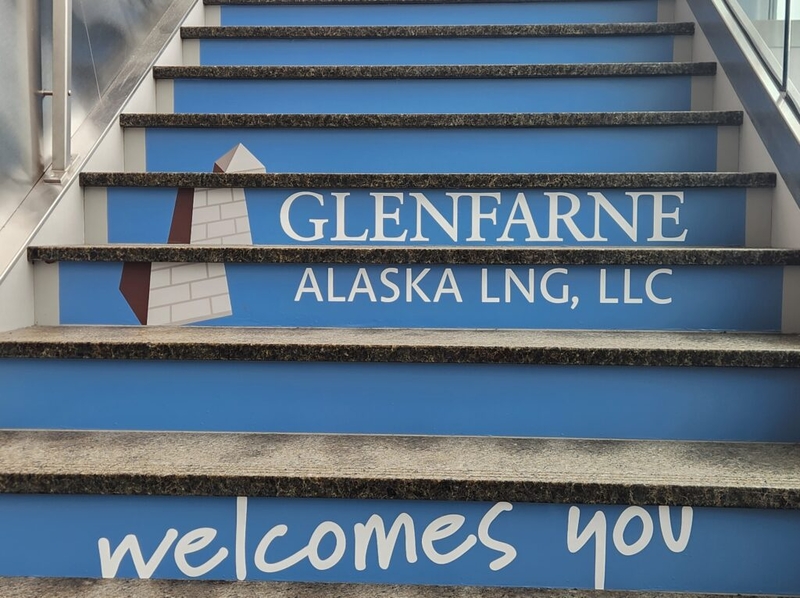
Glenfarne's name is displayed on May. 19, 2026, on the stairs at the Dena'ina Civic and Convention Center, the venue for the three-day Alaska Sustainable Energy Conference. Glenfarne is a major sponsor of the conference. (Photo by Yereth Rosen/Alaska Beacon)
Everyone debating the Alaska LNG project assumes the developer wants what it says it wants: to build an 800-mile natural gas pipeline.
But look at Glenfarne’s deeds instead of its words, and a different possibility emerges. Glenfarne may actually be waiting to see if things work out with the pipeline because it now has an essentially guaranteed moneymaker in the form of a project to import LNG into Cook Inlet for local needs.
Consider the company’s position. Glenfarne paid $10 million and promised to fund the pipeline project’s development in return for 75 percent of the entity that holds the permits, the right-of-way, and a quarter-billion dollars worth of state-funded development work on the only federally-permitted LNG export project on the U.S. Pacific Coast.
In the energy industry, $10 million is sofa-cushion money. It’s not the price of an asset, it’s the price of an option on an asset. And a leaked draft of the state’s own review suggests there’s a highly favorable exit clause for Glenfarne: if Alaska ever wants to get that 75 percent back — to build the project itself or hand it over to a more credible developer — Glenfarne would name the asking price.
Then there’s what Glenfarne has done with its own money — not buying pipe for the gasline, which it promised to order and didn’t, but building an LNG import terminal in Cook Inlet with Enstar, the Southcentral gas utility, locked up as an exclusive customer. Cook Inlet gas is running low and Southcentral will need imported gas soon, pipeline or no pipeline. Imports are the one sure thing in this entire picture. And Glenfarne’s in the catbird seat.
And here’s the rub. The first phase of the pipeline, which Glenfarne now estimates to cost $13 billion to $17 billion, is meant to serve that same Southcentral market before any gas is exported. So Glenfarne is building a relatively cheap, near-term way to supply the Cook Inlet market while asking Alaska to subsidize a $13-billion-plus way to supply the same customers. Once you own a cheap solution to a hungry local market, why rush to build an expensive one and compete with yourself?
The booster answer has been that imports are merely a bridge until the pipeline is ready. But that gets the incentive backwards. A bridge you own, earning money the moment it opens, serving captive customers with no ready alternative, is not a reason to hurry toward a $50-billion megaproject. It’s a reason to relax and see what unfolds.
Now add the politics. To get the Legislature to yes on tax incentives, Glenfarne and the governor promised nearly anything, up to and including a $250 million Fairbanks spur to build political support in the Interior. Yet when the Legislature assembled a bill this year that gave Glenfarne what it said it needed — a big property tax break and an income-tax exemption — the deal collapsed. By several legislators’ accounts, Hilcorp, which controls the North Slope gas the pipeline would carry, leaned on Glenfarne to kill it over the income tax provision in the bill. The governor called that “bullshit.” Either way, the pipeline project is stalled while the LNG import project proceeds.
Put the pieces together and a coherent strategy appears. Build the import terminal, the sure thing, and start making money while Hilcorp and the Legislature duel over income taxes.
Meantime, hold onto your bargain-basement 75 percent stake in the pipeline project like the option it is. If the economics of that project ever come together, either build it yourself or sell out to someone big enough to wrangle Hilcorp and the Legislature into settling their differences. If the pipeline never goes, you’re not exposed, and you make money on LNG imports as far out as the eye can see.
We don’t know Glenfarne’s true intentions, of course. But the incentives all point the same way: the developer’s least risky and most profitable path is not to build the pipeline. It’s to build the LNG import facility, cash the checks, and wait.
That should change how Alaska reads every “almost there” and every new demand for additional concessions: the state may well be negotiating with a company who’s playing a waiting game rather than trying to build a pipeline any time soon. Trying to rush a deal with a counterparty who doesn’t need one is like pushing string.
Glenfarne has arranged its affairs so it can afford to wait. By deferring the pipeline question to next year, a new legislature, and a new governor, the Legislature has responded with precisely the right message: Alaska can wait, too.

Juneau