Despite child care industry struggles, Kentucky facility keeps free seat open for a child in need
Jul 07, 2025 | 5:50 am ET
Description
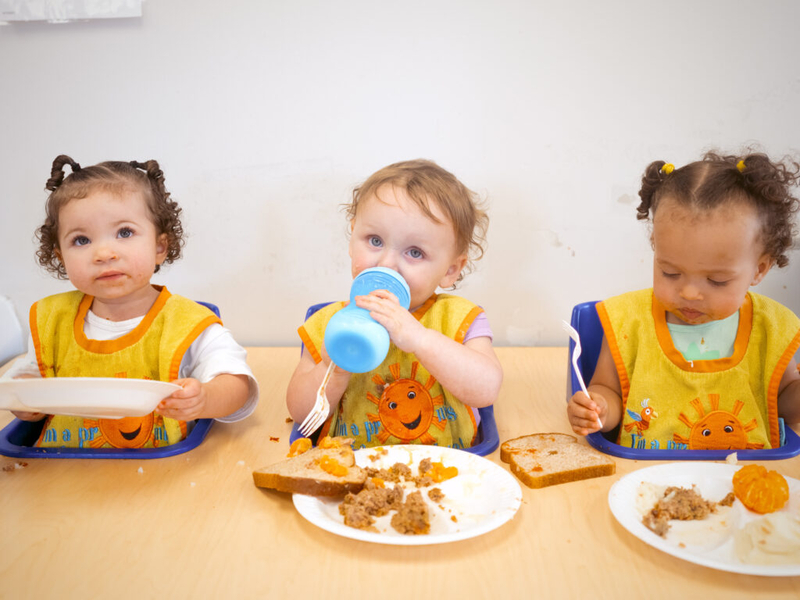
At the Family Enrichment Center in Bowling Green, from left, Tayzlee, Briella and Sanaya eat lunch in the 1-year-olds’ room, June 16, 2025. (Kentucky Lantern photo by Austin Anthony)
BOWLING GREEN — When the Family Enrichment Center was established in 1977 with the goal of addressing child abuse, staff immediately set aside an open — free — seat for a child in need.
Despite tumultuous challenges facing the child care industry, that seat stays open thanks to grant funding. Staff say it’s a key tool in fighting child abuse in Warren County, where around 20% of children live in poverty and food-insecure homes, according to the 2024 KIDS COUNT County Data Book.
Thanks to the program, if Bowling Green parents can’t care for their child — because of a job interview, doctor’s appointment, court appearance or the need for a self-care day — and have nowhere safe to leave their child, they can bring that kid to the Family Enrichment Center’s crisis drop-off for free, explained Nickie Jones, the executive director.
“The very first program we did was the crisis drop-off center,” Jones said. “The group of people here in our area wanted to do something to address child abuse, and they were smart enough to realize that a crisis unit or crisis drop-off or drop-in service was a need to support families.”
The program is open to children between the ages of 6 months and 5 years old — “because they are most at risk from dying from child abuse,” Jones explained.
Usually, children who come to the center through the crisis drop-off are a year old, said Jennie Watt, the director of the Wee Care child care branch of the center.
“Most abuse — it happens at home,” and the center’s staff is deeply aware of that reality, said Watt. Sometimes, parents and guardians just need a mental health break, she said.
The crisis drop-off children spend their day in a play-based classroom with other toddlers and get a breakfast snack and a free lunch, which includes a protein, vegetable, fruit, grain and dairy.
“We just try to be a safe place,” Jones said. “We’re just unique. Nobody else around here does this.”
‘Vital to our community’
In 2024 Kentucky’s child care industry — which some would like to rebrand as “early childhood education” — lost COVID-19 relief dollars that helped stabilize the industry during the last few years. This left many centers to cut pay for their workers, raise tuition for parents, cut services and even close, the Lantern has reported.
As fewer child care centers operate and prices for quality care increase in a state with high rates of child abuse, experts said having quality, affordable — which sometimes means free — child care has never been more important.
Jennifer Bailey, the director of development and marketing at St. Teresa Ministries in Bowling Green, which supports the Family Enrichment Center with a $20,000 grant, said the crisis drop-off program is “vital to our community.”
“Oftentimes, parents have to choose who to leave their children with to go to a job interview or go to work or go to a class,” Bailey said. “And sometimes it’s not always the best decision, and sometimes it can be that they are left alone at a young age.”
Kosair for Kids, a Louisville-based organization that advocates for children’s wellbeing, also helps fund the program with a $50,000 grant.
“What we don’t want is — we don’t want that 4-year-old to be left at home with their 8-year-old older sibling,” said Barry Dunn, the president and CEO of Kosair for Kids. “That’s child neglect, and it’s not that there are bad people out there in those kinds of instances who necessarily want to do that, they just don’t have anywhere else to turn.”
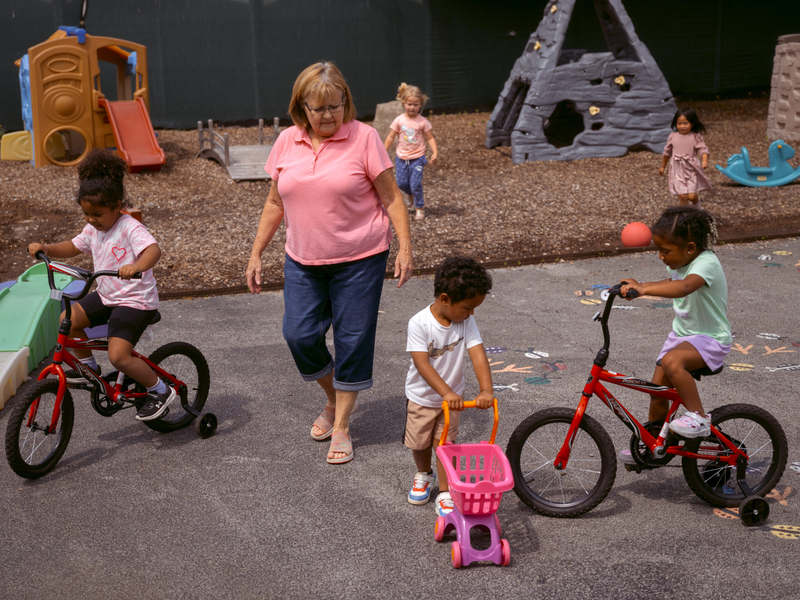
In addition to the crisis drop-off program, the Family Enrichment Center provides parenting classes and supervised visitations. The center also partners with senior volunteers through The Foster Grandparents Program, in which people 55 and older work with children in classrooms on counting and other intellectual skills.
One such volunteer, Faye McKeage, works with pre-K children and is assigned to help two students with reading and counting.
“I want them to grow up to be responsible adults and if I could put a little love in their heart for them to love others, that’s what gives me joy,” she said. “They’re precious.”

‘Human capital’
Jones and the staff at Wee Care always aim to transition their crisis drop-off kids — who are limited to 30 crisis drop-off days per year and 10 hours per week — into full-time care at the center.
They also know that expense is often a barrier for families.
On average, child care in Kentucky costs $8,756 a year, or $730 per month, according to an analysis from the Economic Policy Institute.
“I definitely think that the state needs to fund and help support child care, not only for low-income but middle-income families as well,” said Bailey with St. Theresa’s. “Maybe the state could help in and start off setting some of the cost of the overhead. And you need to pay your workers a good wage. There’s always room for improvement that the state can do to help with child care.”
Kentucky’s Child Care Assistance Program (CCAP) also offers assistance to eligible families. In 2023, about 35,000 children attended a child care program thanks to CCAP, according to the Kentucky Center for Economic Policy. That accounted for about 21% of the state’s child care spots.
Kentucky also needs “preschool for everyone,” Bailey said. In June, Gov. Andy Beshear signed an executive order that established an advisory committee to explore support for universal pre-kindergarten programs in Kentucky.
“Preschool for everyone, definitely at age 4, would be a win-win” Bailey said. “Really, you’re getting those kids in there and getting them ready and prepared for school, where some daycares don’t do that.”
Child advocates said that while the two-year budget approved by the General Assembly in 2024 included valuable investments in child care, it was not enough to stabilize the industry. In 2026, lawmakers will pass a new budget.
“Lawmakers sometimes may not see that those early years are the most instrumental for kids,” Jones said.
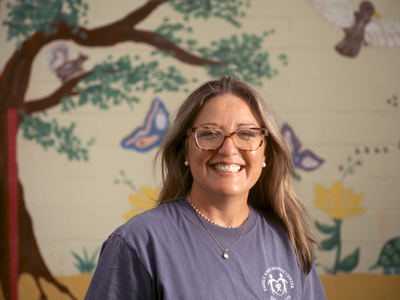
Because of that, she said, “the babies have to be seen as human capital.”
“This is an economic issue,” she said. “Who’s going to be the one that gives the life saving surgery? Who’s going to do that? These kids. They have to have the very best start in life — quality care, quality programming.”
Watt said there are lots of ways to improve and support the industry, starting with public perception.
“This isn’t just coming in and playing with kids all day,” she said. “You’re coming in here and you’re teaching them, and you’re teaching them how to engage, and the language that you use is important.”
Jones agreed, saying the state’s focus on economic development must also include child care.
“Can we tout that we have really good early childhood programming in our area to draw people here? They think about jobs. Who’s going to work those jobs if they don’t have child care?” she said.
There’s a “growing need for child care,” Jones said, and centers will have to adjust to meet those needs.
But she’s determined to keep one seat in every classroom open for a child in need. So far, she hasn’t had to turn away paying clients in favor of the program.
“Not only do we want to help keep the room open, but we’ve also tried to raise quality,” Jones said of the drop-off program. “It’s still something I see very important.”


Frankfort