DeSantis administration misses legislative deadline, gets more money for immigration anyway
Sep 11, 2026 | 5:50 pm ET
Description
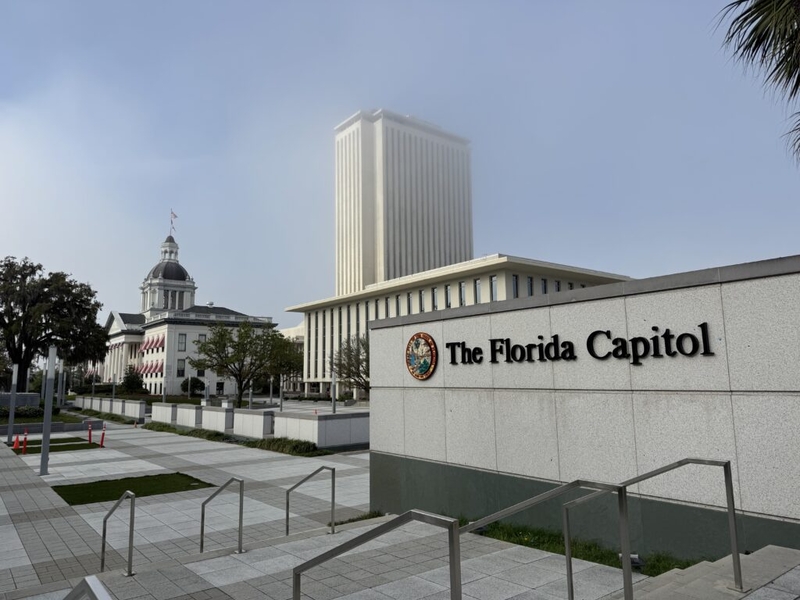
The Florida Capitol building on March 11, 2026. (Photo by Jay Waagmeester/Florida Phoenix)
As Ron DeSantis’ turn as governor nears its end, a legislative spending committee voted along partisan lines Friday to approve budget amendments allowing the two-term governor to pay for his crackdown on immigration.
The Joint Legislative Budget Commission approved a $240 million general revenue transfer to the Emergency Preparedness and Response Fund and agreed to allow the Division of Emergency Management (DEM), which operates the fund, to spend up to $250 million to pay pending invoices related to immigration enforcement and hurricanes Hurricanes Idalia, Helene, and Milton, and the 2026 wildfires.
The approval came about an hour after the DeSantis administration submitted an overdue report to commission members who were poised to start the meeting. The report, which details in part how money was spent, had been due to the Legislature July 15.
Florida still owes $603 million on immigration enforcement contracts
DEM Director Jared Perdue, who attended the meeting at the Florida Capitol, brushed by reporters refusing to answer any questions. Perdue (the Department of Transportation secretary who DeSantis recently appointed head of the DEM), is a public employee. State records show he earns $298,000 in his capacity as transportation secretary.
The mandatory report was a primary reason the Legislature agreed to sign off on re-establishing the fund, first created in 2002 to give DeSantis flexibility in addressing state disasters.
In the eyes of DeSantis, Florida has been in a state of emergency due to undocumented immigration for more than three years, extending his initial January 2023 declaration more than 20 times.
The report shows:
- As of June, the state owed 592 outstanding invoices related to immigration enforcement, such as the Everglades immigration detention facility dubbed by the DeSantis administration “Alligator Alcatraz.”
- Florida has received just $84 million of $608 million in promised federal funds.
- The state owes 82 invoices related to Hurricane Milton and 27 related to Hurricane Helene.
The report includes millions of dollars for “logistical services,” “site healthcare management,” and “facility support services.”
The analysis also found that for state fiscal year 2026-27 (which runs from July 1 through June 30, 2027) a deficit of $1.5 billion in the emergency fund would result unless the Legislature agreed to add money.
That finding of the potential $1.5 billion deficit assumes the fund would pay:
- $2 billion to cover the costs of two major hurricanes during the fiscal year, which includes about 80% of the 2026 Atlantic Hurricane Season (which has been quiet to date) and one month of the 2027 season.
- $100 million for severe weather events aside from hurricanes, which the report says is a conservative estimate.
- $500 million for continued immigration enforcement.
Two months late
Outgoing Senate budget Chair Ed Hooper, a Republican from Clearwater, played down the potential bad fiscal news, telling reporters after the meeting that the state has “significant reserves should there be a natural disaster.”
“I don’t know the answer specifically about the dollar amount [in the state trust fund], and I’m not sure Secretary Perdue has been there long enough to actually have looked into that and come up with a finite number. But he’s committed to me that he is going to be transparent as the Legislature requested and I’ll hold him to that, as least for the next 50 days,” said Hooper said, who leaves office soon.
Democrats questioned the transparency in releasing a report late and approving spending so far after-the-fact.
Senate Democratic Leader Lori Berman suggested the commission lacked time to absorb the report’s findings. She half jokingly suggested that the panel should be as timely in approving the funds as the DeSantis administration had been in submitting the legislatively required report.
“There’s just so many different problems with the fact that we’re just getting this report two months late. Should we wait two months to vote on this appropriation? That would not be something that would be feasible, and it’s the same thing with us getting the report two months late,” Berman said.
Rep. Allison Tant, a Democrat who represents rural counties in North Florida, expressed frustration that her storm-ravaged constituents weren’t being helped when the governor focused his efforts on immigration enforcement.
“In all of these hurricanes and tornadoes, I stood shoulder-to-shoulder with people who were struggling,” Tant said, detailing stories of personally providing aid to constituents in the aftermath of storms.
The commission also approved a third budget amendment that gave the Department of Military Affairs $7.56 million in spending authority to make payroll until the end of the year.
Florida Center for Fiscal and Economic Policy Director Karen Woodall said the push to have the state submit the report was to increase transparency about how DeSantis has spent emergency money.
“I think it was our hope that by having the Legislative Budget Commission involved, we would have legislative oversight — not of what the expenditures already made are, and signing the check, but of being engaged in discussion about what they were planning to do with money, so that there could be some transparency and some real legislative oversight about the use of tax dollars,” Woodall said.
She added that in the future she wants “actual dialogue and transparency over what these expenditures are going to be.”
Tallahassee, FL