Demuth plans to cut $1 billion from Minnesota’s budget, refrains from denouncing tariffs
Aug 25, 2026 | 4:55 pm ET
Description
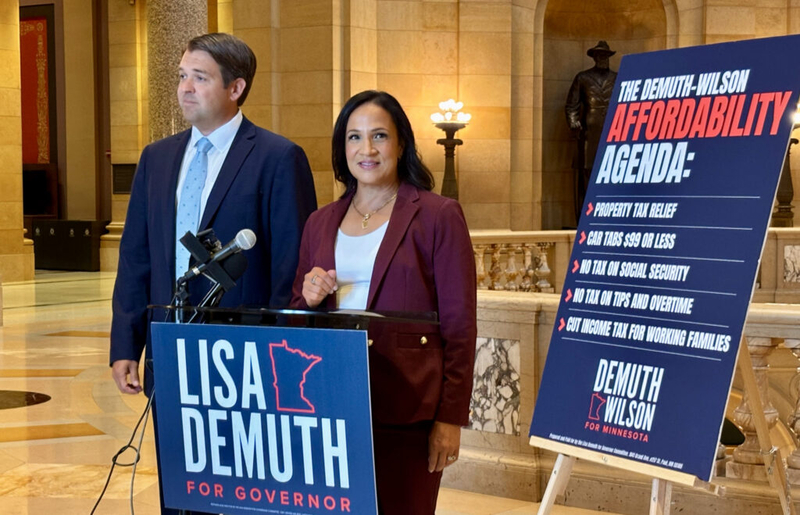
House Speaker Lisa Demuth and her running mate Ryan Wilson announced their affordability plan at the Minnesota Capitol on Aug. 25, 2026. (Photo by Michelle Griffith/Minnesota Reformer)
Republican nominee for governor Lisa Demuth said that if elected in November, she would direct her administration to “find $1 billion in savings across all agencies,” in an effort to make life more affordable for Minnesotans, but she refrained from denouncing the Trump administration’s burgeoning trade war with Canada that’s expected to drive up costs.
Demuth on Tuesday released an affordability agenda, which largely focused on rooting out fraud in Minnesota’s social safety net programs. Demuth argued fraud is driving up costs for Minnesotans via higher taxes. Republicans this year are hoping Minnesotans’ anger with the fraud that occurred under the Democratic-Farmer-Labor Party’s watch will break their 20-year losing streak in statewide races.
“Minnesota has become unaffordable for many families, and fraud is a big part of that,” Demuth said at a Capitol press conference. “How many extra hours did a parent have to work so that the government could tax them, not to cover the costs of a strong economy or strong schools, but actually to feed fraudsters tax dollars?”
The $1 billion in savings Demuth hopes to find amounts to about 1.5% of the state’s current $66 billion, two-year general fund budget.
Demuth will also face voters — for whom cost of living is a primary concern — who have soured on her party’s management of the economy. President Donald Trump’s tariffs and war in Iran have driven up costs of everything from gasoline to ground beef. Congressional Republicans also allowed special tax credits for health insurance to lapse, causing the number of people insured via the Affordable Care Act marketplace to drop in 49 states.
Demuth declined to criticize Trump directly Tuesday.
Demuth’s affordability plan includes cutting the income tax rate for the state’s lowest earners, eliminating the state tax on Social Security benefits and capping all car tab fees at $99.
It’s unclear exactly how Demuth plans to cut $1 billion across dozens of state agencies, but she cited the hundreds of millions lost to fraud. She also said that the state government has “plenty that we can trim back,” including cutting full-time employees.
Sen. Amy Klobuchar, the DFL nominee for governor, has her own affordability plans, including spurring construction of 100,000 new homes to push down housing prices and a state tax credit for healthcare premiums if Congress again declines to act.
A pressing issue for Minnesota is also Trump’s tariff war with Canada — Minnesota’s largest trading partner. In 2025, Minnesota exported $5.6 billion in goods to Canada, or 24% of the state’s total exports.
A new study from the Midwest Economic Policy Institute found that Trump’s 2025 tariffs increased costs in Minnesota by about $1,000 per household. But that impact was not felt evenly, with the burden falling most acutely on lower income households.
Canada on Tuesday announced retaliatory tariffs as high as 50% on hundreds of American products as trade talks collapsed between the two countries. The move came after the Trump administration imposed 50% tariffs on Canadian goods Saturday.
Demuth didn’t criticize Trump’s tariffs when asked about them.
“Tariffs definitely have a purpose, but I think the talks need to continue or restart again,” Demuth said.
Klobuchar has long opposed Trump’s tariffs and sponsored a bill in the U.S. Senate to overturn the tariffs on Canada.
“The new 50% tariffs on Canadian goods, followed by Canada’s decision to retaliate, will only make it harder for Minnesota businesses and farmers to compete and will further drive up prices,” Klobuchar said in a statement.
Demuth’s plan would also allow school boards and local governments to opt out of participating in the state’s paid leave program, which grants nearly all Minnesota workers up to 12 weeks of family leave and 12 weeks of medical leave per year, capped at 20 weeks in a single year.
Demuth said granting this opt-out would reduce costs for counties and school districts, which would then keep property taxes affordable.
In a telling moment of GOP acceptance of the popular paid leave program, Demuth said that as governor she would not seek to repeal the program but implement changes to “make it more workable.”

Saint Paul, MN