Delaware healthcare spending ‘unsustainable,’ health secretary says
Sep 21, 2026 | 6:00 am ET
Description
Photo courtesy of Spotlight Delaware
Why Should Delaware Care?
The cost of healthcare burdens not only patients, but the state, too. When costs rise, patients not only feel that pinch from their own insurance, but also on their tax bill. In recent years, the state has worked to rein in costs, and reverse trends they’ve called “unsustainable.”
Delaware health officials said current spending trends for healthcare are “unsustainable,” and called for a dramatic change in how patients and the state pay for medical services.
The Delaware Health Care Commission, which is composed of governmental and clinical leaders across the state, met on Thursday to discuss a host of problems plaguing the cost of care, and people’s ability to access it.
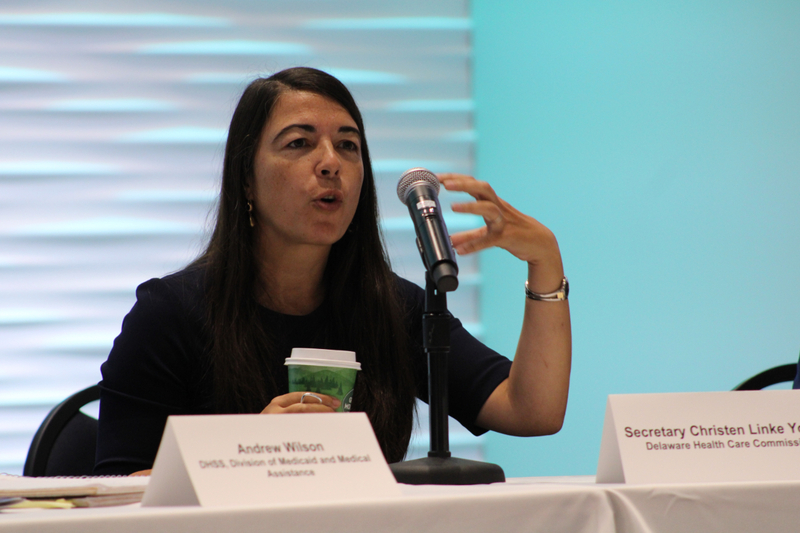
During that meeting, Delaware Secretary of Health and Social Services Christen Linke Young addressed healthcare spending in the state, which has run rampant for years. Additionally, Young said the state cannot sustain further increases in spending.
“The wheels are going to come off,” Young said. “There simply isn’t the money.”
But those same leaders also pointed to solutions, and how the state can better equip itself for a growing and aging population. The commission held its discussion at a retreat in Dover, where members discussed workforce challenges, the cost of care and the state’s dental infrastructure.
Healthcare costs
Leaders within DHSS and the state’s insurance department discussed the rising cost of care, and how the state can change how it pays.
Delaware Insurance Commissioner Trinidad Navarro pointed to challenges for insurers, who he said have lost money for years.
Specifically, he pointed to the open insurance market. Earlier this month, the department of insurance announced rate increases for people who buy plans on the marketplace through the Affordable Care Act.
A few years ago, Delaware had five insurers in its market, Navarro said.
This year, there are only two.
“The other three decided to leave because we can’t force an insurance company to stay here and lose money,” Navarro said.
Andrew Wilson, who runs the state’s Medicaid program, said these losses also extend to the state’s insurance subsidy. As a result of those losses, the outside insurers who manage coverage for the state’s Medicaid program, have to raise their rates.
But even with those rate increases, Wilson said those Medicaid managers still lose money. In turn, those increases mean a greater demand on the taxpayer, pulling funds from schools and infrastructure.
“Those dollars could be going there, but instead we’re dumping into healthcare, and we’re not seeing the outcomes,” Wilson said.
Young, who leads DHSS, said recent jumps in state healthcare spending have become “unsustainable.” She said the state should pursue “some version” of global budgeting models for its hospitals.
Global budget models set annual fixed prices for inpatient and outpatient procedures, meaning hospitals are paid on the front end to deliver services at a cost set by their Medicare and Medicaid reimbursements from previous years.
In neighboring Maryland, the state implemented global budgeting for all of its acute care hospitals in 2014, according to a report from Mathematica. In Delaware, Nemours Children’s Hospital in Wilmington also operates on a global budget for its Medicaid patients.
And in the near future, Delaware’s hospital systems will be restricted in how much they can charge for services.
Additionally, Young said it is going to be on healthcare providers to find efficiencies in operating rooms and hospitals. She said the state’s responsibility will be promoting more incentives to provide efficient care that keeps patients healthy, and away from unnecessary and costly procedures – like value-based-care.
“We are not going to deploy the tools, but what we need to do is create the market conditions so that every dollar that leaves us is being paid out in a way that everybody else makes more money when they deploy the tools that work,” Young said.
Workforce shortages
The commission began its Thursday meeting by discussing workforce shortages in Delaware.
The board focused on a recent success story in Delaware that has expanded the number of providers able to administer anesthesia in the state.
Li Maceda, who is an anesthesiologist with Anesthesia Services in New Castle, said the company lost 20% of its workforce following the COVID-19 pandemic. Maceda said when quarantines ended, procedures that people postponed began to overload their caseload.
“We were really overrun,” Maceda said. “We were short staffed and overrun with cases.”
As a result, anesthesiologists started to resign, leaving the anesthesia practice unable to manage its baseline calls. With no options to help cover these shortages in the short term, Maceda said her practice began to think outside of the box.
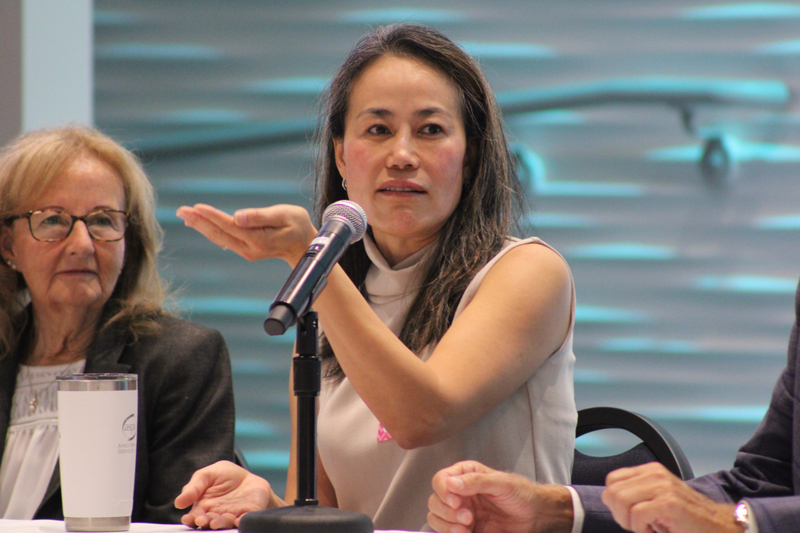
She said the practice started to work with local hospital systems to “upskill” nurses in similar lines of work like sedation nurses.
This utilization of other nurses and professionals in other specialties has helped to lighten the workload, as well as attract nurses into its program.
“Today we’re doing better, but we’re still working,” Maceda said.
Dover