Debates used to mean something in Arkansas politics. Now they’re an afterthought.
Oct 04, 2026 | 6:00 am ET
Description
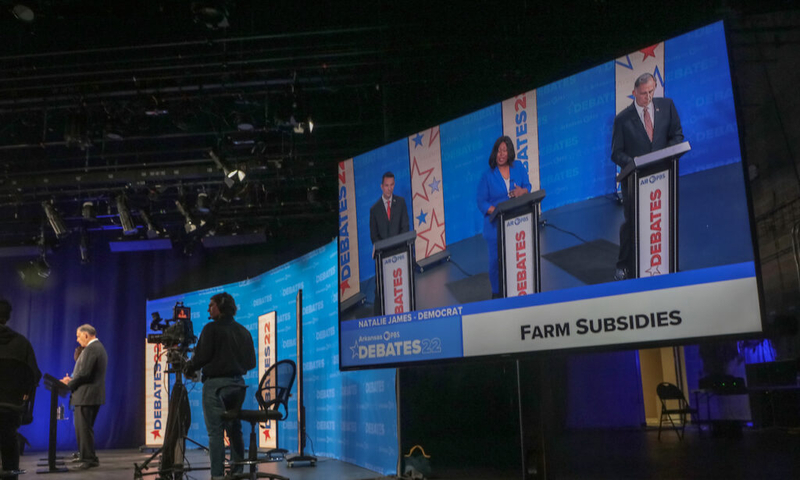
The Arkansas PBS debate between candidates for the United States Senate was held on Oct. 21, 2022 at the Donald W. Reynolds Performance Hall, on the University of Central Arkansas campus in Conway. The participants, from left, are: Libertarian candidate Kenneth Cates, Democratic candidate Natalie James, and Republican incumbent John Boozman. (Photo by John Sykes/Arkansas Advocate)
Seeking a breakout moment in his bid to unseat Mark Pryor in Arkansas’ nationally watched Senate race 12 years ago, Tom Cotton borrowed an idea from the 19th century.
Cotton challenged the two-term Democratic incumbent to a series of debates patterned after the 1858 meetings between Abraham Lincoln and Stephen Douglas. With no moderators or panelists, the two candidates would instead ask each other questions.
“There used to be a time in our politics when voters could look the two candidates in the eye and hear from them directly — that’s what I’m inviting Sen. Pryor to participate in today,” Cotton said.
The Lincoln-Douglas-style debates never materialized, and the two instead squared off in other televised formats with moderators and panelists before Cotton won the race that fall.
Now that he’s seeking reelection, Cotton is a lot less nostalgic for old-fashioned faceoffs. The two-term Republican has declined debates with Democratic rival Hallie Shoffner and Libertarian Jeff Wadlin on public television and on Arkansas State University’s campus, opting instead for one hosted by a conservative Christian media outlet.
That comes in a midterm environment where President Trump’s low approval numbers have given some Democrats hope they can pull off an upset in a solidly red state.
Cotton’s decision isn’t a surprising one, and is a symptom of a larger problem in Arkansas politics. Once considered a rite of passage for candidates, Arkansas debates were among the few unscripted moments of drama on the campaign trail.
Now, they’ve become an afterthought.
Arkansas history is filled with examples of debate moments that shook up a race or helped candidates get more traction. One of the most famous was the 1972 debate between Sen. John McClellan and then-U.S. Rep. David Pryor, Mark Pryor’s late father.
After forcing McClellan into a runoff for the Democratic nomination, David Pryor challenged the incumbent lawmaker to a debate. McClellan used the faceoff to challenge Pryor’s ties to organized labor and went on to win the nomination.
Pryor, who was elected to the Senate in 1978, said the loss and debate performance stung years later.
“I appeared naive and inexperienced, he appeared the seasoned veteran,” Pryor wrote in his autobiography.
Debates have offered Arkansas voters an early look at politicians, even if they don’t win the election. Asa Hutchinson’s surprisingly strong debate performance against then-Sen. Dale Bumpers in 1986 didn’t win him the race, but it earned the attention of political observers impressed with how he fared against a political giant.
Years later, Hutchinson and Mike Beebe repeatedly laid out their differences in a series of debates and forums in the months leading up to the 2006 gubernatorial election. Beebe won that race, and Hutchinson succeeded his former rival eight years later.
Those appearances didn’t necessarily decide the 2006 governor’s race. Neither did Cotton’s debates with Mark Pryor, though the incumbent lawmaker’s answer to a question about how he’d define the middle class offered Cotton additional lines of attack in the race.
But those appearances gave voters a chance to see the clear policy differences in both races. Beebe and Hutchinson split in those debates on how they’d approach education, tax cuts and other issues. The Cotton-Pryor meetings underscored the heated nature of the race and showed the dividing line on healthcare.
With questions about the economy, the war in Iran, fuel prices and many other issues looming, voters deserve as many chances as possible to see the Senate candidates debate.
That’s also true in the governor’s race, where Republican Gov. Sarah Huckabee Sanders has agreed to only one debate with Democrat Fred Love and Libertarian Colt Shelby on Arkansas TV. Sanders did not appear with the two during the Arkansas Press Association’s debate over the summer.
When candidates limit the number of debates they participate in — or outright refuse to debate — voters miss out on seeing the differences between candidates and how they respond to tough questions about their stances. It’s the kind of interaction that can’t be captured in a 30-second ad or dueling social media messages written by campaign staff.
The types of debates Lincoln and Douglas engaged in, complete with hourlong opening statements that drew thousands of spectators in person, may be a relic from another political time.
If candidates aren’t willing to face each other and answer questions, debates themselves could face the same fate in Arkansas.
Little Rock