Data centers and AI: a rare and raw issue in Virginia for this midterm election
Oct 19, 2026 | 5:25 am ET
Description
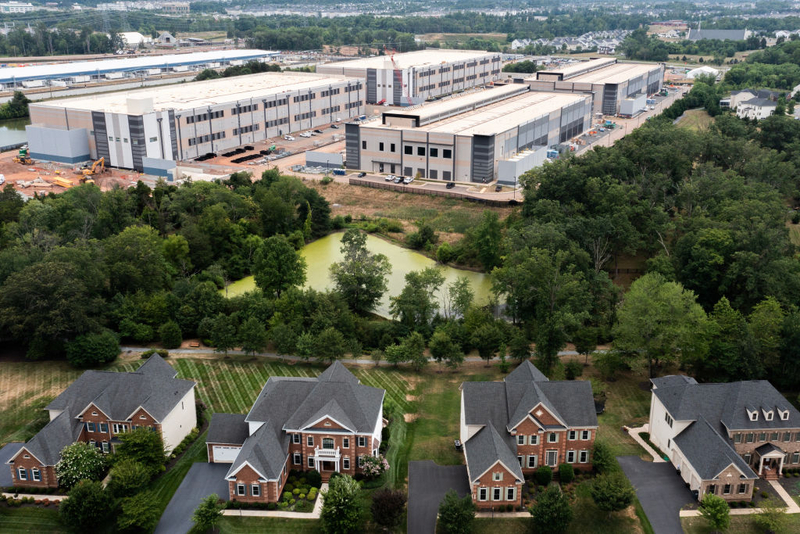
An aerial view shows a data center situated near single-family homes in Northern Virginia. The backlash against data centers has become a flashpoint in state and federal races across the country. (Photo by Nathan Howard/Getty Images)
If you’re alarmed about the proliferation of data centers — gargantuan, windowless megastructures that power social media, live-streaming, cloud storage, e-commerce, text messaging, cryptocurrency, online betting, artificial intelligence and near-universal security surveillance — you’re in good company this election year.
From sea to shining sea, Jane and John Q. Public have emerged from comfortable obscurity to pack marathon meetings of local zoning and governing boards, unified in full-throated opposition to locating data centers in their communities.
The dispute is alive and thriving in this midterm congressional election.
Americans are scared and angry, and nowhere is that truer than in Virginia, the holy land of data centers. Loudoun County, an exurb of Washington, D.C., is home to the planet’s densest concentration of them, and they’ve been springing up like toadstools elsewhere across the commonwealth.
Governmental deference to data centers and the uber-wealthy corporations behind them is faltering, however, as officeholders across the political spectrum — some of them once cheerleaders for the industry — feel firsthand the fresh, hot wrath of constituents defending the most important investments of their lives: their homes.
Funny how perspectives change when re-election is at stake.
Politically, data centers were barely a blip on the screen a year ago. Now, they are featured in candidate talking points and campaign ads, particularly those aired by or favoring Democrats. More on that later.
“This issue is not going away. It just continues to be amplified, and it is going to have an impact on elections here in Virginia and nationally,” said Mark Rozell, a political science professor at the Schar School of Policy and Government at George Mason University.
A statewide poll of 1,101 registered Virginia voters at the end of March by the Schar School and the Washington Post showed a collapse in public support for data centers. Only 35% of respondents were comfortable with a data center in their communities. In 2023, the same poll found 69% were OK with it.
“It’s a rare consensus issue right now for both parties because the public is decidedly on one side of this issue.” Rozell said, noting the potency the issue has in Virginia’s 1st and 7th Congressional Districts where data centers are a daily concern. “Whether it’s accurate or exaggerated fear, … politically there is a great deal of fear out there.”
Following the money for this election cycle, however, reveals Big Data has been kindest to Virginia Democrats.
Of the reported $372,000 given since Jan. 1, 2025, to 10 Virginia congressional and Senate candidates by the data processing and computer services sector, almost four of every five dollars went to Democrats, according to OpenSecrets.org, a nonprofit and nonpartisan tracker of American political spending and influence. Just two recipients — 1st District Rep. Rob Wittman and 2nd District Rep. Jen Kiggans — are Republicans.
It’s hard to overstate the grassroots activism the data center boom in Virginia has provoked since the start of this year, but the issue is not new. Opposition has galvanized residents into clear, effective and organized voices against data center encroachment for a decade or more, and with notable successes lately.
Elena Schlossberg of western Prince William County began battling data centers near her home in 2014. The former makeup artist and middle school counselor became a driving force in the Coalition to Protect Prince William County that recently prevailed over plans to develop the 2,000-acre Dulles Cloud South project that would have packed 4.3 million square feet of computer servers into a structure several stories tall. It would have been the largest such facility on earth.
Not that long ago, Big Tech leviathans like Google, Amazon or Meta could pick their sites almost at will as elected leaders of different localities competed for an edge in landing a data center for their communities. Now, Prince William, Fauquier, Loudoun and Carroll counties are among a growing number of localities denying, delaying or limiting data center construction.
“What’s changed is that community after community after community finally woke up,” said Schlossberg. “The strategy of the industry had been to simply ignore the concerns of the community — concerns we were highlighting about (electrical) grid stress and affordability, about elected leaders not listening to their constituents.”
They’re listening now.
At the state level, this year’s legislative dispute over whether to end a sales tax exemption that saves data centers tens of millions of dollars on new equipment purchases brought the commonwealth closer than it has ever come to a government shutdown from missing the deadline to pass a new state budget.
That disagreement was between Democrats: the Senate majority versus the House of Delegates majority allied with Democratic Gov. Abigail Spanberger.
At the federal level, U.S. Sen. Mark Warner, D-Va., has become a new convert for the data center resistance, Schlossberg said. Until recently, she said, he had kept his distance from her group, calling data centers “a local issue.” Now, the first ad of his campaign for a fourth term focuses on data centers and AI.
“We as a coalition begged Mark Warner to get engaged in the Digital Gateway (project) problem,” she said. “Now, suddenly, he’s concerned? He’s making a statement that ‘they (data centers) need to cover their own costs’ and ‘this is a problem.’ No kidding!”
Yet Republicans face a steeper climb as they struggle to retain their congressional majorities, and the reason is not new: a deeply unpopular Republican president allied with tech billionaires, and a GOP-run Congress that won’t stand up to him.
Republican incumbents saw the peril of risking Donald Trump’s wrath when he garroted the political career of Republican former 5th District Rep. Bob Good, once a loyal Trump footman, for briefly backing Trump’s 2024 primary rival, Florida Gov. Ron DeSantis.
Should they need fresher reminders, look to Republican Rep. Thomas Massie of Kentucky and GOP Sens. Bill Cassidy of Louisiana and John Cornyn of Texas, all of whom lost safe seats in bright-red states to Trump-anointed primary challengers.
So, when Trump took a stand in September supporting full-throttle development of artificial intelligence and the data centers that sustain it — even as top AI researchers warned it could kill humankind — most GOP candidates fell meekly in line, though a few oppose laissez faire AI growth.
Was last month’s presidential show of obeisance toward the world’s mightiest tech companies necessary? Was there any doubt about it after Trump’s second inauguration when Big Tech multibillionaires literally stood beside him as he was sworn in?
If not for fear of Trump, how many more Republicans in this election would publicly align themselves with ordinary voters against limitless wealth and influence from an industry poised to rule the planet?
I suspect there would be quite a few. They talk to people and they read polls. It would fit comfortably into their rhetoric championing working folk. Besides, who doesn’t love a good David vs. Goliath narrative? But it’s late in the game for such an epiphany now.
Issues like this rarely present themselves in politics. It’s real and raw, grounded in deep fear and tenuous hope. Trivialize it at your peril. And for candidates now talking the talk, Schlossberg had a warning.
“If you run and win on this issue but don’t produce the receipts,” she said, “you won’t win again.”
Richmond, VA