Court blocks new Arkansas law requiring Ten Commandments in classrooms
Aug 04, 2025 | 10:37 pm ET

Description
A preliminary injunction granted late Monday temporarily blocks a new state law mandating Ten Commandments displays in classrooms from being implemented in four Northwest Arkansas school districts. (Allan Swart/Getty Images)
A federal judge on Monday night temporarily blocked implementation of a new state law requiring schools to post the Ten Commandments in classrooms that was set to take effect Tuesday.
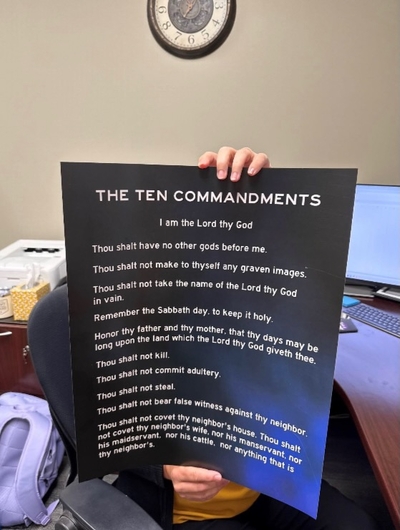
Act 573 of 2025 requires that “a durable poster or framed copy of a historical representation of the Ten Commandments” be “prominently” displayed in public school classrooms and libraries, public institutions of higher education, and public buildings and facilities maintained by taxpayer funds.
According to the law, posters shall be donated or purchased with funds through voluntary contributions. Posters that don’t meet specifications required by the law may be replaced with public funds or private donations.
Seven multifaith families with children in Arkansas public schools filed the lawsuit in federal court in the Western District of Arkansas in June against the Fayetteville, Springdale, Bentonville and Siloam Springs school districts.
Federal judge says he’ll rule on Arkansas Ten Commandments injunction before August 5
Supporters of the law have said it presents the tenets as a historical document that influenced the country’s founders in the creation of the nation’s laws and legal system. Families who filed the lawsuit argue the law infringes on their constitutional rights to freedom of religion.
In his 35-page ruling, U.S. District Judge Timothy Brooks said there is “insufficient evidence of a broader tradition of using the Ten Commandments in public education, and there is no tradition of permanently displaying the Ten Commandments in public-school classrooms.”
Brooks agreed with plaintiffs that Act 573 likely violates their First Amendments rights, and he granted their requested preliminary injunction, which blocks the law from taking effect on Aug. 5 in the four school districts that are defendants in the suit. Brooks also denied motions to dismiss the case by the districts and the attorney general’s office, the latter of which intervened in the lawsuit.
“Americans today might find it far-fetched to imagine a state establishing an ‘official religion’; but the Founding Fathers were not so sanguine,” Brooks wrote. “James Madison, the author of the Bill of Rights, warned that we should ‘take alarm at the first experiment on our liberties’…That ‘experiment’ is happening now, in Arkansas.”
In a statement Monday night, ACLU of Arkansas Legal Director John Williams called the ruling “a victory for Arkansas families and for the First Amendment.”
“The court saw through this attempt to impose religious doctrine in public schools and upheld every student’s right to learn free from government-imposed faith. We’re proud to stand with our clients — families of many different backgrounds — who simply want their kids to get an education,” Williams said.
In a statement Tuesday morning, Attorney General Tim Griffin said he was “reviewing the court’s order and assessing our legal options.”
Brooks rejected three arguments raised by the districts and the state for why the case should be dismissed. First, districts claimed that because compliance with the law is dependent on voluntary contributions, the “likelihood of injury is too speculative.” However, according to court documents filed over the weekend, the Fayetteville School District received hundreds of donated posters on Aug. 1.
Second, the state argued the exact content of the displays is unknown, so plaintiffs can’t “reasonably predict the nature and extent of any alleged injury to their constitutional rights,” and must wait until the posters appear.
Brooks called this argument “disingenuous,” noting the law mandates the exact text and size of the posters. The unknowns are that the displays could be larger than the minimum size or contain extra “historical” information.
Brooks cited a recent U.S. Supreme Court case, Mahmoud v. Taylor, in which parents of public-school children alleged the district’s inclusion of certain books in the English curriculum and the inability to opt their children out of the curriculum violated their constitutional right to free religious exercise. The case supports plaintiffs’ argument in the Arkansas case that there’s no need to “wait and see the context” before seeking a preliminary injunction, he said.
Third, Brooks rejected the state’s “most intellectually dishonest argument” that the law only mandates “passive” displays that invite no student participation. To support its argument, the state cited a Supreme Court case that found a stone monument of the Ten Commandments on the Texas State Capitol grounds was a “passive” display.
Brooks said the state “disingenuously omits from its discussion” that the high court noted the placement of the monument on Capitol grounds “is a far more passive use” of the text than another case where the text confronted students every day.
“Contrary to the State’s contention, the Ten Commandments are not passive because students in public schools are forced to engage with them and cannot look away,” Brooks wrote.
The Arkansas families allege Act 573 violates the First Amendment’s Establishment Clause, which guarantees that “Congress shall make no law respecting an establishment of religion,” and its Free Exercise Clause, which guarantees that “Congress shall make no law … prohibiting the free exercise [of religion].”
According to Brooks, the Supreme Court has explained that a violation of the Free Exercise Clause depends upon a “showing of direct governmental compulsion” that burdens individual religious belief or practice. The violation of the Establishment Clause depends upon “the enactment of laws which establish an official religion.”
“Act 573 is not neutral with respect to religion. By design, and on its face, the statute mandates the display of expressly religious scripture in every public-school classroom and library,” Brooks said. “The Act also requires that a specific version of that scripture be used, one that the uncontroverted evidence in this case shows is associated with Protestantism and is exclusionary of other faiths.”
Brooks concluded Act 573 is likely to violate the plaintiffs’ First Amendment rights and be held unconstitutional and that the school districts and state failed to demonstrate they would be harmed if the injunction was granted.
In his ruling, Brooks noted that 45 years ago, the Supreme Court struck down a Ten Commandments law nearly identical to Arkansas’ law. That precedent remains binding and renders Act 573 “plainly unconstitutional,” he wrote, questioning why Arkansas would “pass an obviously unconstitutional law.”
“Most likely because the State is part of a coordinated strategy among several states to inject Christian religious doctrine into public-school classrooms,” Brooks wrote. “These states view the past decade of rulings by the Supreme Court on religious displays in public spaces as a signal that the Court would be open to revisiting its precedent on religious displays in the public-school context.”
Parents have filed lawsuits against laws similar to Arkansas’ in Louisiana and Texas. A federal appeals court blocked Louisiana’s law in June. Plaintiffs in that case are represented by the same counsel as the Arkansas lawsuit.
“Similar laws appear to be in the works in other states, which will lead to more lawsuits — until, it seems, the Supreme Court puts its foot down,” Brooks said.
This story was updated on Aug. 5, 2025, to include comments from the attorney general’s office.

Little Rock