Could the referendum process be the new Oregon way? This group thinks so.
Nov 24, 2026 | 4:00 pm ET

Description
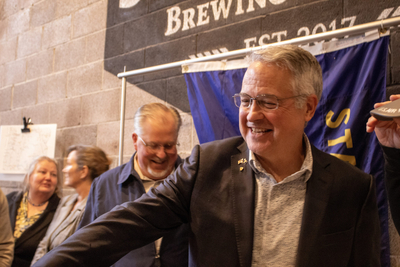
Campaign supporters at a primary election watch party for Rep. Ed Diehl, a Republican gubernatorial candidate from Scio, sign his latest petition attempt to undo parts of a law Democrats passed in the 2026 legislative session that disconnected the state from some of the tax cuts passed under the Trump’s 2025 summer tax and spending law. (Photo by Mia Maldonado/Oregon Capital Chronicle)
A new conservative-led organization has pledged to use one of the few tools at its disposal to push back against progressive Democratic policies crafted in the Oregon statehouse: the ballot initiative and referendum.
Launched by outgoing state Rep. Ed Diehl, R-Scio, and co-founder Nick Stark, the Oregon Freedom Coalition began as the group behind the petition to oppose hikes to the gas tax and other transportation fees legislative Democrats passed in 2025. They quickly gathered more than 200,000 petition signatures to refer those tax and fee increases to voters in May, when more than 80% voted against them.
Now, Diehl said his goal is to build more permanent opposition to progressive policies as Republicans head into the 2027 legislative session with two fewer seats in the Oregon House and one fewer seat in the Senate.
Democrats will hold 39 of 60 seats in the House and 19 of 30 in the Senate, above the three-fifths majority needed to create new taxes or increase existing ones. And voters in 2022 made Republicans’ nuclear option of walking out to deny a quorum and block any legislative action more risky by amending the state constitution to bar lawmakers with 10 or more unexcused absences from seeking reelection.
Diehl, who couldn’t seek reelection to the Oregon House after he lost his bid for governor in the May primary, said the coalition will focus on issues he considers bipartisan, such as tax reform, government accountability, education, public safety and election integrity.
“And if the Legislature is unwilling to act on those issues, then we’re going to take them directly to people,” he said.
While coalition organizers haven’t agreed on which initiatives or referendums to pursue, Diehl acknowledged that it’s considering pursuing a voter-approved ban on transgender girls playing girls’ K-12 sports.
The organization is soliciting Oregonians to sign up for a paid monthly membership with the coalition, ranging from $5 to $25. That funding will support infrastructure for the organization such as policy research, legal work and signature drives, according to the organization’s website. It operates as a 501(c)(4) organization, similar to the National Rifle Association or Sierra Club.
Diehl said he’s had hundreds of people sign up since the coalition launched after the election.
“I think this gives them hope that there is a real feeling that this legislature is going to try and impose some things that are not popular, just like they did with the transportation tax,” Diehl said.
Challenging Oregon’s own blue wave
The coalition takes the position that Oregon’s mostly Democratic legislature is out of touch with Oregonians, Diehl said.
Diehl said he believes that Oregon’s blue wave wasn’t an endorsement of progressive Democratic policies, but more a rebuke of the Trump administration’s performance.
Republican leaders in both legislative chambers seemed supportive of the coalition.
House Minority Leader Lucetta Elmer, R-McMinnville, said she sees the coalition’s formation as Oregonians across the political spectrum wanting their voices heard.
“The election results don’t change our responsibility to represent the people of this state,” Elmer said in an email. “Republicans may have fewer seats in the Legislature, but that doesn’t mean the concerns we’re hearing from Oregonians have gone away.”
Elmer said she respects the work Diehl is doing to engage Oregonians in the political process and “absolutely” supports the referendum process, saying it’s a show of democracy working.
“I believe more public participation and accountability are good things for our state,” Elmer said.
Senate Minority Leader Sen. Bruce Starr, R-Dundee, said he’s seen firsthand the value of the referendum process. He was one of the three chief petitioners for the gas tax referendum alongside Diehl and Taxpayer Association of Oregon founder Jason Williams.
LGBTQ+ advocates, conservatives gear up for fight over trans student athletes in Oregon
“That experience reinforced my belief that meaningful change doesn’t happen exclusively within the walls of the Capitol,” Starr said in an email. “Citizen-led efforts are an important part of ensuring Oregonians have a voice in the decisions that affect their lives.”
Although the coalition operated independently from his caucus, Starr said there certainly may be issues where their interests align.
“Any specific referendum effort would need to be evaluated on its own merits, but I believe there is tremendous value in giving Oregonians more opportunities to participate directly in shaping our state’s future,” he said.
House Democratic leaders declined to comment through a spokesperson. Incoming Senate Majority Leader Anthony Broadman, D-Bend, did not respond to the Capital Chronicle’s request for comment.
“The people of Oregon are not in the mood for more taxes, and any legislation creating more will last about 10 minutes because that’s about how long it’ll take us to write a referendum and walk across the street and submit it to the secretary of state,” Diehl said.
Salem, OR