Coordinated lawsuits against in-state tuition for immigrants a ‘threat to rule of law,’ groups say
Oct 07, 2026 | 6:03 pm ET
Description
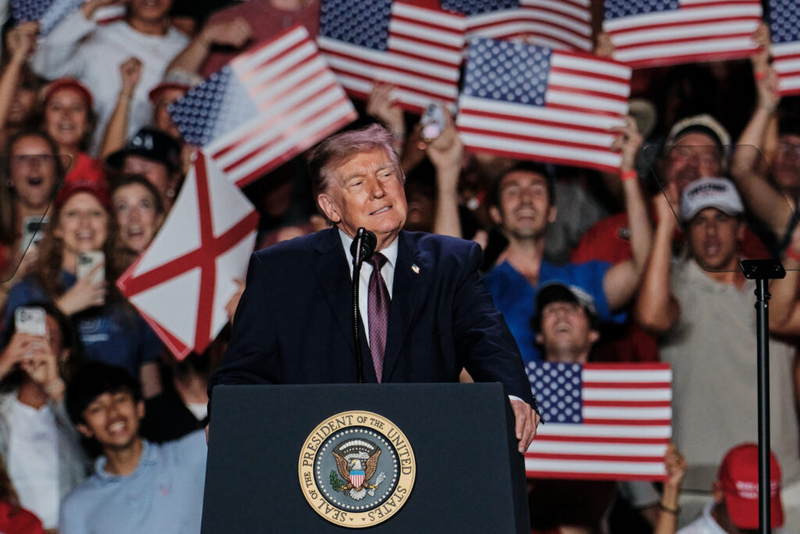
President Donald Trump speaks at the Mitchell Center at the University of South Alabama in Mobile, Alabama on Oct. 2, 2026, as he campaigns in GOP-leaning states ahead of the midterms. (Photo by Dan Anderson/Alabama Reflector)
TOPEKA — A nationwide campaign to dismantle access to in-state college tuition for children of immigrants is “as much a threat to rule of law as what we see in the streets,” said an attorney for a Latino civil rights organization.
A coalition of advocacy groups released a report Wednesday detailing the coordinated nature of the Trump administration’s efforts to eliminate in-state tuition for students who are brought into the U.S. as children and attend public universities and colleges.
Kansas is one of 24 states and Washington, D.C., in active litigation with the United States government over its tuition policies. In September, a federal judge appointed by President Donald Trump struck down Kansas’ law, leaving immigrant students without the access to the in-state higher education they qualified for since 2004.
“The students in these lawsuits are not outsiders,” said Gabby Pacheco, president and CEO of The Dream.US, one of the report’s authors. “They’re students who grew up right here in our backyards, in our country, in our communities, and they are embedded in our states.”
The median age of arrival for students in the U.S. is 4 years old, Pacheco said during a virtual press conference Wednesday. There are 8,800 students, about 4,500 of whom have graduated college, represented in the 26 total lawsuits across 24 states and D.C. Immigrant students and graduates are asking to be treated the same as the classmates they’ve grown up with, Pacheco said.
Their families have been contributing to states across the country not just with their labor but their taxes, she said. She called the lawsuits “self defeating.”
“Not only are they threatening and harming the dreamers and their opportunities for their future, but the future for the broader states and the communities that they live in,” Pacheco said.
Kansas is uniquely positioned among the coordinated series of lawsuits, said Thomas Saenz, president and general counsel for the Mexican American Legal Defense and Educational Fund, or MALDEF, during a virtual press conference. The federal case against Kansas has been appealed to the 10th Circuit Court of Appeals, where a panel of judges will review whether the decision to overturn the law will stand and whether a group, Kansas Students for Affordable Tuition, can intervene in the case.
The appeal, however, is preceded by one in a case against Oklahoma. That case is “well ahead” of Kansas’, and Kansas’ case doesn’t yet have a briefing scheduled, while Oklahoma’s has been fully briefed, Saenz said. It’s unlikely Kansas’ will make it to the U.S. Supreme Court.
Judges across the country are split on whether these state tuition laws are in conflict with federal law, as the Trump administration argues. In Minnesota, a decision went in favor of students. In Illinois, a judge ruled in favor of the U.S.
Saenz said the Trump administration has used “very sharp tactics” to prevent outside parties from becoming involved in the cases. Saenz said the cases are just as much a part of the Trump administration’s immigration policies as immigration enforcement raids and “as much a threat to rule of law as what we see in the streets.”
In Kansas, that has included Democratic Gov. Laura Kelly, who tried to intervene in the case and defend the state law.
Kansas Attorney General Kris Kobach, a Republican, sided with federal prosecutors, culminating his years-long push to rid the state of its tuition equity law.
Kobach said in a non-binding legal opinion published in February that the law ran afoul of federal statutes, classifying in-state tuition for immigrant children as “tuition at greatly reduced rates” and “therefore a public benefit forbidden to illegal aliens.”
The Republican-controlled state Legislature attempted to overturn the law earlier this year, but Kelly vetoed the legislation, allowing immigrant students to receive in-state tuition until the court blocked the law in September.
Saenz pointed out Kelly is term-limited and could be replaced by a Republican governor in January, eliminating a barrier to passing legislation.
But, at this point, Saenz said, “there’s no reason currently for the state Legislature to do anything.”
The cases are “fundamentally about the nation’s talent pipeline,” said Miriam Feldblum, president, CEO of President’s Alliance, an organization involved in releasing Wednesday’s report.
It is “about the immigrant domestic talent pipeline that goes through our nation’s colleges and universities, and that spurs innovation, that fuels our workforce, that enables states and communities to prosper,” Feldblum said. “This is about both individual lives, and this is about the communities that they support, and the institutions and states that they enable to prosper.”
If there isn’t an attempt to defend in-state tuition for immigrant students, Feldblum predicted the ripple effects will be visible for decades.
Topeka, KS