Controversial Trump nominee from Bozeman withdraws after lack of GOP support in U.S. Senate
Mar 11, 2026 | 3:17 pm ET
Description
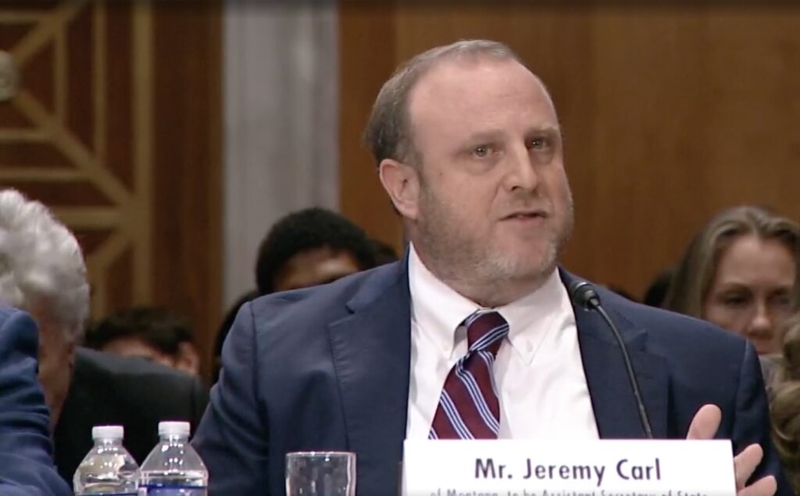
Jeremy Carl is interviewed at his hearing in Washington, D.C. Carl, a Montana resident, whom President Donald Trump has nominated to become the Assistant Secretary of State for the United Nations and international organizations. (Screenshot via U.S. Senate)
Jeremy Carl, the Bozeman man who was nominated by President Donald Trump to become a high-ranking State Department official, withdrew his name from consideration Tuesday after it became apparent that he could not rally enough Republican support from U.S. Senators, especially after a confirmation hearing in which he stood by statements widely viewed as anti-Semitic, saying that “white culture” was under attack.
Carl posted a message on the social media platform X (formerly known as Twitter). While thanking Trump and Secretary of State Marco Rubio, he also lamented that Republicans privately supported him, but were unable to voice public support for his nomination, without naming specific Senators.
“I am withdrawing my nomination for consideration as Assistant Secretary of State for International Organization Affairs. I am tremendously grateful to President Trump for nominating me and then (upon expiration of my original nomination) renominating me for this role, and I am also grateful to Secretary Rubio and his team for their continued support throughout this long and time-consuming process,” Carl said on X. “Unfortunately, for senior positions such as this one, the support of the President and Secretary of State is very important but not sufficient. We also needed the unanimous support of every GOP Senator on the Committee on Foreign Relations, given the unanimous opposition of Senate Democrats to my candidacy, and unfortunately, at this time this unanimous support was not forthcoming.”
This will be a bit more formal than usual, but I wanted to announce that I am withdrawing my nomination for consideration as Assistant Secretary of State for International Organization Affairs. I am tremendously grateful to President Trump for nominating me and then (upon… pic.twitter.com/S6nEamTZg4
— Jeremy Carl (@realJeremyCarl) March 10, 2026
Harmeet K. Dhillon, the U.S. Assistant Attorney General for Civil Rights, replied to the announcement, “Thank you for being willing to serve! God works in mysterious ways.”
Carl responded that Dhillon, who has drawn her own share of controversy, remains one of the “shining lights of this administration.” Dhillon has been known for opposing masking laws during the COVID-19 outbreaks as well as challenging mail-in ballots for elections.
Carl was introduced to the Senate by U.S. Sen. Steve Daines, a Republican from Montana, who told the Senate’s Foreign Affairs Committee that Carl and he shared a loved for former Republican President Ronald Reagan.
However, Daines remained silent when contacted repeatedly about whether he supported Carl’s nomination. Carl had served in the first Trump administration as an undersecretary for the U.S Department of Agriculture. In the current nomination, Carl would have been America’s face of the State Department for international relations, including working closely with the United Nations, an organization which he criticized at his February nomination as out-of-step with Trump administration’s priorities.
“As President Trump has said, the U.N. has potential, but needs renewed focus as it has strayed far beyond its original purpose of solving international disputes peacefully,” he told the committee.
Carl’s nomination also appeared to be in trouble when U.S. Sen. John Curtis, a Republican from Utah, expressed serious doubts about the scholar’s writings and interviews on Israel and Jewish people.
In an October 2024 podcast appearance, Carl said, “Jews have loved to play the victim. The Holocaust dominates so much of modern Jewish history. Jews love to see themselves as oppressed.”
Those remarks drew stern rebukes from Democrats on the committee, including U.S. Sen. Jacky Rosen of New Mexico, who is Jewish.
Curtis wondered if Carl’s previous remarks would make the relationship between the U.S. and Israel more difficult, and that was before the commencement of joint attacks on Iran.
The Senate committee also spent considerable time probing a significant amount of writing Carl had done about “white culture.” But at the hearing, Carl struggled to come up with a coherent definition of white culture, or set of common characteristics. Still, Carl repeatedly said he stood by his research.
Part of that research included a discredited “white replacement theory” which says that Democrats have supported illegal immigration as a way to sway elections as birth rates decline among white citizens. He also claimed that before President Trump took office again, no race was more targeted and discriminated against than white culture.
“This is my belief and I am not running away from that. Of course, all races in different contexts can be subject to severe discrimination,” Carl said. “But when we look at our legal structure, white Americans are very disenfranchised in overt ways. We see it in the Small Business Administration and other places.”
Describing himself not as a racial nationalist, rather a “civic nationalist,” Carl’s final sticking point which drew the ire of several senators, including New Jersey Democrat Cory Booker, was asserting that the participants in the Jan. 6 U.S. Capitol insurrection were treated worse than African Americans during the Jim Crow period in the U.S. South.
“It’s shameful. Sir, you have no decency. You have no honor. You say inflammatory things because you think it will ingratiate you to those who are paying your salary and you sit here before me and try to wrap yourself in an American flag,” Booker said during the February nomination hearing.
Helena, MT