Constitutional: The amendment that could restore formerly incarcerated Virginians’ voting rights
Oct 07, 2026 | 5:28 am ET
Description
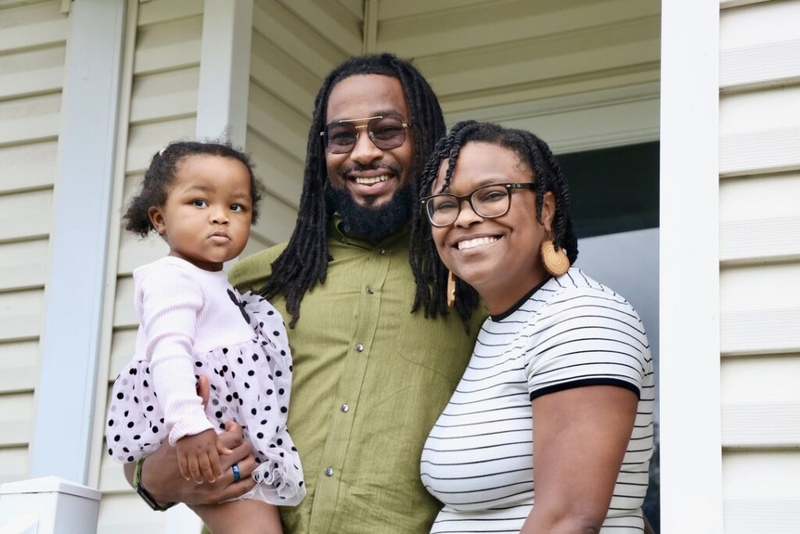
Quadaire Patterson and wife Santia Nance stand with daughter Trinity on the porch of their Henrico County home in the summer of 2026. (Photo by Charlotte Rene Woods/Virginia Mercury)
Quadaire Patterson will vote for the first time this fall, a fact that brought a smile to his face on a recent afternoon as his 1-year-old daughter Trinity frolicked around the living room of the Henrico County home he shares with his wife.
He said he has been thinking about how future elections can shape Trinity’s future. But presently, he is eager to vote for a proposed amendment that could cement voting rights for former felons, like himself, into Virginia’s constitution.
Patterson, who was incarcerated at 19 years old after committing an armed robbery, served 16 years of a 20 year sentence before being released early in 2024 through a good behavior program.
He and wife Santia Nance joined other formerly incarcerated people and their families to advocate for the law change that allowed his early release. He has frequented the state capitol in the years since to lend insight to criminal justice legislation, despite being unable to vote for lawmakers himself.
That changed this summer when Gov. Abigail Spanberger restored his voting rights along with more than 60,0000 formerly incarcerated Virginians. But the restoration process remains subjective; the amendment aims to make it a certainty.
“Voting rights have been deduced down to a privilege that can be handed out and restricted,” Patterson said. “This amendment restores it back to the people.”
Virginia’s current constitution permanently disenfranchises people with all felony convictions unless they are pardoned by a governor or successfully petition one.
Restorations trended downwards under former Gov. Glenn Youngkin. For years, it had been unclear which former felons would get their voting rights back, and the criteria guiding that decision was murky.
After trying unsuccessfully to pass the restoration amendment, lawmakers saw a new opportunity when Democrats gained majorities in the legislature in 2023 and tried again.
The current amendment had to pass the General Assembly two years in a row and will appear on statewide ballots this fall, where voters will approve or reject it.
Most Republican state lawmakers have consistently blocked the restoration amendment. Del. Mike Cherry, R-Colonial Heights, is an exception.
Cherry sponsored an earlier version of the amendment in 2022, which failed. And when the latest attempt advanced earlier this year, he joined his Democratic colleagues in voting for it.
He first offered adjustments that would have limited the measure’s scope: one to exclude people with violent offenses, and another mandating former felons pay restitution in full before getting their voting rights back.
Those efforts were unsuccessful.
In an interview with The Mercury, Cherry described his tweaks as a way “to bring some of my other colleagues along with me.”
This was in reference to GOP lawmakers who staunchly opposed restoring rights to people convicted of murder or manslaughter.
“That’s where (some of my Republican colleagues) fall on it. They want the victims to be restored,” Cherry explained. “They don’t like the fact that someone can get their rights back if they’ve disenfranchised someone else permanently.”
He said he understood their perspective but still supported the amendment, even without his proposed changes.
“If a judge didn’t give you a life sentence, we shouldn’t give you a life sentence as a society,” he said. “Once you’ve been adjudicated for your crime and you’ve served your time, then your right should be restored.”
Similarly, Patterson likened the state’s disenfranchisement to “this extra sentence that carries on.”
Other former inmates released as part of the good behavior law have gone onto serve local government commissions, become peer recovery specialists, launch nonprofit organizations, or join lobbying and advocacy groups.
Nance, Patterson’s wife, said it’s important for those experiences to gain visibility, especially for those behind bars.
“I’m big on having our story reflect what potential there is for incarcerated people currently,” she said.

Patterson said the time he spent separated from society made him eager to not just rejoin it, but help shape it.
He and Nance have supported criminal justice reform laws like visitation standards and probation reform. The couple is optimistic about Spanberger’s new standards for the state’s prisons and a community council that’s been set up to brainstorm ideas on how to improve corrections practices in the state.
About 200,000 more Virginians may also be able to vote this year, after a federal judge ruled that people with certain felony convictions should never have lost their right to vote in the first place.
A Reconstruction-era law stipulated that people convicted of felonies that were considered common law in 1870 could lose their rights.
The state now only excludes murder and manslaughter offenses from the list, the Virginia Department of Elections announced in September.
With congressional midterm elections and the voting rights amendment on ballots, Virginia voters will also have two other pending constitutional amendments to consider.
The first would permanently protect reproductive rights, including access to contraception, fertility treatments and abortion.
The second would enshrine same-sex marriage protections, ensuring gay marraige would remain legal in the state even if federal standards changed.
Though early voting has been under way since Sep. 18, Patterson plans to cast his first-ever ballot on Election Day, Nov. 3.
Concerning the amendments, Patterson said he and his wife have already made up their minds.
“It’s a ‘yes’ all the way down the ballot for us.”
Richmond, VA