Conservative groups lose appeal of election overhaul lawsuit
Apr 23, 2026 | 7:31 pm ET
Description
Photo via Getty Images
An appeals court has dismissed a lawsuit from conservative groups that challenged how Arizona counties verify early ballot signatures and run ballot drop-boxes, among other things.
Brought by the America First Legal Foundation and the Strong Communities Foundation of Arizona on behalf of a group of voters, the lawsuit rehashed numerous claims that election deniers have made unsuccessfully in court for years. The conservative groups argued that Maricopa, Yavapai and Coconino counties illegally used unstaffed ballot drop boxes, canceled voter registrations and used improper procedures to verify voter signatures on vote-by-mail ballot envelopes.
The America First Legal Foundation was created by White House Deputy Chief of Staff Stephen Miller, the architect of Project 2025 and one of President Donald Trump’s closest advisors. The Strong Communities Foundation of Arizona, which mostly operates under the name EZAZ, is run by conservative political operative Merissa Caldwell, formerly Merissa Hamilton.
The Arizona Court of Appeals on Wednesday affirmed a Yavapai County Superior Court judge’s 2025 decision to dismiss the case.
In a unanimous decision written by Judge Anni Hill Foster, and joined by Judge David Gass and Chief Judge Randall Howe, Foster wrote that America First Legal lacked standing to bring the lawsuit because it did not allege that any Arizonans had been denied the right to vote, nor did it contest the results of an election.
The plaintiffs merely “disagree with Yavapai County’s election practices,” Foster wrote.
American First Legal Foundation initially filed a nearly identical lawsuit in February 2024 in Maricopa County Superior Court, but voluntarily dismissed it about two weeks later. The foundation then refiled this lawsuit five days later in the much more conservative Yavapai County.
Even after refiling the lawsuit in Yavapai County, the contents of the complaint still mostly focused on Maricopa County, a target for unproven claims of election misconduct since 2020.
“The Maricopa Defendants’ administration of elections in Maricopa County has been sloppy, shoddy, and rife with mistakes,” attorney James Rogers wrote in American First Legal Foundation’s initial Yavapai County complaint. “Their mismanagement has made Maricopa County — and the entire State of Arizona — the laughingstock of the nation.”
Rogers added that Yavapai and Coconino counties used many of the same election practices as Maricopa County, which he said violated Arizona law.
The lawsuit heavily cites Republican Kari Lake’s failed attempts to overturn the results of the 2022 election for Arizona governor that she lost to Democratic Gov. Katie Hobbs.
“Election day on November 8, 2022 in Maricopa County was marred by ‘widespread failures’ and ‘technical problems’ that led to ‘the anger and frustration of voters who were subjected to inconvenience and confusion at voter centers’” Rogers wrote, quoting Lake’s lawsuit.
Judges at the trial and appeals courts, as well as the Arizona Supreme Court, roundly rejected Lake’s arguments that the courts should overturn the results of the 2022 election and declare her the governor.
The appeals court declined to consider Rogers’s arguments about ballot printer failures in Yavapai County, which he claimed were similar to those in Maricopa County. In her trial, attorneys for Lake failed to prove that long lines caused by ballot printer issues prevented anyone from casting a ballot, but Rogers repeated the claim anyway.
“Because of these (printer) failures, some voters could not vote and were disenfranchised,” he wrote.
While America First claimed that Yavapai County illegally used unmanned ballot drop boxes, the appellate panel concluded that the organization “pointed to no authority to support their claim” that Arizona law requires drop boxes to be staffed at all times.
The Court of Appeals similarly found that Rogers showed no proof that the way Yavapai County verified or cured voter signatures was contrary to state law.
Voto Latino, which intervened in the lawsuit on behalf of the counties, celebrated the appeals court’s decision.
“The lawsuit brought by Stephen Miller’s group was a transparent attempt to disenfranchise voters of color by forcing a radical overhaul of our election infrastructure,” the organization’s executive director, Beatriz Lopez, said in a statement. “By attacking drop boxes, signature curing, and established verification practices, these plaintiffs sought to manufacture administrative chaos and erect barriers designed to silence the voices of Arizonans.”
America First Legal Foundation did not respond to a request for comment. In its initial complaint, the foundation made some predictions about the then-upcoming November 2024 election.
“There is a near-certainty that the November 5, 2024, election will be marred by the same mistakes and maladministration as the 2020, 2022, and 2023 elections,” Rogers wrote.
After President Donald Trump won Arizona and the presidency in 2024, and Republicans grew their majorities in the Arizona Legislature, the groups that had complained of maladministration when their candidates lost prior elections were mostly quiet. But many of those groups and the politicians aligned with them, alongside Trump, have continued to push for sweeping changes to the way the nation’s elections are run, based on their unproven claims of fraud and maladministration in 2020 and 2022.
“This ruling represents the latest in a series of failed attempts by right-wing groups to dismantle election administration in this critical battleground state,” Voto Latino said in the statement.
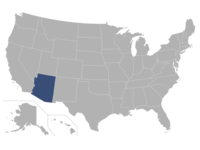
Phoenix, AZ