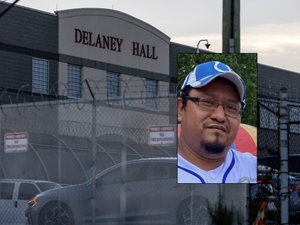
Community rallies after death of Plainfield man in ICE custody
Aug 04, 2026 | 7:17 pm ET
Description
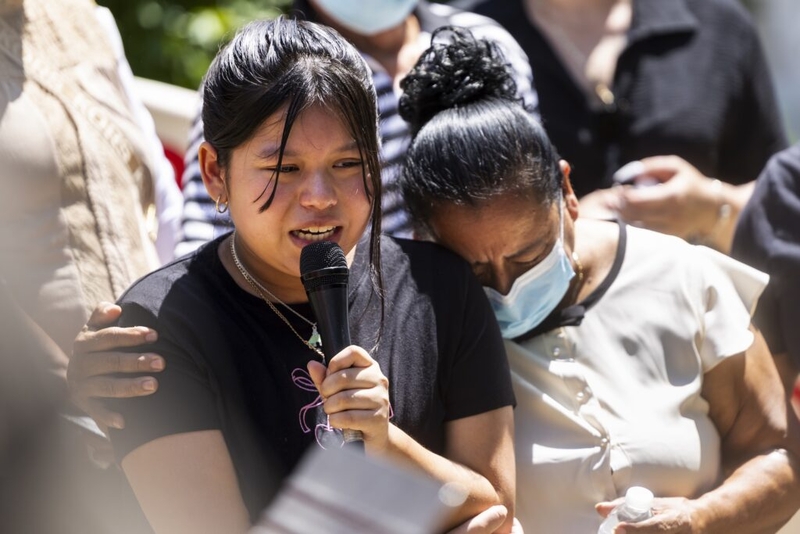
Ashley Cornejo, 12, the daughter of Edwin Jovanny Lopez Cornejo, and Maria Cornejo, the mother of the 39-year-old detainee at Delaney Hall, cry during a rally at the Reformed Church of Highland Park on Aug. 4, 2026, days after Cornejo’s death. (Photo by Anne-Marie Caruso/New Jersey Monitor)
HIGHLAND PARK — On the lawn of the Reformed Church of Highland Park Tuesday, nearly 100 people rallied to call for the closure of Newark migrant jail Delaney Hall after the death of a 39-year-old man in ICE custody Saturday.
Edwin Jovanny Lopez Cornejo’s family made pleas to Gov. Mikie Sherrill and the Attorney General’s Office to investigate his death and called for the release of his medical records, while urging the federal government to cease the detention of undocumented immigrants. Cornejo was detained at Delaney Hall for six weeks before his death.
“I’m going to grow up without a father,” said Ashley, Cornejo’s 12-year-old daughter. “They didn’t even let him see me one last time before he died.”
For roughly two hours, the crowd in front of the church prayed, chanted for the closure of Delaney Hall, and heard stories from people who have loved ones held at the Newark detention center.
Cornejo was a Salvadoran immigrant who lived in the U.S. for more than 20 years, according to his family. They said he had diabetes and high blood pressure and was not being given his medication regularly since he had been detained June 18. His mother said she has still not been contacted by U.S. Immigration and Customs Enforcement officials or Geo Group, the private company that runs Delaney Hall.
ICE, which said Cornejo was deported in 2006 after crossing the border illegally, stated that Cornejo received “proper medical care and was seen by medical professionals” while in custody. His official cause of death is still pending.
His brother disputes that Cornejo was receiving the medical attention he needed, noting he was on daily medication. Cornejo told his brother in jail phone calls that to get Tylenol for a headache, he had to fill out a form, and often wouldn’t receive it for two or three days.
“Nothing will bring back my brother,” he said in Spanish. “It’s not right, everything that happened. And no one knows, no one speaks up because of fear, but sometimes we need to lose our fear to get justice.”
Jenny Garcia, an activist with American Friends Service Committee, said that Delaney Hall detainees have complained about being given the wrong medication or being told they have to split medication because there isn’t enough for everyone. She alleged that ICE is not being truthful about whether detainees are seen by doctors or given the medicine they need.
Maribel Encalada said her dad is one of those people who is denied medical care. Her 58-year-old father, who came to the U.S. over 40 years ago, has been in detention for several weeks. He’s been denied medical attention for his high blood pressure and a painful toothache that’s developed since he arrived at the jail, she said. He’s also been fed moldy bread, she said.
“Every day that he is denied proper medical care is another day that his health is put at risk,” she said. “Access to basic medical treatment is not a privilege, it’s a basic human right — and my father’s story is not the only one.”
Cornejo’s death comes amid a rising death toll in ICE custody nationally. At least 22 ICE detainees have died in the first seven months of the year, according to the agency’s national data. At this point in 2025, ICE had reported 12 in-custody deaths.
Up until June, ICE policy required the agency to report deaths of detainees who die within 30 days of being released from custody, but it now no longer does. Advocates said the change makes it harder to track deaths tied to medical neglect that surfaces after someone is released or transferred.
Several activists expressed concerns about whether there could be more deaths linked to Delaney Hall than ICE has reported publicly.
After an unannounced visit to the jail Monday, Rep. Rob Menendez (D-08) said that in July, a person who was being processed at Delaney Hall was having a medical episode when ICE released them from custody, and they later died at University Hospital in Newark. His office said it is working to learn more about the circumstances of the death and other medical emergencies that have occurred inside the facility, noting an ambulance was on site Monday morning.
An unsigned statement from the U.S. Department of Homeland Security, which oversees ICE, said all immigrant detainees are provided with medical care and downplayed in-custody deaths as just “0.008% of the detained population.”
“As bed space has rapidly expanded, we have maintained higher a standard of care than most prisons that hold U.S. citizens — including providing access to proper medical care. For many illegal aliens this is the best healthcare they have received their entire lives,” the statement reads. “Being in detention is a choice. We encourage all illegal aliens to take control of their departure with the CBP Home App. The United States is offering illegal aliens $2,600 and a free flight to self-deport now.”
Sally Pillay, a longtime volunteer with Eyes on ICE, on Tuesday called detention centers “death camps.”
“We have so many people right now in immigration custody at Delaney Hall who have been detained for over a year in that facility, who have medical issues, medical concerns. We have a number of individuals who are diabetic, who are not getting their medications in time, and they are not getting food,” Pillay said.
She said she’s “pleading and begging” lawmakers to help get medically vulnerable people out of detention as soon as possible.
Rep. Analilia Mejia (D-11), who said her mother was once undocumented, called on ICE to be abolished. Mejia urged her colleagues to continue to visit the detention centers, press federal officials, and enter all that they discover into the congressional record.
“I will do my part, you will do your part, and I know that together we will demand and we will win the kind of justice that, sadly, Edwin was not given,” she said. “Shut it down.”
Trenton, NJ