Colorado Gov.-elect Phil Weiser names transition team to face ‘challenges on many fronts’
Nov 04, 2026 | 5:23 pm ET
Description
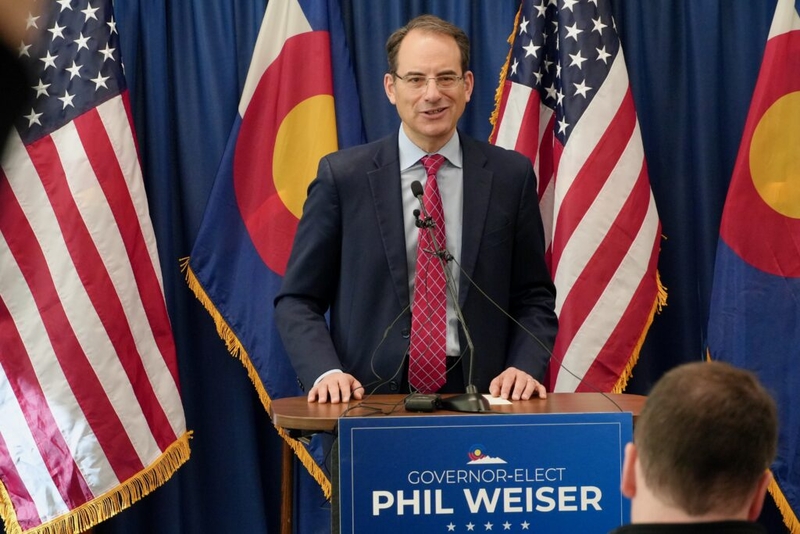
Gov.-elect Phil Weiser, Colorado's Democratic attorney general, spoke to reporters at a press conference on Nov. 4, 2026. (Photo by Chase Woodruff/Colorado Newsline)
Colorado Gov.-elect Phil Weiser said Wednesday he has a “very long reading list” as he prepares to take office in the coming months — including a controversial budget proposal released this week by outgoing Gov. Jared Polis.
Weiser, Colorado’s Democratic attorney general, defeated Republican Victor Marx by a landslide in the governor’s race Tuesday, leading a Democratic ticket that tightened its grip on the levers of state government amid a “blue tsunami” of positive results for the party nationally.
He will be inaugurated as Colorado’s 44th governor on Jan. 12, 2027. On Wednesday he named a roster of well-known Democratic figures to lead his transition team between now and then, including former Interior Secretary Ken Salazar, former Gov. Roy Romer and former Denver Mayor Federico Peña, all of whom were named honorary co-chairs of Weiser’s transition.
“We’ve got challenges on many fronts,” Weiser said in a press conference Wednesday near the state Capitol in Denver. “I believe that one of the most important things I’m going to need to do is to build a team worthy of meeting these challenges.”
Those challenges include a state budget that could be in for another round of painful cuts when the Legislature, where Democrats on Tuesday captured supermajorities in both chambers, convenes next year. Polis on Monday released his final budget request as governor, initiating a process that will be completed by Weiser and the Legislature’s Joint Budget Committee, with a final vote typically held in late March.
Polis’ proposal includes a strict growth cap on the state’s safety-net Medicaid program, which would mean hundreds of millions of dollars in cuts to existing services as healthcare costs continue to soar. Healthcare advocates slammed the plan, which they said puts “the health of vulnerable Coloradans at risk.”
“There’s a Medicaid commission right now that is analyzing these issues from all sides. I’m very much looking forward to that conversation,” Weiser said. “It is obvious that there has been real growth, and there has to be the type of scrutiny that is happening, and we will continue that.”
He spoke as unofficial results showed Colorado voters approving Proposition NN, a referred measure to increase K-12 education funding by about $500 million a year by raising the state’s constitutionally-mandated revenue growth cap, potentially alleviating some budgetary pressure. The results of Amendment 87, a graduated income tax measure that would raise $2 billion a year by hiking taxes on incomes over $500,000, remained too close to call Wednesday.
‘Adjustments’ for anti-LGBTQ+ measures
Weiser signaled a willingness to back legislative changes to a pair of anti-trans ballot initiatives that appeared on track to pass by slim margins. Proposition 134, which to prevent transgender children from participating in school sports, and Proposition 135, which would prohibit health care professionals from knowingly performing any surgery on a minor “for the purpose of altering biological sex characteristics,” were both backed by anti-LGBTQ+ organization Protect Kids Colorado.
“We’re going to have to take a look at these anti-trans measures, and what adjustments are necessary and appropriate,” Weiser said. “I will say, for example, I don’t believe it would be acceptable for Colorado to have every student athlete have to go through full-body examinations or other invasions of privacy.”
Also on the governor-elect’s to-do list, he said, was to take up recommendations from a “competitiveness council” convened by Polis this year to address a state business climate that conservative lobby groups say is holding Colorado back economically.
“We should be open to asking: Can we create more targeted laws? Can we remove unnecessary and cumbersome restrictions?” Weiser said. “That dialogue that I’ve been having with the business community will continue.”
Landslide victory
Election results Wednesday showed Weiser winning 61% of the vote in the governor’s race, holding a 27-point lead over Marx, a first-time candidate and ministry leader from Colorado Springs.
It’s the most lopsided result in a Colorado governor’s race since former GOP Gov. Bill Owens’ blowout reelection victory in 2002, and is set to be one of the five largest winning margins in a governor’s race in state history.
Marx, who failed to pick up endorsements from many prominent Colorado Republicans — some of whom backed Weiser instead — did not hold an election-night watch party and had not released a public statement on his loss as of midday Wednesday. Weiser said Marx called him to concede the race around 9:30 p.m. Tuesday.
“He congratulated me on my victory, and he said he was praying for me and for Colorado,” Weiser said. “I told him I appreciated it. It was a very cordial conversation.”
Denver, CO