Iowa Republicans’ legislative majorities shrink in 2026 elections
Nov 04, 2026 | 5:22 pm ET
Description
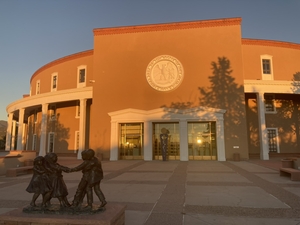
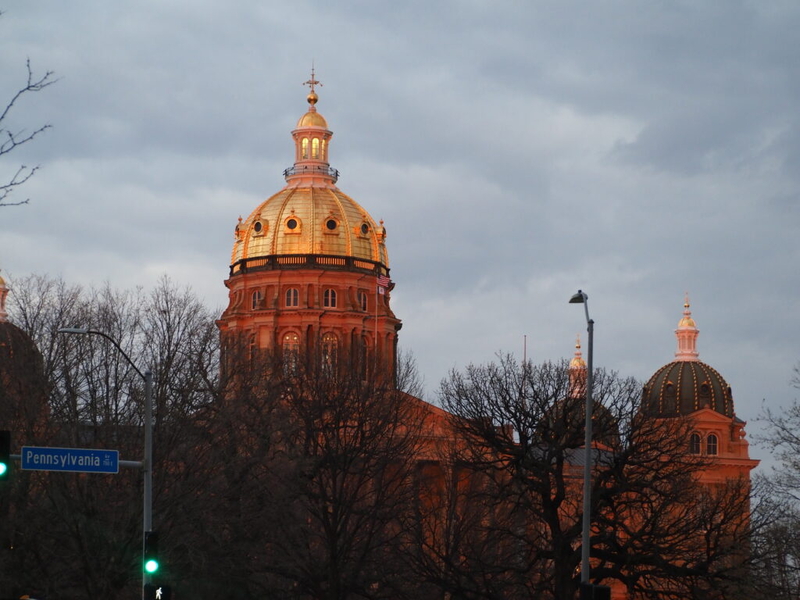
The Iowa State Capitol as seen April 8, 2026. (Photo by Robin Opsahl/Iowa Capital Dispatch)
Though Iowa Republicans suffered serious losses in Tuesday’s midterm elections, the party appears to have kept control of both chambers at the Iowa Legislature.
However, these Republican majorities are smaller than previous years. In the Iowa Senate, Republicans currently hold a 32-17 majority, with one vacancy — already a decrease from the GOP supermajority elected to the chamber in 2024.
Democrats flipped two GOP seats in special elections: Sen. Catelin Drey, D-Sioux City, won a special election in September 2025 to represent Iowa Senate District 1 after Sen. Rocky De Witt, R-Lawton passed away in June 2025, and Sen. Mike Zimmer, D-DeWitt replaced Lt. Gov. Chris Cournoyer in Senate District 35 through a January special election victory.
Drey survived her first general election, defeating Republican Christopher Prosch Tuesday with 57.4% of the votes, according to preliminary results. But Zimmer was not reelected to serve a full term, as Republican Joe Stutting is set to take the seat with a lead of 51.9% to Zimmer’s 48.1%.
Iowa Senate Democratic Leader Janice Weiner recognized Zimmer’s efforts in the district despite the election loss.
“Senator Zimmer once again overperformed the 2024 Democratic vote margin of his district,” Weiner said. “This was a direct result of his hard work to represent his constituents and work in a bipartisan way to deliver for eastern Iowa.
But Senate Majority Leader Mike Klimesh said Prosch’s victory — and the retention of many seats currently in GOP control — showed the strength of Senate Republicans’ message. Klimesh said “Iowa Senate Republicans continue to be a bright spot in difficult election years,” as the party saw major losses in federal and statewide races.
“Iowa Senate Republicans talked to voters about our historic accomplishments and our vision for jobs, affordability, and common sense and the voters responded, taking out a Democrat incumbent,” Klimesh said. “We are happy to see continued successes with voters and the agenda Republicans delivered for the last several years.”
The current vacancy in the Iowa Senate has existed since June after Iowa Sen. Julian Garrett, R-Indianola, died following a battle with cancer. The winner in the general election race to fill the Senate District 11 seat has not yet been called. As of 4 p.m. Wednesday, Republican Hollie Arlene Zajicek leads with 59.2% to Sinikka Waugh at 40.8%, with 67% of votes counted.
Another still uncalled race was in Iowa’s Senate District 47, where results show Democratic challenger Nikhil Wagle leading with 50.2% of the vote to incumbent GOP Sen. Scott Webster with 49.8%. The AP estimates 99% of votes have been counted, showing Wagle with a 151-vote lead.
If Wagle retains the lead, it could mean Senate Democrats flipped two seats in the chamber, as the AP called the race for Democratic Iowa Rep. Heather Matson in Senate District 21 against Republican John Hollinrake. The seat is currently held by Iowa Sen. Mike Bousselot, R-Ankeny, who had initially run in another district before ultimately ending his campaign to work in the private sector.
Weiner said these results show that voters want changes in how the state government operates.
“Today, voters made their voices heard and resoundingly rejected another decade of one-party rule in Iowa, which has left too many Iowans feeling like their voices aren’t being heard,” Weiner said in a statement. “That isn’t healthy for our state, and it isn’t how Iowa is supposed to work. These results are a reminder that Iowa deserves a government focused on getting back to the basics: making sure families can afford the essentials, fully funding our public schools, protecting our water, and finally confronting Iowa’s cancer crisis.”
Weiner’s comments echo those of Democratic Gov.-elect Rob Sand. As he celebrated victory Tuesday night, he said his win meant “balanced government has been restored.” Sand said Democrats and Republicans will be forced to reach compromises in a divided government in 2027, and said he looked forward to working with state lawmakers “on the same common sense ideas and solutions that we advocated for throughout this campaign” come January.
But Republican state leaders like House Speaker Pat Grassley have already laid out plans to push back against “radical” policies proposed by Sand or Democrats.
“Governor-Elect Sand ran as a moderate,” Grassley said in a statement. “Now, we’ll find out if he was being genuine. If Sand brings forward sensible policies that make Iowa a better place to live, work, and raise a family, House Republicans stand ready and willing to work with him to accomplish that shared mission.
“But rest assured, if he tries to enact the same radical left agenda that we’ve seen democrats champion across the country, then our caucus will stand strong as a firm firewall. We will not allow Iowa to follow the failed path of neighboring states like Illinois or Minnesota. Iowans expect accountability, and we intend to deliver it.”
House Republicans maintain a majority after the 2026 general election, but the party has lost its 2024 supermajority hold on the chamber. Republicans entered Election Day with a 66-33 majority.
The chamber also had a vacancy, as Iowa Rep. Jon Dunwell, R-Newton, resigned from his seat in September after Gov. Kim Reynolds appointed him to serve on the Iowa Utilities Commission. Dunwell, who had already announced he would not seek reelection, had his House District 38 seat filled by Republican Matthew Oleson in the general election, according to preliminary results showing Oleson defeating Democrat Brad Magg.
Grassley said House Republicans’ agenda allowed the caucus to “maintain a strong majority after what was obviously a tough night for Republicans nationwide,” but GOP numbers in the chamber still took a hit. The AP had not called eight Iowa House races as of 3 p.m. Wednesday, but Democrats appeared to have picked up 11 seats in the chamber.
This includes the defeat of several Republican incumbents. In the Des Moines metro alone, Democrat Tom Walton unseated Rep. David Young in House District 28, Heather Sievers defeated Rep. Bill Gustoff in House District 40, former state Rep. Molly Buck won against Rep. Ryan Weldon in House District 41.
Democrats also took House District 43, a seat currently represented by Rep. Eddie Andrews, who did not run for reelection as he competed to become the GOP gubernatorial nominee. Democrat Jill Alesch will fill the seat with her win against Republican Nicole Hasso. One of the races not yet called by the AP is House District 46, but with 99% of votes counted, Democrat Amy Newton Rosenow leads with 50.7% against Rep. Dan Gehlbach with 49.3%.
This trend continued statewide, according to preliminary results.
- Democrat Mike Tupper defeated Rep. David Blom in House District 52.
- Democrat Jacob Welper won against Rep. Christian Hermanson in House District 59.
- Democrat Matt Robinson defeated Rep. Jennifer Smith in House District 72.
- Democrat Randy Meier defeated Rep. Thomas Determann in House District 69.
- Incumbent Rep. Mark Cisneros was defeated by Democrat Nick Salazar in House District 96.
- Democrat Jennifer Kirkman unseated Rep. Matt Rinker in House District 99.
Iowa House Democratic Leader Brian Meyer said his caucus “delivered the biggest electoral gains in a generation, sending a clear message that our state is ready for bold, balanced leadership.”
“I am incredibly proud that we picked up House seats all across Iowa, confirming that when Democrats fight for every Iowan, we win,” Meyer said Tuesday. “The momentum is on our side, and tonight’s results lay the foundation leading into 2028 and beyond. With a stronger caucus than we’ve seen in years, Iowa House Democrats are ready to get to work with Governor-Elect Sand, stand ready to stop any veto efforts, and fight for every Iowan, because tonight shows that when we fight for every Iowan, we win.”
The remaining six uncalled races are seats that are expected to stay aligned with current party control.
- In House District 21, incumbent GOP Rep. Brooke Boden has a 59.1% lead against Democratic challenger Spencer Waugh at 40.9%, with 65% of votes counted.
- Incumbent Republican Rep. Samantha Fett leads with 57.9% to Democrat Rory Taylor’s 42.1% with 66% of votes counted in House District 22.
- Rep. Daniel Gosa, an incumbent Democrat, is leading with 58.9% in House District 81 against GOP challenger Dillon Fillion with 99% of votes counted.
- In House District 94, Rep. Mike Vondran, an incumbent Republican has a lead at 50.8% against Democrat Karen Roebuck at 49.2%, with 99% of votes counted.
- House District 97 is currently represented by Rep. Ken Croken, a Democrat who was defeated in the June primary by Adam Peters. Peters holds a general election lead at 69.4% to Republican Charlie Helmick at 30.6% with 99% of votes counted.
- Democratic Rep. Monica Kurth announced in 2025 she would not seek reelection in House District 98. With 99% of votes counted, Democrat Andrew Fitzgerald leads with 60.6% against Republican Nathan Ramker at 39.4% in the race to fill her seat.
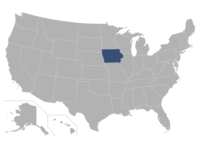
Des Moines, IA