Closing Virginia’s child care affordability gap could cost up to $4.5B a year
Oct 20, 2026 | 5:28 am ET
Description
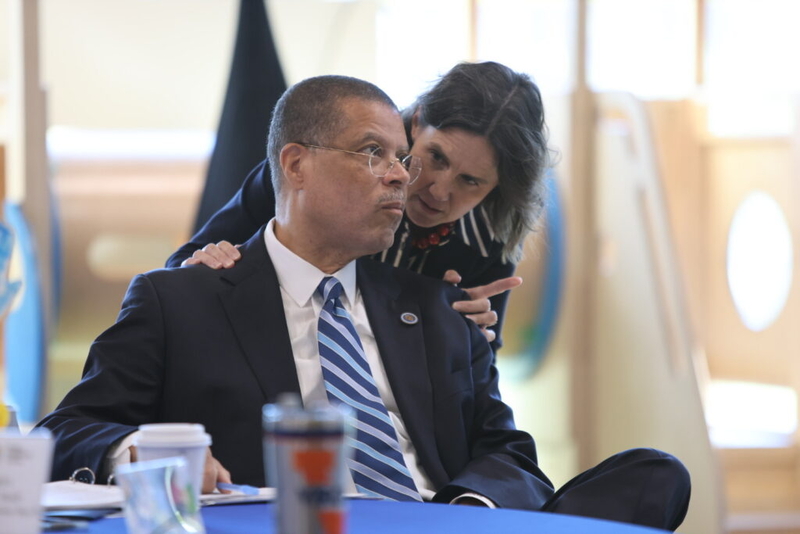
Secretary of Education Jeffery Smith and Superintendent of Public Instruction Jenna Conway speaking inside the Peake Childhood Center in Newport News during the child care funding summit on Oct. 14, 2026. (Photo by Nathaniel Cline/Virginia Mercury)
Closing Virginia’s child care affordability gap would require up to $4.5 billion annually over the next decade, according to the Virginia Department of Education — an investment that, under one scenario, would also raise annual pay for 43,000 educators by an average of $17,000.
Virginia currently lacks at least 140,000 child care slots needed to support working families. Earlier this year, the General Assembly directed the agency to report on parent demand and service needs, calculate funding needs based on current program eligibility, measure historic growth, and account for relevant economic-development projects.
Providers and experts said the additional funding would not only close the gap on child care slots but also support educator recruitment and retention, expand services to meet the diverse needs of students and families, and make care more affordable while helping providers cover costs.
“For us to have a strong economy, we must also have affordable and high-quality childcare options for all Virginians,” said Secretary of Education Jeffery Smith to child care providers. “They go hand in hand.”
Smith spoke at an Oct. 14 summit at the Peake Childhood Center in Newport News, where discussion focused on creating affordable child care.
One takeaway from the summit: Child care costs in every Virginia region exceed three times the historical federal affordability benchmark of 7% of family income, underscoring how far out of reach affordable care remains.
Families and providers are feeling the pinch, with state reimbursements covering 51% of the “cost of quality,” or the estimated amount a provider needs to deliver high-quality early childhood care and education. Raising the minimum wage to $15 without corresponding subsidy increases also poses a challenge for providers, who may have to raise tuition or reduce staff and enrollment.
The agency said 80% of child care providers had to raise tuition for families as a result of the statewide minimum wage increase. Among subsidized providers, one in four cut enrollment and one in five cut staff.
The funding options
Superintendent of Public Instruction Jenna Conway said last week the state invests more than $600 million a year in early childhood programs, up from about $75 million in 2018, including funding for child care subsidies and the Virginia Preschool Initiative.
State lawmakers will have access to the agency’s report, which includes long-term projections and three options to expand access and supply.
The Affordability for All plan is the most expensive option, costing $4.5 billion annually over the next 10 years. Families would pay no more than 0%to 10% of their income for child care. The plan would serve an additional 240,000 new children and reach 66% of working families.
The Improving Affordability option costs $3.7 billion annually, caps copays between 2.5% and 20% of household income, serves an additional 190,000 children and increases teacher wages by $14,000 per year.
The third option, the Sustaining Historic Growth plan, costs $1.6 billion annually, serves 39,000 new children and raises wages by $9,500 per year. Families that qualify would be capped at 5% of the income distribution but would receive no assistance if they make more than $122,000 a year.
Conway said the latter proposal would still leave most families in need without assistance.
The amounts do not account for expected cost increases from inflation and benchmarking over the next 10 years.
Sen. Mamie Locke, D-Hampton, co-sponsored the legislation directing the agency to explore child care demand with Del. Briana Sewell, D-Prince William. Locke said she looks forward to moving the issue toward a “good outcome” after what she called a productive meeting with parent advocates and teachers.
“I think these numbers show that the commonwealth will need to invest in our kids,” Locke said.
Advocates now wait
Several child care providers and parents attended the Newport News summit and offered suggestions and feedback.
Jennifer Parish, executive director of Peake Childhood Center, said the funding proposals gave her hope that early childhood providers may receive more support, since the subsidy program covers only about half the true cost of quality care and leaves nonprofits dependent on fundraising.
She said early childhood programs play a key role in preparing children for kindergarten by building early literacy, math, social and self-regulation skills.
However, low wages are a major reason centers struggle to hire and retain qualified staff. During a tour last week, she showed advocates and providers rooms filled with students and others sitting empty.
“We have empty classrooms at our center right now because we can’t find the staff to open up the room,” Parish said.
Cheryl Morman, a home-based childcare provider in Richmond, said the funding shortfalls make it difficult for her and other providers to pay educators fairly, cover care costs and support inclusive care for children with special needs.
“There need to be teachers and educators whom we can pay a livable wage so they can provide the care that all children need, especially children with special needs,” Morman said.
Kayla Brewer, a parent representative and member of the Commission on Early Child Care and Education, emphasized that families need affordable, high-quality care with consistent educators, and that public agencies, providers, families, and employers must share responsibility for making childcare accessible.
Addressing the funding challenge, Brewer said, “Educators deserve more, but parents can’t afford to pay it.”
Gov. Abigail Spanberger will present her proposed budget amendments to lawmakers in December, setting up the next step in the debate over child care funding.
Richmond, VA