Clayton Tucker poised to become first Democratic agriculture commissioner in nearly 40 years
Nov 04, 2026 | 12:15 am ET
Description
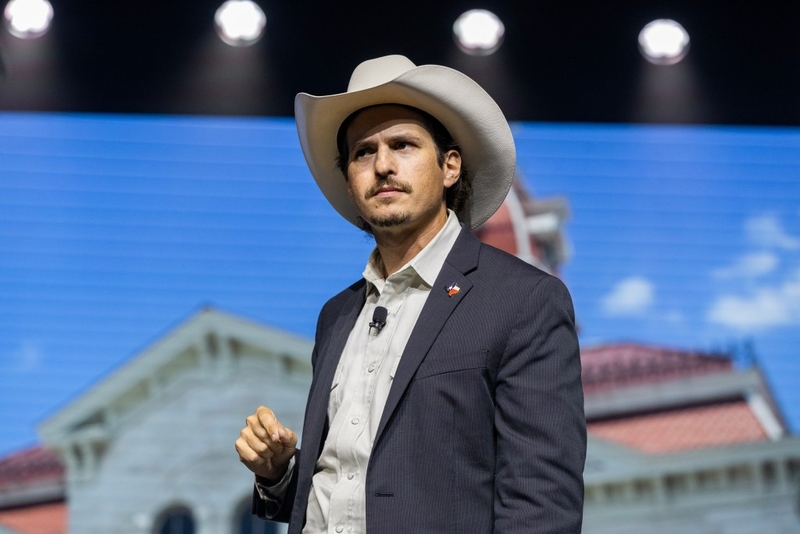
Clayton Tucker, Democratic candidate for Agriculture Commissioner, speaks to convention attendees at a general session of the Texas Democratic Convention in Corpus Christi on Friday, June 26, 2026. (Eddie Gaspar/The Texas Tribune)
Subscribe to The Y’all — a weekly dispatch about the people, places and policies defining Texas, produced by Texas Tribune journalists living in communities across the state.
LUBBOCK — Clayton Tucker, a Lampasas rancher, is on track to make history Tuesday night as he declared victory against Republican Nate Sheets to become the first Democratic agriculture commissioner in nearly 40 years.
Tucker, 35, held a wide lead at 11 p.m. The race had not been called by the Associated Press as of publication time.
“To every Democrat, Republican and Independent who believed in this campaign, thank you,” Tucker shared on social media. “You proved that when Texans stand together to protect our land, our water, and our communities from the Greedy Few, organized people can beat organized money.”
Tucker’s win comes on the heels of a contentious election cycle where Democrats gained momentum fueled by growing dissatisfaction in rural Texas. The cost of living, along with the data center boom and school funding, are among some of the issues that caused backlash for Republicans this year.
Tucker is now set to lead one of the state’s most complex agencies with a $1.8 billion budget. The department provides financial assistance to farmers and ranchers, infrastructure grants for rural communities and financial aid for rural hospitals. The department also administers the National School Lunch Program to public schools and oversees food subsidy benefits and regulates scales at grocery stores and meat markets.
Tucker will walk into a difficult time for agriculture. Farmers and ranchers have faced years of drought ruining their crops and draining their water, rising inflation, tariffs, losing land to urban sprawl and development among other issues.
Tucker will usher in a new era for the agriculture department as the first new commissioner in over a decade. Outgoing commissioner and lifelong Republican Sid Miller ran the department since he was elected in 2014, staving off election challenges by both Democrat and Republican hopefuls. Sheets, Tucker’s opponent, beat Miller earlier this year during the Republican primary.
Although Miller lost in March, he still held a strong presence in the race. Miller appeared at data center community meetings alongside Tucker, and the two smiled together in photos on the first few days of early voting. While Miller stopped short of endorsing Tucker, he bashed Sheets — and Republican Gov. Greg Abbott, who endorsed Sheets — throughout the race, told voters Sheets was not eligible for the office and repeatedly declined to say who he would vote for.
On Tuesday, Miller said voters picked the best man for the job.
“When it comes to agriculture, Clayton and I haven’t found anything we disagree on,” Miller said. “He truly loves farmers and ranchers like I do. He’ll have some good, fresh ideas and probably make it better.”
Miller said he reached out to Clayton and offered to help with a smooth transition into the role.
Tucker, who grew up on the edge of the Texas Hill Country and works on his family’s ranch, made data centers a focus on the campaign trail. While the agriculture commissioner does not have any say in data center operations, Tucker vowed to work with lawmakers to reduce the negative effects on land, water and energy, and agricultural production. He also wants to ensure public school lunches are made and processed in Texas without harsh chemicals or dyes, make industrial hemp available for farmers to grow and bust agricultural monopolies, such as Tyson Foods and John Deere.
Throughout the race, Tucker and Sheets traded barbs. They challenged each other’s eligibility and agricultural experience. Just days before early voting began, attorneys working on Tucker’s behalf sent a letter to the state Republican Party claiming that Sheets was ineligible and demanded he be removed from the ballot.
To be eligible, a commissioner must have either been engaged in an agricultural business, worked at a state or federal agency in a role related to agriculture, have owned or operated a farm, or have been a member of an agricultural association, such as the Texas Agricultural Council.
Disclosure: Texas Agriculture Council has been a financial supporter of The Texas Tribune within the past five years. The Texas Tribune is a nonprofit, nonpartisan news organization that is funded in part by donations from members, foundations and corporate sponsors. Financial supporters play no role in our journalism. Find a complete list of them and more information about our financial and disclosure policies here.
Austin, TX