City of Las Vegas inches toward legislatively mandated heat mitigation plan
Jun 24, 2026 | 7:55 am ET
Description
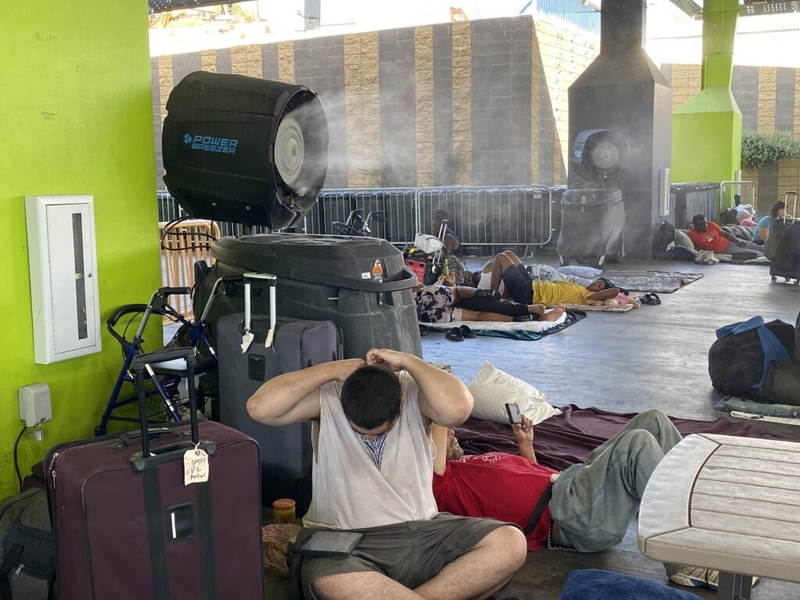
Unhoused folks gather around fans set up inside the Courtyard Homeless Resource Center in 2024. (Photo: Michael Lyle/Nevada Current)
As the City of Las Vegas maps out places to create public drinking water and cooling spaces, some details around its heat mitigation strategy are still sparse. The city council, meeting as the city’s planning commission last week, received an update on the development of the city’s heat mitigation plans.
City of Las Vegas Chief Sustainability Officer Marco Velotta outlined plans for how Las Vegas can combat high temperatures. Commissioners approved the plan, and it is scheduled to go before the council on July 15.
The heat mitigation plan is a part of the conservation element of the 2050 master plan, which the City Council adopted in an effort to provide guidelines for Las Vegas’s future development.
Local heat mitigation plans lack details on access to public drinking water
Las Vegas and Reno are the two fastest-warming cities in the nation, with heat-related deaths on the rise. State lawmakers during the 2025 Legislative Session mandated the state’s two most populous cities and counties adopt heat mitigation strategies.
According to the City of Las Vegas’ heat mitigation plan, additional 24/7 cooling spaces will be provided, with downtown receiving them first, though the implementation dates have yet to be finalized. Currently, only one cooling space is available year-round, 24/7 at the Courtyard Homeless Resource Center.
The plan also promises to spread awareness of the cooling centers once they open through a coordinated, regional response. Velotta suggested that faith-based communities open their doors or provide cooling resources for those in need.
Velotta acknowledged that while exposure to heat is universal, experiences aren’t equal. Those in East Las Vegas, downtown Las Vegas, and around the Las Vegas Strip are met with harsher conditions due to the urban heat island effect, socioeconomic factors, and demographic factors. In Clark County, more than 500 heat-related deaths were reported in 2024, according to the Southern Nevada Health District.
Under the plan, pedestrians, cyclists, and transit users will have more access to drinking water, with an interactive map directing them to the nearest source.
Only a few more than 20 facilities exist within the city limits that provide available drinking water, according to a map provided by the City of Las Vegas during the meeting.
Drawing inspiration from Scottsdale, Arizona, the city plans to use fabric coverings and other shade structures over public spaces and parking lots to mitigate the heat island effect. Downtown Summerlin and Las Vegas Premium Outlets were used as examples for how fabric shadings are successfully used for pedestrians. The city will also expand solar-covered parking.
Other components of the plan include a long-term investment in cooling infrastructure, which would include constructing or renovating buildings, energy efficiency improvements, upgrading HVAC equipment, and adding insulation and passive cooling.
No mention of costs, funding, or starting dates was made during last week’s council discussion.
The City of Las Vegas has previously planted trees to help mitigate the heat island effect.. The city’s Urban Forestry Management Plan calls on increasing the city’s tree canopy to 25% by 2050 by planting and maintaining 60,000 trees.
Las Vegas, NV