Citizenship should not come with an asterisk
Sep 07, 2026 | 6:00 pm ET
Description
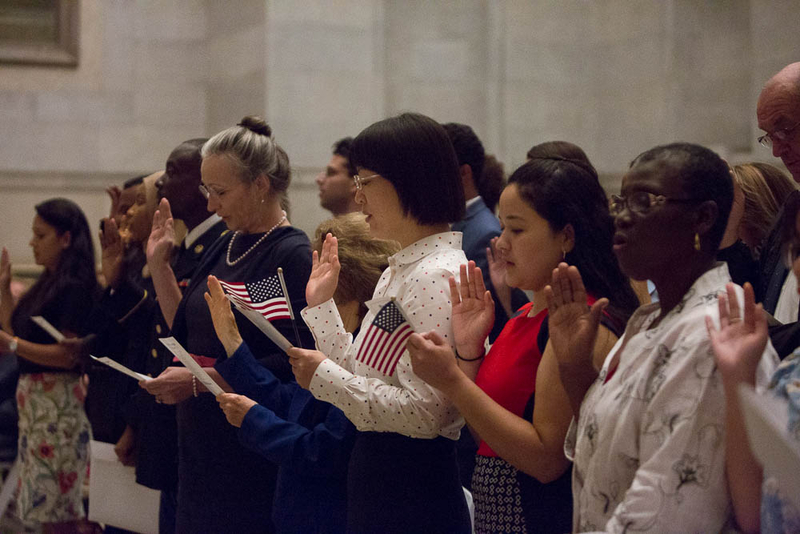
Citizenship candidates take the oath of allegiance during a naturalization ceremony at the National Archives in Washington, D.C., in a file photo from 2018. (Photo by Kelsey Bell/National Archives and Records Administration)
Lately, I have been receiving phone calls that an immigration lawyer should rarely receive. They are coming from American citizens.
Some naturalized years ago. They have American passports, vote in American elections, work, pay taxes and raise their families here. Yet they are asking questions that reveal how unsettled some naturalized Americans have become: Could the government take away my citizenship? Could I lose my passport? What happens if immigration agents stop me because I look or sound like an immigrant?
Behind those questions is an even more troubling one: If I am an American citizen, why do I still feel as though I have to prove that I belong?
The law provides important reassurance. Citizenship cannot simply be canceled because an administration changes its priorities. Denaturalization requires specific legal grounds and judicial process. But the fact that citizens are asking these questions matters, particularly at a moment when immigration enforcement and citizenship itself are increasingly occupying the same political conversation.
A recent federal court decision in Maryland illustrates the tension. On Aug. 3, U.S. District Judge Adam Abelson blocked a USCIS policy that barred nonpartisan nongovernmental organizations from providing voter-registration services at administrative naturalization ceremonies. USCIS has since revised its policy in response to the ruling, once again allowing qualifying organizations to help new citizens register while the litigation continues.
The case is formally about voter registration. Its larger significance is about what happens after someone becomes an American.
Naturalization is supposed to end the immigration journey. After years — sometimes decades — of visas, applications, fingerprints, interviews and government scrutiny, a lawful permanent resident raises a hand, takes the Oath of Allegiance and becomes a citizen. At that moment, the legal line separating that person from other Americans should largely disappear.
Yet other developments are making that line feel less settled. The Justice Department has expanded its pursuit of denaturalization cases, recently describing its own initiative as the nation’s “largest denaturalization effort ever.” Many of those cases involve serious allegations that citizenship was illegally obtained or procured through concealment or misrepresentation. The government has legitimate authority to pursue fraud, with the safeguards the law requires.
But government actions send messages beyond the people named in lawsuits, and some naturalized citizens are hearing a broader one: perhaps citizenship is not quite as permanent for them as they thought.
Aggressive immigration enforcement adds another layer to that anxiety. ProPublica documented more than 170 instances in which U.S. citizens were held against their will during immigration operations, raids or related encounters during the first nine months of the current administration. That does not mean immigration authorities have the legal power to deport American citizens; they do not. Nor does it establish that every encounter resulted from mistaken citizenship.
For the citizen wondering what happens when an immigration officer approaches him, however, the distinction can feel academic. A passport can prove that you are an American. It cannot guarantee that nobody will first assume otherwise.
After more than three decades practicing immigration law, that is what troubles me most about the calls I am receiving. Some naturalized Americans increasingly seem to believe that citizenship comes with an asterisk, particularly if they were born abroad, speak with an accent or think others perceive them as foreign.
That is not merely an immigration issue. It is an American one.
There is a profound difference between telling someone that she is a citizen and building a society in which she confidently knows that she will be treated as one. Naturalization is supposed to transform “them” into “us.” If citizens continue to feel that they must carry documents to demonstrate their Americanness, or worry that the immigration system they supposedly left behind can suddenly reach them again, that transformation is incomplete.
The Maryland case offers a timely reminder of what naturalization is supposed to mean. A person enters the ceremony as an immigrant and leaves it as a citizen, entitled to participate fully in American civic life.
There should not be one category of Americans presumed to belong and another expected to prove it.
Citizenship is supposed to settle the question of belonging. When the Oath of Allegiance ends, the immigrant has become an American.
There should be no asterisk after that sentence.

Annapolis, MD