Chatfield embezzlement trial adjourned indefinitely, witness admission headed to Court of Appeals
Sep 21, 2026 | 11:37 am ET

Description
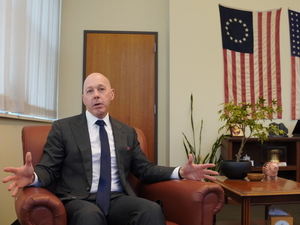
Former Michigan House Speaker Lee Chatfield speaks with his lawyer, Mary Chartier-Mittendorf, after a stay was granted in his trial for alleged financial crimes over the admission of an expert witness on Sept. 21, 2026. (Photo by Katherine Dailey/Michigan Advance.)
The trial of former Michigan House Speaker Lee Chatfield for alleged financial crimes, which was scheduled to begin Tuesday, has been adjourned indefinitely following a request for a stay from Chatfield’s attorneys over the qualification and admission of an expert witness.
That witness, Michelle Gallagher, is a Certified Public Accountant and an expert in forensic accounting with Adamy Evaluation. A hearing on Monday, which ended in the stay being granted, centered on Gallagher’s admission of evidence, which assistant attorneys general for the state of Michigan were requesting.
Gallagher’s admission as an expert witness will now go to the Court of Appeals, and the timeline for that decision is unclear.
Ingham County Circuit Court Judge Morgan Cole had initially denied a motion from Chatfield’s attorneys to exclude Gallagher as an expert witness and said that she would be permitted to testify as an expert in the field of certified financial forensic accounting.
In the high-profile case that was expected to be a hallmark of Attorney General Dana Nessel’s final few months in office, Chatfield faces 13 felony charges, including conducting a criminal enterprise and embezzlement from a nonprofit organization, his 501(c)(4) social welfare organization, the Peninsula Fund.
Chatfield was first charged in 2024 by Nessel along with his wife Stephanie, who has since pleaded guilty to embezzling from a political nonprofit organization formerly controlled by Lee Chatfield — a deal which resulted in her avoiding a trial and prison time.
Chatfield has pleaded not guilty to all of the charges.
Gallagher testified in a 2025 hearing to determine if the case would go to trial, as an expert witness who had compiled a report for the Michigan Attorney General’s office examining the Chatfields’ financial records.
Gallagher told the court at that time that, from January 2020 to April 2021, 99% of the more than $150,000 spent on the Chatfields’ personal credit cards was reimbursed by the Peninsula Fund.
She re-iterated those statements in Monday’s hearing, which focused on the findings of the report.
“I felt very confident that during this time period, of all the charges that were made, the Peninsula Fund had paid about 99% of the charges during that time period,” Gallagher said.
Gallagher also noted that the payments of those cards were “sporadic” in that they were not paid off consistently each month. Gallagher’s analysis was based on documents that she received from the attorney general’s office, including bank statements and credit card statements.
Mary Chartier-Mittendorf, Chatfield’s attorney argued Monday for the stay of proceedings.
“We cross-examined Ms. Gallagher, and while I respect the court’s decision, I believe that there is an arguable and reasonable legal basis to challenge Ms. Gallagher as an expert in this case, both because of her lack of experience with 501(c) organizations but also the methodology that she used in this case, which is essentially reviewing a policy in isolation and not in context with the people who are actually tasked, paid to enforce the policy and to make decisions about whether expenses are allowed or disallowed,” Chartier-Mittendorf said.
Cole in turn said that the court is required to grant a stay unless a motion is frivolous, and that the motion presented on Monday was not frivolous, given that Chatfield’s attorney “has an absolute duty to represent her client zealously, even if it is on the eve of trial.”
“The court has no other option but to stay this matter and adjourn the trial date until, and we receive a ruling from the Court of Appeals,” Cole said. “As soon as we do, we will get on the bus without scheduling immediately. Just knowing that this will take priority over all cases, it will end up being the oldest case on my docket. So when it does come back, it’s go time.”
The attorney general’s office requested that Cole deny the stay due to concerns about timeliness for the trial, though Chartier-Mittendorf insisted that “this is not a delaying tactic.”
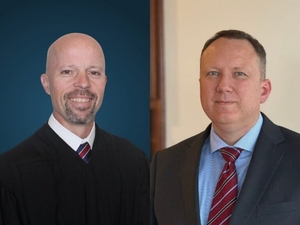
Nessel, who initially charged Chatfield in 2024, will leave office at the end of December, meaning the decision on how to proceed with Chatfield’s case may likely fall to her successor — either Democrat Eli Savit or Republican Doug Lloyd.
Monday’s hearing reviewed evidence previously heard by the court
Much of Gallagher’s questioning from Chartier-Mittendorf centered around her classification of car washes as personal expenses, who said in her closing statement, “the issue with the car wash, I think, highlights how flawed the analysis is.”
Chartier-Mittendorf argued that a car wash, if Chatfield were using that car to drive potential donors to the Peninsula Fund, could be a legitimate business expense, though Gallagher responded that she disagreed, and believed that two monthly car wash subscriptions would not be an appropriate expense for purposes of furthering the exempt purpose of the organization.
“It’s all contextual. She’s making these determinations essentially in a vacuum, and the government is trying to wrap that up as qualified expert testimony. That methodology is not reliable,” Chartier-Mittendorf said. “The people who can say whether expenses were allowed or not allowed are the officers of the Peninsula Fund, which she said that’s not within the scope of my work to even think about, or the Dykema Law Firm compliance team, which this court will find out at trial was paid to manage the Peninsula Fund.”
However, Gallagher and assistant attorneys general argued that the witness’ role was not to opine on whether or not fraud had occurred.
“Her job is to just calculate expenses,” Assistant Attorney General Dan Gunderson argued. “She already testified that she doesn’t look at criminal intent, and her report indicates that she’s not.”
Cole had also agreed that there were sufficient facts and data to support the factual foundation of Gallagher’s opinion.
“The fact that Ms. Gallagher put the categories in independent three separate categories: allowed, unallowed, and questionable, that analysis and summary of her findings furthers that it is sufficient data, and it’s fair and reliable, because she did not attempt to put anything that was questionable automatically into the unallowed expense,” Cole said in her initial decision to admit Gallagher as a witness.
Chartier-Mittendorf also challenged the fact that Gallagher had adequate experience working with 501(c)4 organizations like the Peninsula Fund, after Gallagher said that she had advised individual clients in a “handful” of cases on what would qualify as allowed 501(c)4 expenses, which she later said to be less than five cases.
Lansing, MI